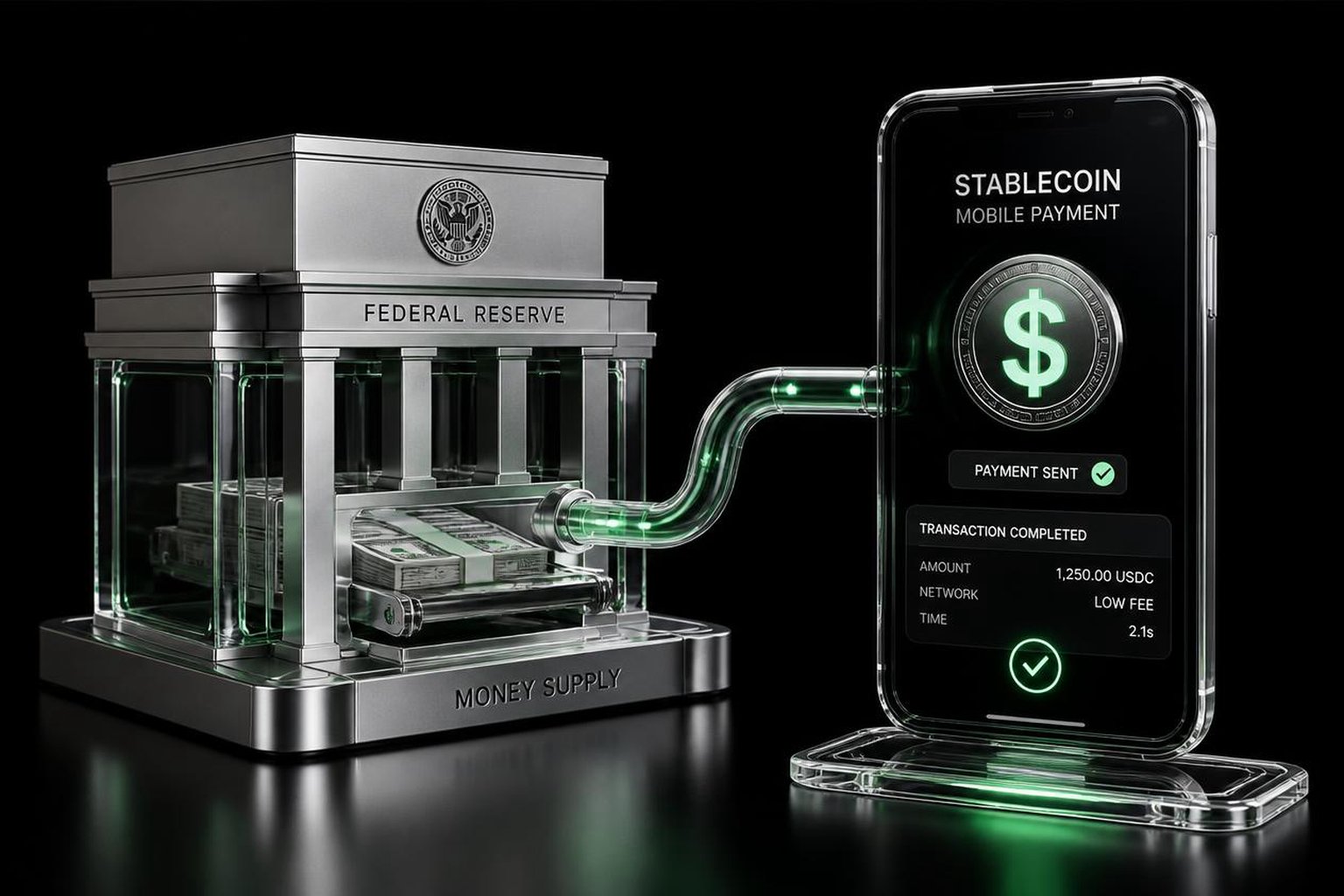
The Same Dollar Counted Twice: The Fed Studies Putting Stablecoins in the Money Supply While African Central Banks Rush to Plug Them Into Phones
On the same day, the world’s most conservative monetary statisticians and its most active mobile-payment continent both started treating stablecoins as real money — the Americans agonizing over how to count them, the Africans over how to use them.
Article Brief
On September 4, Federal Reserve staff published a FEDS Note discussing how to fold GENIUS-Act-compliant payment stablecoins into the M1 or M2 monetary aggregates, anchored on the “same-dollar” accounting problem: stablecoin reserves (bank deposits, Treasuries, money-market funds) are already inside the money supply, so adding tokens at face value would inflate apparent liquidity. Almost simultaneously, regulators in Ghana, Mauritius and Uganda began drafting coordinated frameworks to plug stablecoins into a $1.4 trillion mobile-payment ecosystem with more than 1.2 billion registered accounts. The common thread: stablecoins are no longer treated as crypto assets to be decided on, but as monetary infrastructure to be measured and integrated.
The Fed’s “Same-Dollar” Problem: Where Does a Stablecoin Sit, M1 or M2
On September 4, Federal Reserve staff Kristen Payne and Mary-Frances Styczynski published a FEDS Note that, for the first time, systematically examined how GENIUS-Act-compliant payment stablecoins, tokenized deposits and tokenized money-market funds could be incorporated into the U.S. monetary aggregates. Today payment stablecoins sit outside every official measure, including the monetary base, M1 and M2. The note is independent staff research rather than a policy proposal and changes no current definition, but its very existence is worth attention.
The core is a problem that sounds technical but is not: the same dollar could be counted twice. A customer sends dollars to an issuer, the issuer deposits them in a bank account or a government money-market fund, and mints an equal-face-value stablecoin against that reserve — a reserve that was already sitting inside M1 or M2. Adding the stablecoin at face value would therefore insert a second layer of “money” backed by no corresponding purchasing power. The GENIUS Act makes this overlap structural rather than incidental: its permitted reserve assets are bank deposits, U.S. Treasuries and government money-market funds, precisely the instruments already captured in M1 and M2.
— Federal Reserve FEDS Note, September 4, 2026
Whether a stablecoin lands in M1 or M2 depends on use rather than label. M1 covers currency and highly liquid balances that can be spent immediately; M2 adds savings-type instruments including small time deposits and retail money-market funds. The Fed staff frame the test by economic function: if a stablecoin is used mainly for everyday household and business payments, its instant settlement could arguably make it more liquid than a demand deposit, supporting an M1 slot; if it is used mainly to store value or as crypto-trading liquidity, it fits better outside M1 but inside M2.
The geography problem may be the harder one. A dollar stablecoin issued by a U.S.-regulated company can flow globally on public blockchains, and on-chain records generally lack the residency information needed to isolate U.S. holdings. The GENIUS Act constrains U.S.-regulated issuers without distinguishing domestic from international circulation, so isolating the “U.S.-held” portion would require an entirely new reporting regime. The researchers also cite a BIS sample of 141 million Ethereum transactions in 2025, in which roughly a third generated multiple steps and nearly 60% of transfer events occurred inside complex transactions, meaning that treating every on-chain transfer as a standalone payment would overstate the payment role of stablecoins.
The scale comparison explains why this is not urgent today. The global stablecoin market is roughly $292 billion, while seasonally adjusted U.S. M2 stood at $23.218 trillion in July 2026 — the entire global stablecoin market is a fraction of M2, and only a portion of it is held by U.S. residents. Circle’s USDC had $71.826 billion in circulation against $71.904 billion in reserve fair value as of July 31, most held in the Circle Reserve Fund, a government money-market fund. The note’s real signal is directional: central-bank staff do not usually draft measurement frameworks for assets they expect to remain marginal. The BIS had just argued at Jackson Hole that stablecoins fail at scale for payments, while Fed staff simultaneously worked out how they would be counted if they succeeded.
African Central Banks Go the Other Way: Stablecoins Are Not the Problem, Failing to Reach Phones Is
Almost in the same week, Africa offers the opposite answer. On September 6 and 7, regulators in Ghana, Mauritius and Uganda made clear they intend to treat stablecoins as a distinct asset class to be plugged into the formal financial system, rather than folding them into broad crypto rules. According to GSMA data, global mobile money processed more than $2 trillion in 2025 with 2.3 billion registered accounts; Africa alone counts more than 1.2 billion registered accounts and about 347 million active users, contributing roughly 65% of global mobile-money transaction value, above $1.4 trillion. For Africa, plugging stablecoins into this already-running phone-payment rail is the natural path.
The three central banks are taking different routes but share one principle. Uganda’s Capital Markets Authority is drafting a Virtual Assets Service Providers Bill, and director of market supervision Denis Kizito frames it as “same activity, same risk, same regulation” — a token that behaves like money should face the same licensing, custody and reserve rules as other payment instruments. The Bank of Ghana is furthest along, considering a licence for locally issued stablecoins expected to be denominated mainly in the cedi, alongside a separate framework for foreign-currency tokens already circulating; virtual-assets head of oversight Tahiru Alhassan says a cedi-backed stablecoin “can be seen as an enabler of monetary policy,” the same currency in a new wrapper. Mauritius’s Financial Services Commission issued a stablecoin guidance note in mid-August, layering reserve, redemption-right, custody and disclosure expectations on its licensing regime for virtual-asset service providers in place since 2021.
— Gillian Darko (Yellow Card) and Abdallah Mukalled (Ripple), UN ECA webinar on stablecoins, September 2026
Cross-border payments are the most immediate use case in Africa. Yellow Card group vice-president of strategy Gillian Darko says the largest share of stablecoin activity she sees comes from cross-border payments, treasury management and transfers between African countries, with customers using dollar-pegged tokens to hedge currency swings. The World Bank ranks Africa as the world’s most expensive place to move money across borders, and that cost is pushing both individuals and companies toward stablecoins. Darko’s judgment is blunt: “dollar rails for cross-border settlement, local-currency stablecoins for domestic use.” Ghana and Rwanda have already signed a fintech-licence passporting deal, with ambitions to pull more countries in, but Mauritius’s Khonsu Visham cautions that cross-border mutual recognition of licences must come after supervisors build trust through shared data and a joint pilot — “passporting is a possible later stage of regulatory integration.”
Regulators are also wary of an access gap. CGAP senior financial-sector specialist Ivo Jeník warns that if stablecoin services depend on bank accounts, identity checks and reliable connectivity, the roughly 1.3 billion adults excluded from the formal financial system could be left behind. Afework Temtime of the UN Economic Commission for Africa folds stablecoins into the African Continental Free Trade Area (AfCFTA) and the Pan-African Payment and Settlement System (PAPSS), calling the conversation “a critical moment for Africa’s digital financial transformation.” In short, Africa is not rejecting stablecoins; it is working to ensure they grow on phones already in people’s hands.
Implications for Practitioners
Sources
- 1. Fed Staff Map the Problem With Counting Stablecoins as Money — Stablecoin Insider, September 6, 2026
- 2. Fed staff: Stablecoins could be double-counted in M1 or M2 — Blockport, September 2026
- 3. African nations move to bring stablecoins into the financial mainstream — Daily Maverick, September 7, 2026
- 4. TickerTape 197: Federal Reserve Staff Note + African Regulators Commit To Unified Stablecoin Frameworks — Chavanette Advisors, September 6, 2026
- 5. Ghana, Mauritius, and Uganda Draft Frameworks for Stablecoin Regulation — Payments Africa News, September 2026
- 6. UN-Backed Webinar Pushes African Stablecoins Toward Cross-Border Payments — NFSI, September 2026
发表回复