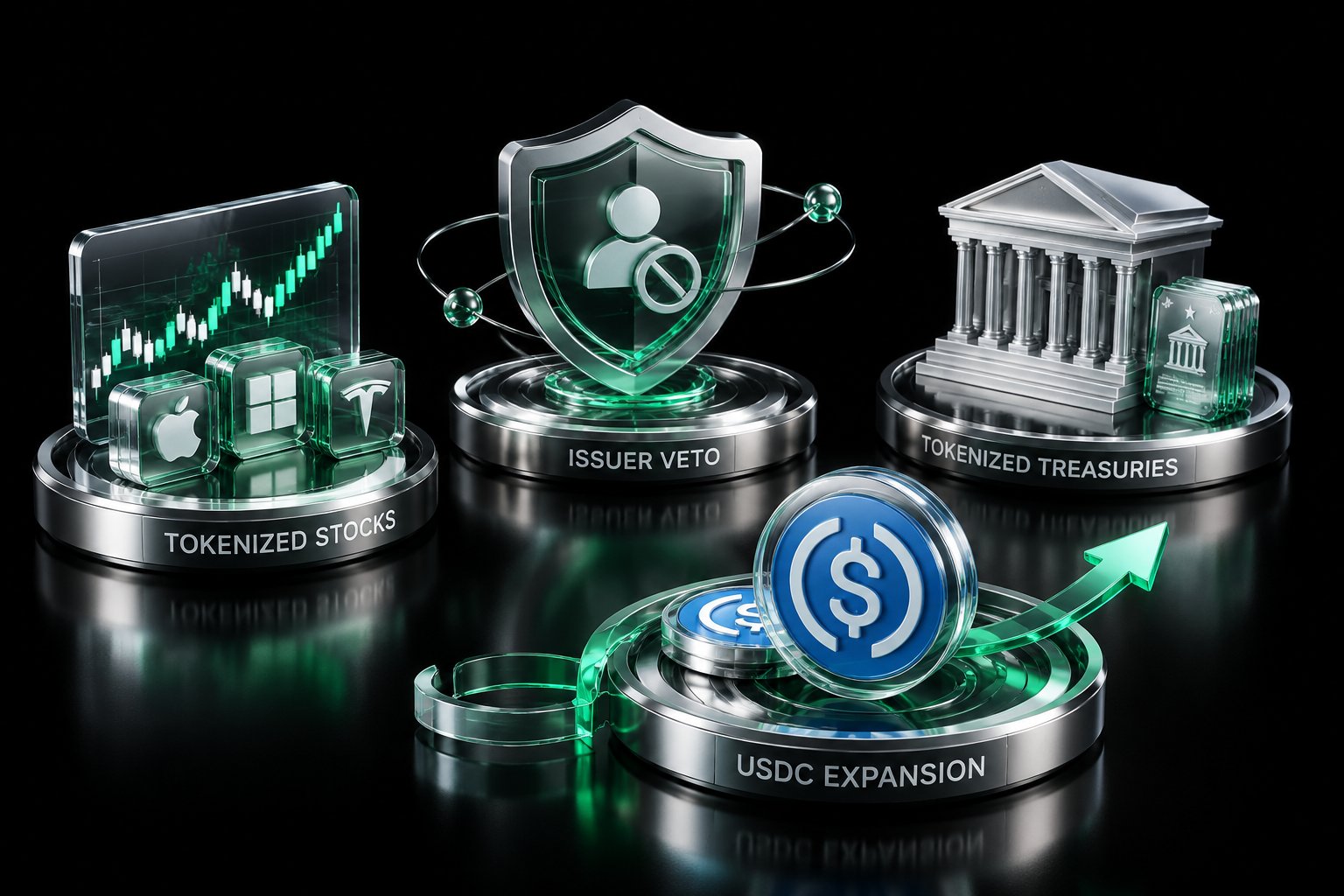
Nine Issuers Veto Tokenized Stocks on OKXICE as Ondo’s USDY Overtakes BUIDL
Tokenized Treasuries (total)
$14.9B
RWA.xyz · mid-Oct
USDY (overtakes BUIDL)
$2.33B
Ondo · first-time lead
USDC circulation
$73.3B
▲ 19% YoY
OKXICE first-batch objection rate
14%
9 / 63 tickers vetoed
Nine Issuers Block Tokenized Versions of Their Stocks on OKXICE, Putting the SEC’s Opt-Out to Its First Big Test
OKXICE, the 50-50 joint venture between crypto exchange OKX and Intercontinental Exchange (parent of the NYSE), disclosed on October 15 that nine listed companies formally objected within the SEC’s designated window to having their shares tokenized for trading on the venue — roughly 14% of the 63 US stocks in its first planned batch. It is the first large-scale real-world test of the issuer veto clause in the SEC’s Innovation Exemption, issued on September 17.
- Objectors: Broadcom, UnitedHealth Group, Verizon, CoreWeave, Cerebras Systems, AppLovin, Applied Digital, Rocket Lab and Applied Optoelectronics
- Mechanics: the SEC Innovation Exemption (published Sept 17, in the Federal Register Sept 22) requires venues to notify issuers before listing and grants a 30-calendar-day objection window; a written objection within it bars that specific venue from offering the token
- OKXICE plans 24/7 permissioned tokenized-stock trading via Uniswap v4 pools, settled in USDC/USDT/USDG, with underlying shares held 1:1 by a registered broker-dealer
- Most objectors gave no reason; Applied Optoelectronics said publicly it could not predict tokenization’s effect on its share price and liquidity, and worried investors might assume the company sponsored the tokens
- The venue is not yet live and still plans tokens for Nvidia, Apple and Microsoft; Securitize listed issuer-consented US equities on Solana on Oct 8
Regulatory signal
The opt-out model is being used at scale for the first time; SEC will weigh it in its comment period when deciding whether to make the exemption permanent
Industry impact
Every new listing batch becomes a negotiation with issuers, making broad index coverage hard to achieve
Structural gap
Synthetic products tracking only price can still bypass company consent, so pure price-exposure instruments escape issuer vetoes
Sources: Crypto Briefing · CoinAlert News · October 18, 2026
Ondo’s USDY Edges Past BlackRock’s BUIDL as the Tokenized-Treasury Crown Changes Hands
RWA.xyz data shows Ondo Finance’s tokenized-Treasury product USDY has reached roughly $2.328 billion, narrowly ahead of BlackRock’s BUIDL at about $2.204 billion, making it the second-largest single tokenized fund after Circle’s USYC. Ondo says its total tokenized US Treasury assets — including USDY, OUSG and tokenized Treasury ETFs — have crossed $3 billion, ranking first across platforms.
- USDY $2.328B vs BUIDL $2.204B, a lead of about $124M; Circle USYC at roughly $2.384B remains the largest single product
- The overall tokenized-Treasury market stands at about $14.91B across 100+ assets and 86,000+ holders
- Very different structures: USDY uses a Reg S wrapper for non-US retail (18,358 holders); BUIDL targets US qualified purchasers (107 holders, $5M minimum)
- Ondo and BlackRock are also intertwined: OUSG holds BUIDL as its core underlying, and USDY’s portfolio includes a BlackRock-managed iShares 0-1Y Treasury ETF
- The ONDO governance token has decoupled from the business: down 9% on the week and 79.5% below its December 2024 high of $2.14
Competition
A crypto-native issuer has outpaced a traditional asset-management giant in size for the first time, putting tokenized Treasuries into a multi-player race
Value decoupling
USDY’s growth is not flowing into ONDO, underscoring how governance tokens and asset scale are diverging
Structural note
Retail-led Reg S and institution-led qualified-purchaser structures now run side by side, deepening segmentation
Sources: CryptoCompass · 24/7 Wall St. · October 18, 2026
Circle Takes USDC into 40 Emerging Markets as Samsung Wallet Adds Stablecoin Transfers
Circle CEO Jeremy Allaire said at the IMF/World Bank meetings in Bangkok that the company will enter roughly 40 emerging and developing markets across Southeast Asia, Latin America, Africa and the Middle East, moving USDC from the early-adopter phase into mainstream scaling. Meanwhile, Samsung Wallet announced stablecoin transfers over the Solana and Sui networks, citing the GENIUS Act as a key catalyst — turning consumer electronics into a stablecoin distribution channel.
- USDC circulation hit $73.3B in Q2, up 19% YoY, roughly 25% of the stablecoin market (USDT near 60%); by adjusted transaction volume, USDC has passed 60%
- Expansion firepower: a $400M all-stock acquisition of Singapore payments firm Tazapay (closing 2027) plus a $100M strategic investment from Binance, adding 60+ banking and fintech partners across 100+ markets
- The GENIUS Act is expected to take effect in January; Allaire called it a watershed that will create “legal digital dollars.” Circle secured a federal banking charter in July
- Samsung picked high-throughput Solana and Sui rails, reaching consumer users who have never touched a DEX through a pre-installed wallet
- Circle says machine-to-machine micropayments between AI agents are driving USDC usage, while warning that AI amplifies security risks in financial infrastructure
Distribution shift
Pre-installed consumer wallets plus a 40-country payments network move stablecoins from trading tools onto everyday payment rails
Regulatory catalyst
Circle is building its global footprint ahead of the GENIUS Act taking effect in January, with the banking charter as a door-opener abroad
AI variable
Machine-to-machine payments become a new growth driver for stablecoins, even as AI attacks become a systemic concern
Sources: Reuters via BigGo · Decrypt via Verdice · October 17, 2026
Chainalysis: Italy, Portugal and Singapore Hold 66.9% of Tokenized US Treasuries
Chainalysis North America report data shows that within geolocated tokenized-Treasury holdings, Italy, Portugal and Singapore together account for 66.9%, with US-based holders in the minority. The concentration reveals what tokenized Treasuries really are — a dollar-access tool for offshore investors rather than a US retail phenomenon.
- By value: Italy 29.9%, Portugal 18.8%, Singapore 18.2%, with the US itself at just 10.5%
- By holder count: Japanese retail accounts for 16.4% of holders (top) but only 0.4% of value — mass small retail dollar-cost averaging vs a few high-net-worth entities driving value
- Tokenized Treasuries at $15.42B represent 42.8% of all onchain RWA; total onchain RWA surpassed $36.07B in Q2, up 135% YoY
- US investors can buy Treasuries through any broker, so they lack the incentive to hold tokenized versions; offshore users avoid account-opening friction via onchain wrappers
- The “geolocated” qualifier matters: many wallets route through custodians and privacy tooling, so the real distribution is likely more dispersed
Market structure
Tokenized Treasuries are fundamentally a dollar-access tool; the demand map points to Lisbon, Milan and Singapore rather than New York
Concentration risk
A few jurisdictions and large holders dominate, and issuer and custodian concentration become systemic watchpoints
Policy implications
US-issued assets held mainly by foreign capital could feed future tax and capital-flow policy debates
发表回复