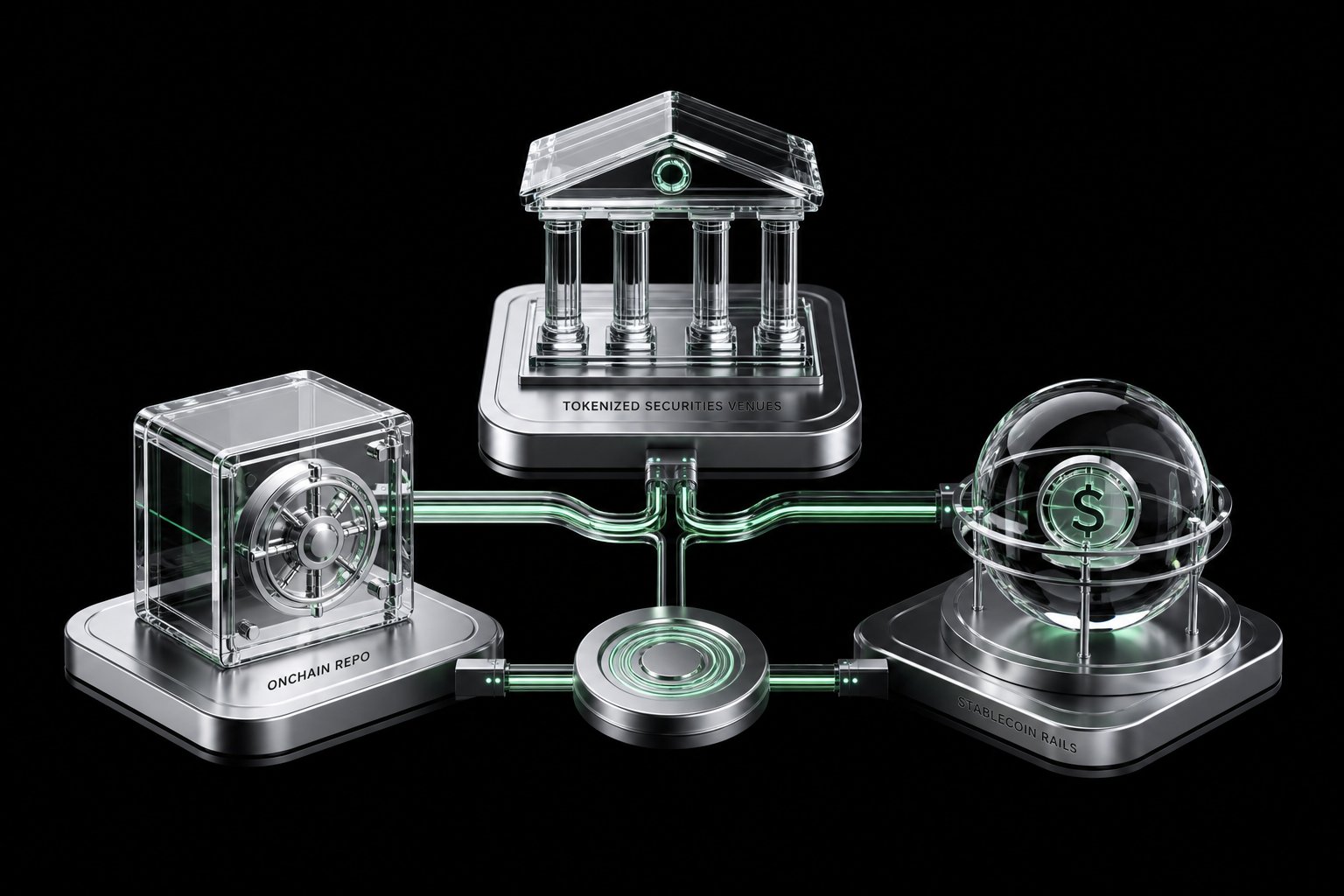
SEC Names First Three Tokenized Securities Venues as Stellar Repo Goes 24/7
On-chain RWA Market Cap
$38.99B
+0.64% MoM
RWA Asset Holders
5.30M
+12.55% MoM
Stablecoin Monthly Volume
$10.31T
+33.23% MoM
Q3 Tokenized-Stock Onchain Volume
$37B+
18x Since Jan
SEC Names First Three Tokenized Securities Venues; Innovation Exemption Draws Its First Legal Challenge
On October 21 the SEC published the first three firms planning to operate tokenized securities venues (TSVs) under the Innovation Exemption, while cautioning that appearing on the list does not establish compliance with the exemption’s conditions. The next day, consumer-protection group Better Markets filed a comment letter urging the SEC to rescind the exemption, arguing the agency should have used the Administrative Procedure Act’s notice-and-comment rulemaking process rather than an exemptive order. It is the first systemic legal challenge to the Innovation Exemption framework since it was issued in September.
- TSV LLC (filed Sep 23): owned by Obsidian Systems co-founders Ali Abrar and Ryan Trinkle, plans to run on Canton Network; Trinkle also sits on the Canton Foundation board
- OKXICE TSV (filed Oct 4): the OKX–ICE joint venture, plans to run on X Layer, OKX’s Ethereum Layer 2
- Kephas Corp. (filed Oct 14): U.S. subsidiary of Perpetuals.com led by former FTX Europe head Patrick Gruhn, running on public permissionless Layer 2 Kronos X Public with permissioned trading pools
- Better Markets says the exemption waives best-price display, customer data protection, cybersecurity and insurance requirements; a Columbia Law School Shadow SEC statement calls the order “a rule in substance”
- Exemption runs through Sep 17, 2031; Q3 onchain volume in tokenized stocks/ETFs topped $37B (Dune, 18x since January)
Regulatory Picture
Abstract rulemaking now becomes a concrete roster; the three venues span Canton, X Layer and Kronos technology paths
Legal Foundation
Exemptive order vs. APA rulemaking determines rule stability for US tokenized securities over the next five years
Market Momentum
Q3 onchain volume above $37B validates demand-side readiness; the compliance-path debate does not cool trading
Stellar Completes First Institutional Repo: USDM1 Collateral Rolls 72 Times Through a Weekend
Ascend Markets and M1X Global announced on October 23 the completion of the first regulated institutional repo transaction on the Stellar network. The trade used USDM1, a digital sovereign bond issued natively on-chain by the Republic of the Marshall Islands (backed 1:1 by short-dated US Treasuries), as collateral to borrow Circle USDC. Smart contracts executed 72 automated hourly rollovers across a 72-hour window that included a weekend, handling collateral locking, interest calculation and clearing end to end — with total network fees of less than one US cent.
- USDM1 collateral: governed by New York law, bankruptcy-remote custody at Surus Trust, perfected first-priority security interest under UCC Articles 8 and 9 — high-quality collateral rather than a speculative token
- Financing priced at SOFR + 10 bps (3.98% annualized), Chainlink oracles monitored collateral value with a 2% haircut and an LTV cap of 98%
- Automated KYC/AML executed at the code level (ERC-3643 / SEP-57); US-registered broker-dealer Peak Execution Services arranged the trade
- Ran continuously from Oct 16–19, crossing a weekend to prove 24/7 secured financing can bypass settlement-system operating hours
- More details expected at Stellar Meridian 2026 (Oct 28–29); Stellar holds roughly $3.64B in RWA assets (rwa.xyz)
24/7 Financing
A “perpetual repo” proof: secured financing sidesteps settlement cutoffs, redeploying sovereign-debt resources around the clock
Cost Structure
72 rollovers cost under a cent in total, against traditional repo back-office revaluation and operations
Compliance Path
SIFMA-aligned parameters, code-level KYC/AML and a registered broker-dealer create a replicable template for institutions
Sources: U.Today · Our Crypto Talk · October 23, 2026
Securitize Links the Cash Leg to a Federally Chartered Bank, One-Stop Mint, Custody and Settlement
Anchorage Digital and Securitize announced on October 20 that institutions on the Securitize platform can now mint and redeem stablecoins directly with Anchorage Digital Bank — the same federally chartered bank handles minting, custody and settlement end to end, removing intermediary sourcing. The move lets the dollar leg of a tokenized trade meet the same counterparty and custody standards as the securities leg for the first time, landing one day before the OCC finalized its GENIUS Act stablecoin rules and adding another piece to the federally supervised “digital dollar + tokenized securities” stack.
- Anchorage Digital Bank (the first federally chartered crypto bank in the US) issues USDtb (with Ethena Labs) and USA₮ (with Tether); dollars sit in segregated accounts at a national trust bank
- About 99% of USDtb’s ~$530M reserves were held in BlackRock’s BUIDL fund (independently attested as of Aug 31) — tokenized money-market funds are becoming the underlying infrastructure for regulated digital dollars
- Securitize hosts $4B+ in assets (tokenized funds for Apollo, BlackRock, BNY, Hamilton Lane, KKR and VanEck); NYSE-listed as SECZ
- Direct minting removes price drift and thin liquidity from market sourcing; one institution owns the full mint-to-redemption chain, simplifying compliance review
- rwa.xyz: the tokenized RWA market grew from roughly $23B at end-2025 to $31B by March 2026
Cash-Leg Compliance
The dollar side of tokenized trades meets the securities-side standard: federal oversight, bank custody, direct mint-and-redeem
Ecosystem Linkage
USDtb reserves feed back into BUIDL; tokenized money-market funds underpin the stablecoin economy
Regulatory Resonance
Landing in step with the GENIUS Act rulemaking, bank-issued stablecoins and tokenized securities form an institutional combo
Sources: Tradetech Eye · Yahoo Finance · October 20, 2026
BUIDL’s Avalanche Holdings Overtake Ethereum as Institutional Tokenization Goes Multichain
BlackRock’s flagship tokenized fund BUIDL ($2.17B) now holds $481.81M on Avalanche, exceeding $422.72M on Ethereum — with Solana leading overall. Ethereum, the chain where the fund launched in April 2024, has been surpassed by two later chains. The onchain distribution reflects reallocation by the administrator based on settlement speed, fees and compliance environment, marking a shift from single-chain pilots to production-grade multichain deployment where distribution follows demand.
- BUIDL chain mix: Solana first; Avalanche $481.81M vs. Ethereum $422.72M, with Ethereum still the infrastructure base but a shrinking share of supply
- The $2.17B fund invests in short-dated Treasuries, cash and repos, anchoring at $1 with daily dividends; Securitize is tokenization agent, BNY Mellon administrator and custodian
- Avalanche’s C-Chain offers sub-second finality and EVM compatibility; Solana brings high throughput, low fees and liquidity depth — both have custody, integrations and stablecoin infrastructure built in
- Inter-chain flows are administrator reallocation, not retail trading; investor yield, fees and redemption mechanics are unaffected
- For regulators, multichain distribution raises new questions around transfer restrictions, investor validation and reserve disclosure consistency
Multichain Norm
The largest asset manager runs across public chains on demand; the single-chain pilot era is over, distribution follows demand
Competition Dimension
Ecosystem competition shifts from incentives to custody, compliance and liquidity depth; infrastructure maturity decides
Regulatory Question
Consistency of cross-chain reserve disclosure and investor verification becomes a new compliance question
Sources: TronWeekly · Sharpe Terminal · October 23, 2026
发表回复