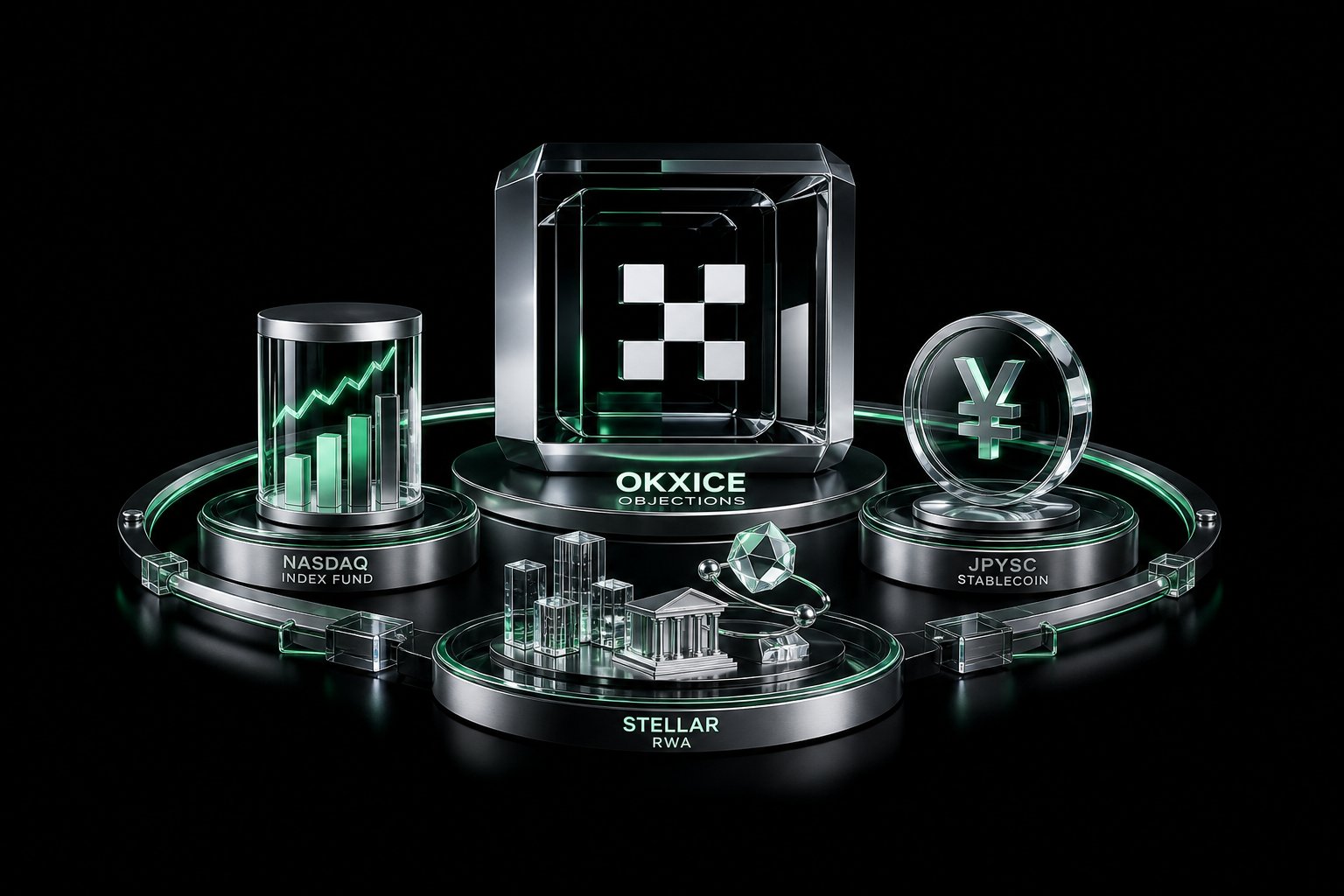
26 Issuers Reject Tokenized Stocks as Onchain Funds and Yen Stablecoins Converge
OKXICE objecting issuers
26
~37% of notified roster opted out
Tokenized stock holders
5.3M
83% of RWA holders · 10x in 4 months
Stellar RWA total
$4B+
JQQQ and Securitize join
Uniswap tokenized stock deposits
$300M
+2,451% YoY
IBM, Oracle and Intel Join Objections as OKXICE Tokenized-Stock Opposition Hits 26
OKXICE, the tokenized securities venue jointly built by OKX and NYSE parent Intercontinental Exchange, faced fresh headwinds on October 27 as IBM, Oracle, Intel and quantum computing firm IonQ formally joined the list of issuers objecting to having their shares tokenized, bringing the reported total to 26. The prior group of 22 already included Microsoft, Alphabet, Goldman Sachs, Wells Fargo, Cisco and Arm. Of the 62 companies in the original notification roster, 23 have now objected, roughly 37%.
- Under the SEC’s innovation exemption issued September 17, venues must notify issuers and give them a 30-day objection window; a timely objection blocks the listing under the exemption
- Latham & Watkins warns the current rule has no withdrawal mechanism: once trading begins, silence becomes irrevocable consent, forcing issuers to object preemptively to retain leverage
- SIFMA’s October 19 comment letter urges the SEC to replace opt-out with affirmative issuer consent and extend the objection period from 30 to 90 days
Market Impact
Tech and finance giants push back en masse, testing issuer trust in third-party tokenized listings
Structural Trend
Objecting is not rejecting tokenization: Nasdaq publicly backs it while opting its own shares out of the exemption
Regulatory Focus
The “silence means consent” mechanism is the core dispute; affirmative consent may shape the rule revision
Source: Finwire · Capital.com · October 27, 2026
Janus Henderson and Centrifuge Launch JQQQ, the First Nasdaq-Licensed Onchain Index Fund
Janus Henderson and Centrifuge launched JQQQ on the Stellar network on October 27 — the first issuer-sponsored, blockchain-native Nasdaq-100 tracking fund under an official Nasdaq index license. Shares are minted exclusively via Centrifuge’s institutional tooling inside a segregated portfolio of Anemoy Capital SPC Limited in the British Virgin Islands, restricted to eligible non-U.S. professional investors with a $100,000 minimum commitment, explicitly excluding domestic U.S. capital.
- This marks RWA tokenization’s first expansion from short-duration treasury and credit pilots into officially licensed benchmark equity primary issuance
- Janus Henderson’s active tokenized institutional footprint crosses $1 billion, building on the S&P 500-tracking SPXA fund
- JQQQ is not a synthetic derivative: it is an issuer-sponsored fund with Janus Henderson Investors US LLC as sub-investment manager under a direct Nasdaq license
Market Impact
Index licensors step in directly, moving onchain funds from synthetic wrappers to native primary issuance
Structural Trend
Fund shares become composable onchain building blocks for collateral management, treasury allocation and instant cross-border settlement
Growth Watch
Track JQQQ’s first $100M seeding phase and its eligibility as qualified collateral in permissioned lending markets
Source: A47 News · October 27, 2026
BlackRock, SBI and Startale Sign MOU to Link Yen Stablecoin JPYSC With Tokenized MMFs
BlackRock Financial Management, BlackRock Japan, SBI Holdings and Startale Group signed a memorandum of understanding in Tokyo on October 27 to explore connecting tokenized money market funds with JPYSC, a yen-denominated trust-type stablecoin. The collaboration spans three pillars — technology and infrastructure, business and distribution, and regulation and market development — and is explicitly open to a broader range of financial institutions and infrastructure providers.
- JPYSC is issued by SBI Shinsei Trust Bank and went live June 24; Japan’s amended Payment Services Act provides the legal foundation for stablecoins
- No specific fund, blockchain or launch timeline has been named — this is a settlement-architecture study, not a token announcement
- BUIDL offers the precedent: institutional tokenization requires the full loop of cash into yield assets, settlement, and cash redemption
Market Impact
The world’s largest asset manager joins a Japanese financial group to build a yen stablecoin x tokenized MMF loop
Structural Trend
Japan moves from stablecoin legislation toward infrastructure deployment, targeting global onchain finance leadership
Watch Point
The decisive questions are legal finality of conversion and avoiding two isolated, non-interoperable liquidity pools
Source: The Digital Track · Block2Learn · October 27, 2026
Securitize Adds Stellar at Meridian 2026, Expanding RWA Footprint Beyond the Big Three
Securitize announced at Meridian 2026, the Stellar Development Foundation’s annual conference in Lisbon, that it added Stellar to its supported blockchains. The platform that manages BlackRock’s BUIDL money-market fund had previously deployed only on Ethereum, Solana and Avalanche; CEO Carlos Domingo called Stellar “the fourth-largest ecosystem for tokenized real-world assets.” Stellar’s protocol-level architecture lets RWA issuers bake in KYC requirements, clawbacks and sanctions compliance — critical infrastructure for institutions moving real assets onchain.
- Franklin Templeton already runs a tokenized money market fund on Stellar, and MoneyGram moves capital across the network daily for cross-border transfers
- Securitize listed on the NYSE in July while dual-listing its own shares on Solana and Avalanche; the stock closed at $8.16 on October 27
- The RWA stablecoin market is projected to reach $4 billion within three years, with yield differentials proving tokenized assets can compete on risk-adjusted returns
Market Impact
BUIDL’s manager goes multi-chain, accelerating institutional capital rotation across fragmented liquidity pools
Structural Trend
Protocol-level compliance (KYC, clawbacks, sanctions) becomes a hard requirement for blockchains hosting institutional RWA
Regulatory Variable
The GENIUS Act pushes yield generation off-chain, compressing onchain arbitrage and testing risk-adjusted product returns
Source: Gokhshtein Media · October 28, 2026
发表回复