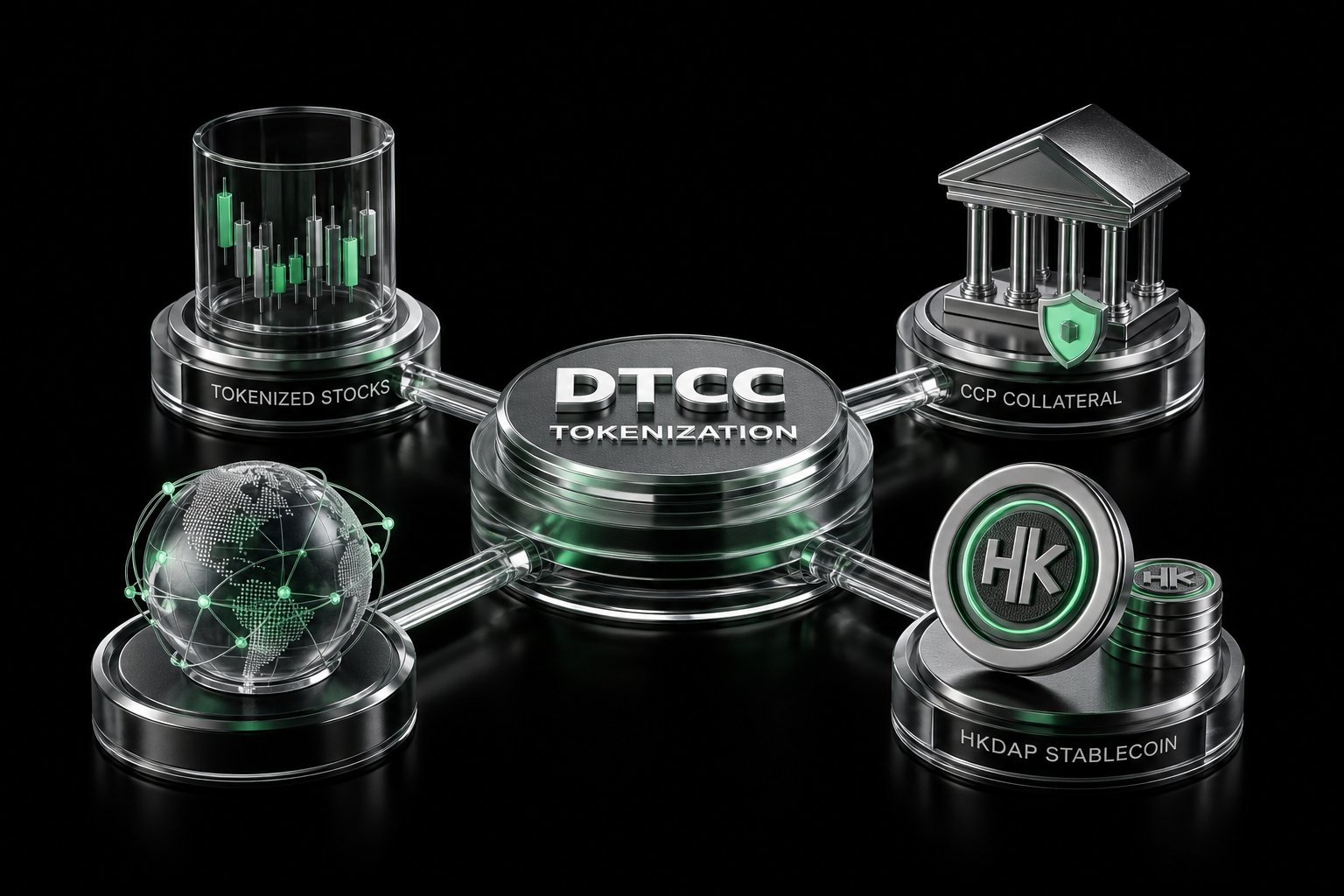
Clearing Rails Go Onchain as Tokenized Securities Enter Regulated Markets
Onchain RWA Market Cap
$39.56B
▲ 2% · 5.457M holders
Monthly Stablecoin Transfer
$10.09T
▲ 38.53% MoM
DTC Assets Under Custody
$114T
Tokenization live · 34 securities
OKXICE Objecting Issuers
38
Covers 34 of 63 tickers
DTCC Tokenization Service Goes Live: DTC-Custodied Securities Tokenized 1:1, First Batch of 34
DTCC’s subsidiary DTC officially launched the DTCC Tokenization Service on October 28. The service mints 1:1 digital-twin tokens for securities held in DTC custody, giving holders the same legal rights and economic entitlements as the underlying securities. Traditional markets and onchain use share the same CUSIP code, DTC-registered wallets can transfer peer-to-peer 24/7, and built-in compliance controls enable near-real-time ownership tracking. The first batch of 20 DTC participants signed on, including Barclays, Bank of America, J.P. Morgan, Citi, Fidelity, Morgan Stanley and UBS.
- 34 securities are tokenizable in the first batch; DTC custodies roughly $114 trillion in assets, and the service is integrated with the Canton Network and DTCC’s private Besu network, with more public chains to follow in 2027
- The 20 signing participants: Alpaca, Apex, Barclays, Bank of America, BNP Paribas, BBH, Citadel Securities, Citi, Clear Street, DriveWealth, Edward Jones, Fidelity, Interchange, J.P. Morgan, Marex, Mirae Asset, Morgan Stanley, State Street, UBS and Velocity
- Ecosystem partners include BitGo, Blockdaemon, Fireblocks, HashKey, Kaleido, Prometheum, Talos, Tradeweb, Virtu and Ondo; the SEC granted a No-Action Letter in December 2025 authorizing tokenization of Russell 1000 constituents, major index ETFs and U.S. Treasuries
Model Rivalry
Custodian-led 1:1 digital twins go head-to-head with OKXICE’s third-party tokenization model
Institutional Signal
20 top clearing participants signed on, moving tokenization from pilots to regulated production
Liquidity Upside
A convertible channel opens across $114T of custodied assets, reshaping collateral mobility and cross-market liquidity
OKXICE Tokenized-Stock Objections Hit 38: Walmart and Eli Lilly Join as Nasdaq Courts Issuers
The wave of issuer objections to OKXICE, the tokenized-stock venue backed by OKX and NYSE parent Intercontinental Exchange, keeps building. A notice disclosed October 28 added Walmart, Eli Lilly, Carnival, Arcos Dorados and Cigna, bringing the total to 38 companies and covering 34 of the 63 originally proposed tickers, more than half. According to journalist Jacquelyn Melinek, Nasdaq representatives actively courted listed companies to object to trading on OKXICE, pointing to Nasdaq’s own issuer-oriented Nasdaq Equity Token model as the right track.
- The objector list climbed from 9 on Oct 15 to 16 on Oct 19, 22 on Oct 23 and 38 on Oct 28; 23 of the 38 are listed on Nasdaq
- Under the SEC innovation exemption, a venue must notify issuers first and companies have 30 days to file a written objection; a timely objection bars that venue from offering the stock under the exemption, and the bar applies only to that specific venue
- TSV LLC on Canton Network plans to trade tokenized shares of Canton Strategic Holdings (CNTN) as early as November 2, using an issuer-led model with SEC-registered onchain transfer agent Fairmint, sidestepping the 30-day objection window
Market Split
Issuers object to third-party off-venue tokenization, not tokenization itself; sponsor-led models keep traction
Fragmentation
DTCC’s custodian model and TSV’s issuer-led model advance while OKXICE’s third-party path comes under pressure
Rule Evolution
The 30-day objection window effectively becomes an issuer veto, reshaping how tokenized stocks get listed
Source: The Defiant · Yahoo Finance · October 28, 2026
Bank of England Consults on Tokenized Collateral for CCPs: Government Bonds First, Stablecoins and Tokenized MMFs in Scope
The Bank of England published a consultation on October 29 seeking views on draft supervisory expectations for central counterparties (CCPs) accepting tokenized collateral. The BoE sees tokenized collateral as a promising near-term application of tokenization in wholesale markets, but stresses that the benefits depend on robust operational resilience, cybersecurity, interoperability, custody arrangements, and legal certainty around ownership, settlement finality and default handling. It favors a technology-neutral, outcomes-based approach, with initial adoption expected to focus on tokenized versions of established eligible collateral such as government securities.
- The consultation extends to regulated stablecoins, tokenized money market fund (tMMF) units and tokenized gold: stablecoins need scrutiny of backing assets, redemption, valuation, issuer confidence and reliable cash conversion; tMMFs require assessment of redemption arrangements, liquidity and procyclical effects in stressed markets
- For tokenized gold, regulatory treatment may hinge on whether the token maintains its link to allocated underlying bullion; regulatory status alone does not establish suitability, and assets must still meet liquidity, enforceability, valuation and risk-management standards
- No changes are proposed to the CCP Rulebook’s collateral eligibility requirements; the consultation only seeks views on applying the expectations to a broader range of assets, with the policy response to the UK EMIR replacement expected in Q4 2026
Regulatory Stance
Technology-neutral and outcomes-based, opening the door for tokenized collateral in central clearing
Global Alignment
Follows CFTC and ESMA moves, as CCP tokenized-collateral frameworks advance in parallel
Early Use Cases
Tokenized government bonds should land first; stablecoins and MMF units still need to pass stress tests
Source: Bank of England via Reg Tomorrow · October 29, 2026
Standard Chartered-Led HKDAP Stablecoin Lands on Solana: First Hong Kong Licensed Stablecoin Ties Up With a Public Chain Foundation
Anchorpoint Financial, led by Standard Chartered (Hong Kong), announced a strategic partnership with the Solana Foundation on October 30 to bring the Hong Kong-licensed HKD stablecoin HKDAP to the Solana network, supporting native minting and redemption plus retail payments, tokenized asset trading and other high-frequency settlement use cases. The Solana Foundation will also join Anchorpoint’s Tokenised Asset Programme as a strategic partner, following PwC’s earlier participation. It marks the first direct engagement between HKDAP and a public chain foundation, and the first direct collaboration between Solana and a Hong Kong licensed stablecoin issuer.
- Anchorpoint is a joint venture of Standard Chartered (Hong Kong), HKT and Animoca Brands, licensed under the HKMA’s FRS01 stablecoin issuer regime in April 2026, and has operated HKDAP in institutional beta since August
- Hong Kong’s Stablecoins Ordinance requires issuers to be licensed, hold fully backed reserves of high-quality liquid assets and redeem at par; with the HKD pegged to the USD within the 7.75-7.85 band, HKDAP effectively becomes a dollar-linked instrument issued outside direct US oversight
- Per rwa.xyz, Solana hosts $18.89B of onchain RWA, of which $14.13B (about 75%) is stablecoins, with $370.94B monthly transfers across 13.56M addresses; the Solana Foundation is also joining Hong Kong’s OASES program and opening a local office
Hong Kong Race
After HSBC’s RedCoin, the Standard Chartered-led HKDAP and HSBC camp now run side by side toward retail HKD stablecoins
Compliant Rails
A licensed stablecoin linking to public chain infrastructure gives institutions a compliant onchain HKD settlement gateway
Ecosystem Signal
Solana’s stablecoin-heavy RWA ecosystem extends toward HKD-denominated assets
Source: CoinAlertNews · U.Today · October 30, 2026
发表回复