The 26% Survivors: GENIUS Reserve Tests Split the Stablecoin Map
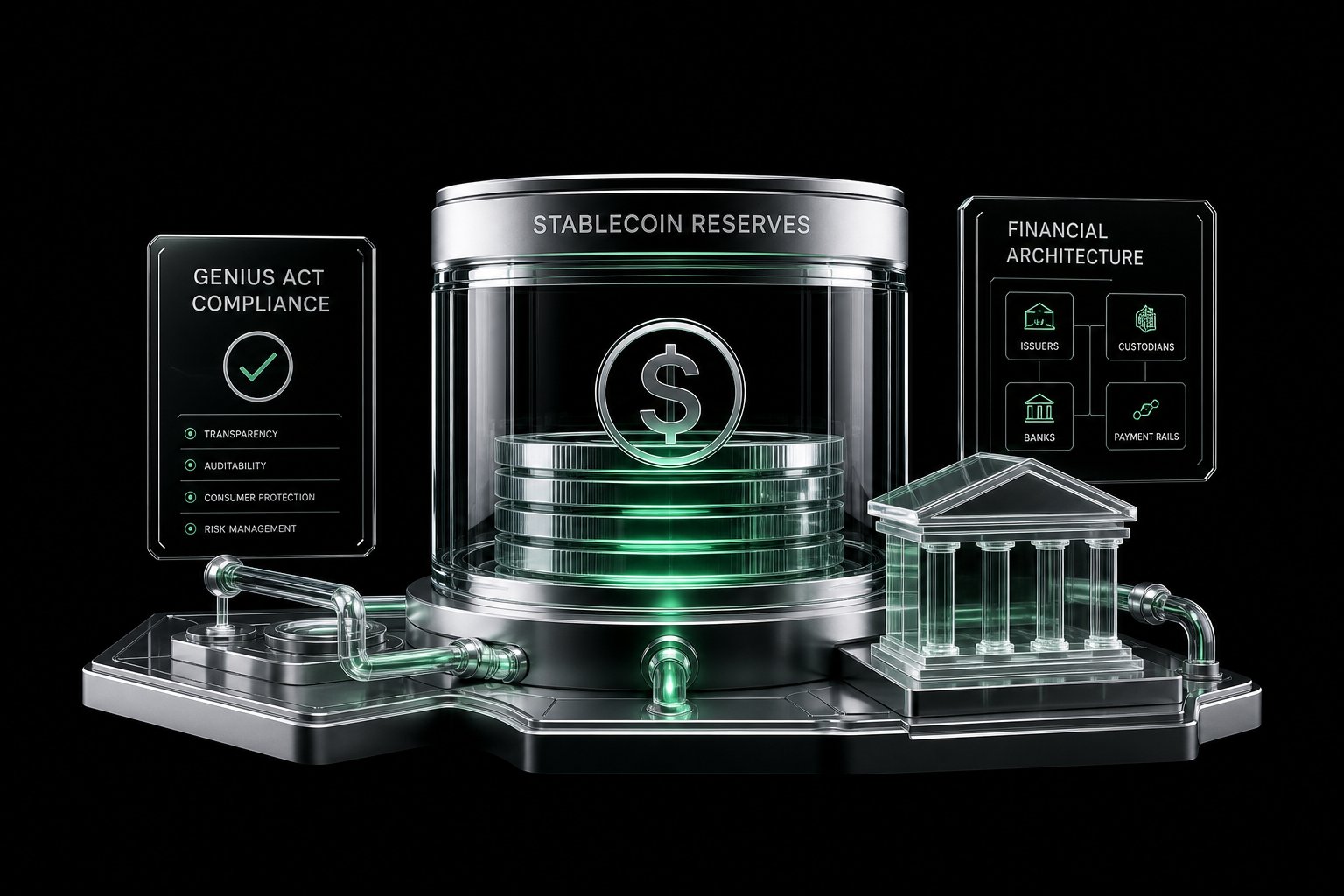
A Bank Policy Institute study on Nov. 6 found that only two of the ten largest dollar stablecoins, representing 26 percent of outstanding tokens, meet the GENIUS Act’s reserve asset requirements — compliance is a gate, not a guarantee.
Key Takeaway
With the GENIUS Act taking effect on Jan. 18, 2027, reserve structure has become the compliance dividing line for stablecoins: only USDC and PYUSD (26 percent of outstanding tokens) among the ten largest dollar stablecoins currently meet the requirements, while USD1 and Ripple USD are dragged down by money market funds holding agency debt and longer-dated Treasuries, and USDT plus the crypto-backed USDS/DAI sit entirely outside the framework. In the same week, Nigeria’s central bank on Nov. 5 introduced its own stablecoin regime with a N15 billion capital floor, exporting reserve discipline from the United States to emerging markets. Reserve compliance is turning into the entry ticket for issuers and the proof of access for payment use cases.
Out of Ten Stablecoins, Only Two Pass
On Nov. 6, Bank Policy Institute (BPI) researchers Laurence Bristow and Eva Funaki published a note examining the reserve assets backing the ten largest dollar stablecoins by circulation as of June 30, 2026. These ten tokens account for 97 percent of all stablecoins outstanding — not a sample, but the market itself. The conclusion is blunt: only two coins, representing 26 percent of outstanding tokens, hold reserves that align with GENIUS Act requirements; another 2 percent are expected to come into compliance soon; the remaining 72 percent fall short, with offshore stablecoins accounting for 65 percent and crypto-backed stablecoins for 7 percent.
The GENIUS Act’s reserve requirements for “payment stablecoins” are specific: U.S. Treasury securities with less than 93-day maturity, overnight reverse repurchase agreements secured by Treasuries, and bank deposits, among other highly liquid assets. Congress passed the Act in July 2025, the OCC finalized implementing rules on Oct. 21, and the regime takes effect on Jan. 18, 2027. With only about 70 days left until the effective date, the market’s existing reserve structures have already delivered the verdict — most top coins fail the test under their current asset mixes.
The four onshore coins are the focus. Circle’s USDC and Paxos’ PYUSD hold GENIUS-compliant reserves; World Liberty’s USD1 and Ripple USD do not, because both hold money market funds that in turn hold agency debt and longer-dated Treasuries. BPI also noted that World Liberty’s OCC conditional approval (Decision No. 1385) requires its stablecoin business to comply with the GENIUS Act, and Ripple USD’s state-trust framework is “subject to alignment with GENIUS requirements” — the question for both is not whether they will be covered, but when they will adjust their asset structures.
— BPI, “Not All Stablecoins Will Follow GENIUS Reserve Asset Requirements”, Nov 6, 2026
USDC is the largest onshore stablecoin, with over $73 billion in circulation. The BPI note contains a piece of history: before the Silicon Valley Bank (SVB) crisis in March 2023, USDC’s reserves were 85 percent Treasury bills plus 15 percent uninsured bank deposits, with just over half of those deposits held at SVB. When the bank failed, the market began to question USDC’s solvency and the coin de-pegged, trading as low as 87 cents. Circle subsequently cut its Treasury bill exposure and shifted into Treasury-backed repurchase agreements; by July 2026, about 70 percent of reserves were Treasury-backed repos, with the remaining 30 percent split evenly between uninsured bank deposits and Treasury bills. BPI uses this history as a reminder: even today’s compliant coins de-pegged in 2023. Compliance is a gate, not a guarantee.
On the offshore side, the protagonist is USDT. BPI discloses that as of June 30, 2026, USDT’s reserves were 61 percent U.S. Treasury bills, 10 percent overnight repos secured by Treasuries, and close to zero bank deposits; the remaining 29 percent consisted of gold, public equities, bitcoin, secured loans, term repo loans and other investments, a share that has slowly grown over time. Tether does not publish the maturity structure of its Treasury bills, only that the weighted average maturity is under 90 days — even assuming every bill matures within 93 days, only about 71 percent of USDT’s reserves would meet GENIUS standards. BPI also lists USDT’s three de-pegging episodes: October 2018, November 2022 (after the FTX collapse), and August 2023 (when liquidity dried up during the crypto winter). Tether’s separately issued U.S.-compliant version, USA₮, has less than $200 million outstanding — the dual structure means mainstream USDT will stay offshore, outside the GENIUS perimeter.
The crypto-backed group is led by Sky Protocol’s USDS and DAI, together close to $14 billion outstanding, making them the third-largest stablecoin. USDS reserves are not backed 1:1 by real-world assets but come in three flavors: minted directly by exchanging one USDC, borrowed against crypto collateral pledged to Sky’s DeFi lending protocol, or created by Sky-affiliated entities deploying funds into strategies. By June 2026, crypto-collateralized loans accounted for 42 percent of USDS reserves, stablecoins 38 percent, and tokenized real-world assets 20 percent; nearly 90 percent of the RWA sleeve sits in tokenized funds investing in short-term Treasuries, repos and AAA-rated collateralized loan obligations. Crypto-collateralized loans are not eligible reserve assets under the GENIUS Act, and USDS/DAI’s positioning means they will not become payment stablecoins in the Act’s sense — they look more like leverage protocols wearing a stablecoin’s clothing.
Same Week, Nigeria Writes Reserve Discipline into Its Own Rules
Across the Atlantic, an emerging market moved in parallel. The Central Bank of Nigeria (CBN) on Nov. 5 issued the Regulations for the Operations of Non-Security Virtual Assets in Nigeria, effective immediately, signed by Musa Jimoh, Director of the Payments System Policy Department. The 169-page framework splits stablecoins into two classes: Class 1 for naira-referenced stablecoins and Class 2 for those pegged to foreign currencies such as the U.S. dollar. Class 2 issuers face a paid-up capital floor of N15 billion (about $11.1 million), Class 1 issuers N10 billion, and other non-security virtual asset service providers N1 billion. Capital must be kept strictly separate from issuer reserves, the CBN reserve deposit, customer funds and operational liquidity — the same money cannot satisfy multiple regulatory obligations.
The reserve rules mirror GENIUS: issuers must back outstanding stablecoins 1:1 with eligible reserve assets plus an additional 2 percent buffer; minting is only allowed once equivalent reserves are received and held; holders can redeem at face value, generally by the next business day, with a maximum five-business-day window under stress; algorithmic stablecoins and tokens pegged to fiat but backed mainly by other cryptocurrencies are banned outright. At least 40 percent of the reserve pool must be cash or eligible high-quality liquid assets, and naira-backed coins must hold at least 20 percent of the pool as a dedicated non-interest-bearing cash deposit at the CBN, withdrawable only with the Bank’s prior written consent. Stablecoins with circulating value above N500 billion for 30 consecutive days, or used by more than five million Nigerians, are designated systemically important and subject to enhanced oversight.
On offshore issuers, the CBN’s stance matches Washington’s: no offshore exemption. Foreign issuers serving Nigerians must operate through a locally incorporated, licensed entity; Class 1 issuers must be incorporated in Nigeria, and Class 2 applicants must establish a Nigerian entity before final approval; operators are covered whether or not they maintain a physical office in the country as long as they direct services at Nigerian customers. Licence application fees are N10 million with an annual renewal fee of N5 million; operating without a licence draws a minimum fine of N100 million plus at least N1 million for each day the violation continues. Existing operators have a 180-day transition window to obtain licences, may only continue at their current scale in the meantime, must register within 30 days and begin supervisory reporting within 60 days. Peer-to-peer platforms face a new requirement: before releasing or crediting a regulated token, they must verify that the naira account name and Bank Verification Number (BVN) match the customer.
Reserve Structure Becomes Proof of Access: Compliance Turns from a Threshold into an Operating Variable
Read together, the two stories send one core signal: the center of gravity in stablecoin regulation has shifted from “do you have a licence” to “what exactly are your reserve assets.” GENIUS uses a list of short-dated, highly liquid, low-volatility assets — 93-day Treasuries, repos, bank deposits — to separate payment stablecoins from investment tokens at the balance-sheet level; the CBN reproduces the same logic for the naira economy with 1:1 full backing, a 40 percent cash floor, a 2 percent buffer and systemic-importance thresholds. Regulators are no longer satisfied with “the issuer says reserves are sufficient”; they demand that the reserve structure survives a checklist inspection.
For practitioners, three groups now face different circumstances. First, onshore issuers: USD1 and Ripple USD need to restructure their reserves now, replacing money market funds with direct holdings of 93-day-or-less Treasuries or Treasury-backed repos. This is not a quarter-end reporting game but a hard condition embedded in the OCC conditional approval and the state-trust framework. Second, offshore issuers: USDT’s 65 percent share will not vanish overnight, but as U.S. institutional payments, bank clearing and custody begin treating GENIUS compliance as a condition of access, the usability of offshore stablecoins inside the regulated payments stack will narrow gradually; USA₮’s $200 million circulation shows the compliant version is still symbolic. Third, crypto-backed stablecoins: USDS/DAI were never payment stablecoins, and the reserve test effectively pins them to their “DeFi leverage tool” positioning, with no path into banking or clearinghouse rails.
BPI’s caution is also worth remembering: compliance does not mean immunity from de-pegging. USDC’s 87-cent history in 2023 is in front of us, and USDT’s three de-pegging episodes are written into the report. Reserve structure solves the question of whether the asset side is stable; redemption mechanics, liquidity management and the ability to handle stress scenarios determine whether a run becomes a systemic event. Issuers that market GENIUS compliance as a safety promise will pay for it during the next de-pegging.
Takeaways for Practitioners
Sources
- 1. Not All Stablecoins Will Follow GENIUS Reserve Asset Requirements — BPI, Nov 6, 2026
- 2. Study Finds Most Stablecoins Fail GENIUS Act Requirements — PYMNTS, Nov 6, 2026
- 3. Most U.S. Dollar Stablecoins Fail GENIUS Act Reserve Tests, BPI Study Says — PaymentsHighRisk, Nov 6, 2026
- 4. CBN Sets N15bn Capital Requirement for Dollar Stablecoin Issuers — PUNCH, Nov 6, 2026
- 5. CBN Tightens Grip On Crypto Market, Sets N15bn Capital For Dollar Stablecoin Issuers — Independent Nigeria, Nov 6, 2026
- 6. CBN Introduces N15bn Capital Benchmark for Dollar-Backed Stablecoin Operators — Business Post Nigeria, Nov 6, 2026
- 7. Nigeria Introduces Crypto Rules, Prohibits Algorithm-Dependent Stablecoins — Crypto News Mag, Nov 6, 2026
- 8. CBN Tightens Stablecoin Rules with BVN Match and N15bn Capital — CoinAlertNews, Nov 6, 2026
发表回复