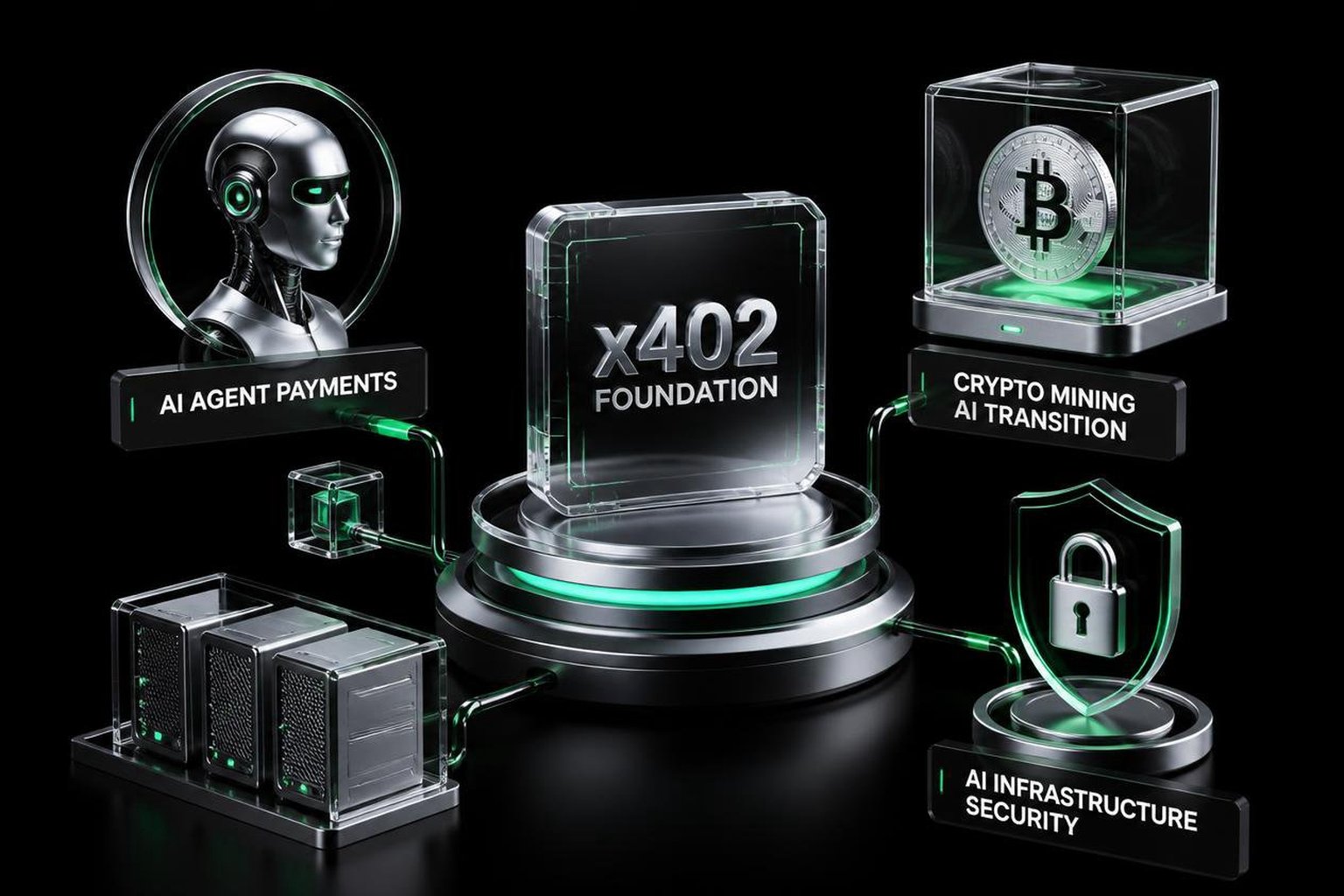
AI Agent Payments Enter Their Institutional Era: x402 Foundation Launches, Miners Pivot, Security Warnings Mount
This week the AI-blockchain narrative shifts from proof-of-concept to institutional standardization: the x402 Foundation launches, Binance Agent OS goes live, miner AI pivots accelerate, and AI infrastructure itself becomes a concentrated hacking target.
On September 2, Ripple, Coinbase, and Circle joined the Linux Foundation-backed x402 Foundation as founding members to set open standards for AI agent payments. It is the most important event of the week in the AI-blockchain convergence track: three firms representing different infrastructure layers of the stack, the Ripple ledger and RLUSD stablecoin, exchange and custody, and the USDC issuer, are jointly betting on interoperable machine-to-machine settlement rails.
Almost simultaneously, Binance launched Agent OS, letting AI agents read market data and submit orders on Spot, Futures, and Convert markets; MoonPay extended its PayBox to xAI’s Grok, its third deployment after ChatGPT and Claude. Three signals point to the same fact: AI agent payment rails are moving from single-company experiments toward industry standards and scale.
1. This Week at a Glance
The main events in the AI-blockchain track this week (August 31 – September 5):
First, the x402 Foundation launched with Ripple, Coinbase, and Circle as founding members and Linux Foundation backing, aiming to build cross-chain, multi-asset open standards for AI agent payments. Second, Binance launched Agent OS, allowing AI agents to execute trades on Spot, Futures, and Convert markets with subaccount isolation and funding caps. Third, MoonPay extended PayBox to Grok, covering Solana and multiple EVM chains under the x402 standard. Fourth, at a House Financial Services Committee hearing, Circle President Heath Tarbert said AI agents “don’t stop for nights, weekends, or holidays” and need fast, programmable, always-on rails, stressing the GENIUS Act and agentic identity. Fifth, Bitget launched AI Smart Grid to auto-select assets and rebalance every four hours. Sixth, Hyperscale Data shut its Michigan mine and converted 20MW of compute to an AI hosting contract worth about $1.2 billion.
2. This Week’s Top 3 Events
3. Trend Observations
Across this week’s events, the real common thread is “standards before traffic,” not any single product. The launch of the x402 Foundation means agent payments are escaping the fragmentation of proprietary, siloed efforts and moving toward an interoperable protocol backed by a neutral arbiter like the Linux Foundation. This competes with the agentic commerce push from Visa and Mastercard, and suggests 2026-2027 could be the window when machine-payment network effects lock in.
At the same time, the security debate is shifting from “token protocol vulnerabilities” to “AI infrastructure itself.” When an AI gateway becomes a concentration point for keys, and when agent skill files can be poisoned, the self-custody and private-key security logic the crypto industry built over years needs recalibrating. The permission boundaries and policy execution layers of agent wallets are becoming the new security frontier.
4. What to Watch Next Week
In the week of September 7, watch whether the x402 Foundation discloses more members and initial technical specs, especially the concrete design of settlement layers and cross-chain schemes. Watch whether Binance Agent OS releases early usage data (user numbers, trading volume) to validate real traction for agent trading. Watch whether Hyperscale Data’s first 20MW phase at the Michigan site comes online in late September, tracking the revenue realization pace of the miner AI pivot. And watch continued congressional hearings around AI agent payments, stablecoins, and the GENIUS Act.
- CoinArticle — Ripple, Coinbase, Circle Join x402 Foundation for AI Payment Standards
- StockTi — Binance Opens Trading to AI Agents, BNB Rises 5.2%
- PYMNTS — Lawmakers Test the Rules for AI Agents That Move Money
- Crypto News Today — MoonPay Expands PayBox to Grok
- Cryptopolitan — Hyperscale Pulls a Michigan Site Off the Bitcoin Network for a $1.2B AI Deal
- BugsToday — AI Infrastructure Is Being Hacked for Keys, Shells and Crypto Mining
- CryptoRank — Three-of-Seven CISA KEV Additions Now Target AI Infrastructure
发表回复