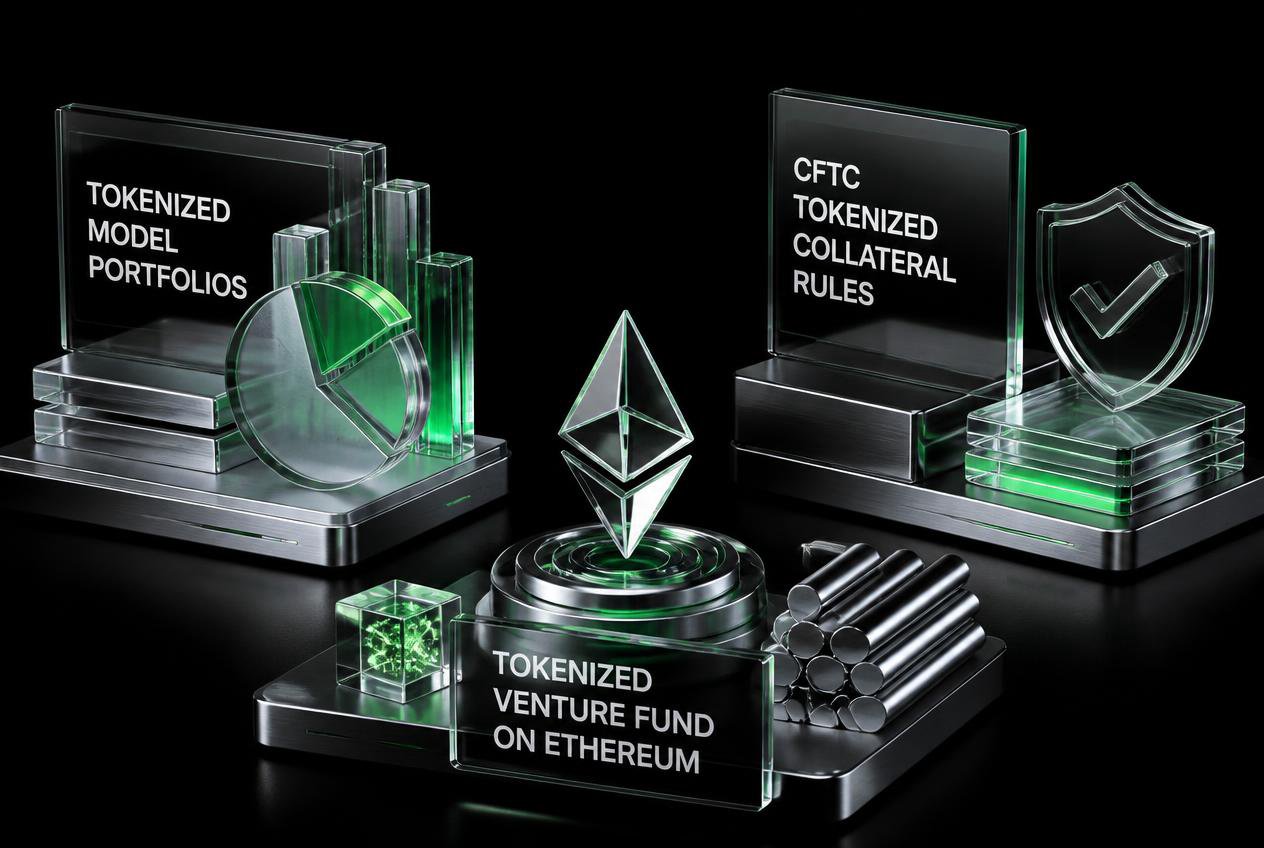
BlackRock’s Model Portfolios Go On-Chain as CFTC Clarifies Tokenized-Asset Rules
Tokenized RWA Market Cap
$46B
▲ Ethereum holds 48.4%
Tokenized Funds
$34.7B
75.5% of the RWA market
On-Chain RWA Deposits
$7.4B
▲ 3x YoY · DeFi -15%
RWA Perp DEX Volume (Q3)
$365B
▲ +32% QoQ · Equities 48%
BlackRock Hands Three Model Portfolios to Ondo for Tokenization, Its First Third-Party On-Chain Launch
Three BlackRock-designed model portfolios (High Income, Diversified Growth and High Growth) will be tokenized by Ondo Finance into transferable on-chain tokens named BLKHIon, BLKDIGon and BLKGRWon, each holding a mix of stocks, bonds and bitcoin ETFs. It is the first time BlackRock has let another firm tokenize portfolios it designed; its earlier tokenized products, such as BUIDL, were issued in-house. Ondo launched seven tokenized model portfolios on the same day, three of them built on BlackRock strategies. When investors buy a token, smart contracts automatically purchase the underlying ETFs and reinvest dividends. The tokens can be used as DeFi collateral, transferred and traded 24/7, and are initially restricted to eligible non-U.S. investors.
- The three strategy tokens cover high income (bond-heavy), diversified growth and high growth, with weights and rebalancing schedules visible on-chain
- Broadridge data shows model-portfolio assets reached $9.8 trillion in June 2026, up from $7.7 trillion a year earlier, with 87% of 400 surveyed advisers using them
- Ondo holds about $3.9 billion in tokenized assets; BlackRock has said it has roughly $110 billion in AUM connected to digital assets
- Token holders do not get direct shareholder rights in the underlying securities, a different rights tier from “true” tokenized stocks
Product Paradigm
A shift from single-asset tokenization to packaged strategy tokens, with rebalancing run by smart contracts
Distribution
The world’s largest asset manager reaches crypto wallets through a third party, bypassing brokerage accounts
Market Reaction
ONDO rose about 18% in 24 hours on spot buying while derivatives open interest fell
Source: Wall Street Journal via TradingView · Azat TV · September 24, 2026
CFTC Updates FAQs to Clarify Tokenized Assets for Customer Funds and Blockchain Records
Three divisions of the U.S. Commodity Futures Trading Commission jointly updated crypto-related FAQs, focusing on two practical questions: customer funds invested in tokenized permitted investments, and the use of blockchain to meet recordkeeping obligations. The guidance builds on the March 20 FAQs and Staff Letters 25-39 (tokenized collateral guidance) and 26-05 (a no-action position on digital assets accepted as margin collateral). The key boundary: tokenization changes only how ownership and settlement are recorded, not whether the investment itself qualifies under existing rules, and tokenized instruments must carry legal and economic rights equivalent to their traditional versions. Chairman Michael Selig said the update fits the agency’s push for regulatory clarity.
- Tokenized permitted investments must provide the same legal and economic rights as their traditional equivalents to count toward customer funds
- Blockchain records can satisfy Regulation 1.31 if they stay reliable, accessible, retained for the required period and producible to regulators
- The guidance is a staff interpretation, not binding, and does not change the permitted-investment list under Regulation 1.25; futures commission merchants cannot invest customer funds directly in payment stablecoins merely because of crypto guidance
- It dovetails with Token Terminal data: tokenized RWAs hit $46 billion, with funds at $34.7 billion, or 75.5%
Regulatory Signal
A technology-neutral approach that folds on-chain assets into the existing framework — direction first, no new rules
Institutional Compliance
Gives futures firms and clearing houses a workable route to tokenized collateral and on-chain records
Adoption Pace
Non-binding guidance lowers the immediate compliance burden and allows phased adoption, with formal rulemaking likely to follow
Source: Blockonomi · The Crypto Times · September 24, 2026
ARK Invest Tokenizes Its Venture Fund Through Securitize on Ethereum, Adding OpenAI Exposure
ARK Invest has tokenized its ARK Venture Fund (ARKVX) through Securitize on Ethereum. The fund invests in both private and public technology companies, with named holdings including OpenAI, Anthropic, Stripe and Databricks, but buying the token gives investors a fund-level interest rather than direct equity in any of those companies. Securitize handles issuance and investor access on Ethereum. The SEC issued an amended order on September 21 allowing the fund to offer a tokenized share class that may trade on one or more alternative trading systems or be quoted through other permitted channels, plus a separate class that could be listed on a national securities exchange.
- ARKVX is a continuously offered, closed-end interval fund: investors may buy on an ongoing basis while the fund makes periodic repurchase offers
- Tokenization changes only how the interest is recorded and does not by itself create a secondary market — the announcement says shares are not exchange-listed and no secondary market is expected
- Cathie Wood said tokenization puts ARK’s view of changing capital markets into practice
- Access remains subject to investor-eligibility and geographic restrictions
Private Markets On-Chain
A venture fund issues a compliant tokenized share class, opening an on-chain entry to late-stage private and AI assets
Regulatory Path
The SEC order opens both ATS and exchange tiers, offering a template for tokenized fund shares
Liquidity Limits
On-chain records do not equal free trading; repurchase mechanics and fund structure remain the real constraints
Source: FinWire · Securitize / ARK Invest · September 24, 2026
CoinShares: On-Chain RWA Deposits Triple to $7.4B as Tokenized Assets Outgrow Broad DeFi
A “Hybrid Finance” report by CoinShares and Token Terminal shows RWA deposits across lending protocols and decentralized exchanges rose from $2.3 billion in Q2 2025 to $7.4 billion in Q2 2026, while total DeFi deposits fell about 15% and aggregate crypto-native DEX volume dropped roughly 70%. Ethereum hosts nearly 70% of RWA deposits, with yield-bearing collateral concentrated in Aave, Morpho and Kamino. RWA perpetuals were the fastest-growing segment: TradeXYZ volume grew about twenty-fold since launch, and Q3 2026 RWA perpetual DEX volume reached $365 billion, up 32% quarter over quarter, with public equities contributing about $175 billion, or 48%.
- RWA spot volume rose roughly 220% year over year, driven largely by tokenized gold (XAUT, PAXG) and products such as sUSDe
- Tokenized RWA market cap reached $46 billion: funds at $34.7 billion (75.5%), commodities at $7.7 billion, tokenized stocks at $3.5 billion
- Ethereum leads with $22.2 billion, or 48.4%, followed by BNB Chain at $5.5 billion, Stellar and zkSync Era at about $3.3 billion each; top issuers include Sky at $4.5 billion, Securitize at $4.2 billion and Ondo at $3.5 billion
- Selected RWA strategies yielded roughly 3.2% to 5.5%, with tokenized Treasury funds at the low end and private-credit or delta-neutral strategies at the high end
Capital Structure
RWA deposits and trading expand even as DeFi broadly contracts, showing stickier institutional capital
Trading Shift
Activity is moving from issuance to trading and lending, with perpetuals growing far faster than spot
Yield Positioning
Yield-bearing collateral lets investors earn while borrowing, lowering the opportunity cost of posting margin
Source: crypto.news · The Crypto Times / Token Terminal · September 24, 2026
Hamco, Chainlink and Synthesys Take a Pan-Asia Private Equity Fund Natively On-Chain
Hamco announced a partnership with Synthesys and Chainlink to launch the Hamco Tokenized Pan-Asia Private Equity Fund. The fund is a semi-liquid, evergreen private equity structure domiciled in the Cayman Islands and issued through Mint, which combines Chainlink’s Cross-Chain Interoperability Protocol (CCIP), the Digital Transfer Agent (DTA) technical standard and NAVLink into one framework. It is distributed from day one through Synthesys Network’s regulated channels. The private sleeve targets Pan-Asia pre-IPO positions, cornerstone and PIPE allocations, private credit and direct unicorn investments; the liquid sleeve deploys into select listed companies, tokenized money market and credit funds and stablecoins as a near-instant settlement “liquidity engine.”
- Tokenized shares are fractionalized, lowering the high minimums that have kept private equity out of reach, with more flexible subscription and redemption windows
- On-chain, near-instant subscriptions and redemptions from the liquid sleeve address private equity’s long-standing lack of a reliable redemption-funding mechanism
- Chainlink CCIP provides cross-chain interoperability, the DTA standard governs share transfers and NAVLink brings net asset value on-chain
- Asia’s technology value creation is increasingly happening in private markets; the fund aims to widen access to growth captured before the IPO
Private Markets On-Chain
Private equity, long seen as the hardest asset to tokenize, gets a structural answer via an evergreen structure with a liquid sleeve
Infrastructure
CCIP + DTA + NAVLink is used for a Pan-Asia PE fund for the first time, making cross-chain and compliant transfer table stakes
Regional Assets
Pan-Asia pre-IPO and unicorn assets reach global distribution channels through tokenization
Source: Macau Business / PR Newswire · September 24, 2026
发表回复