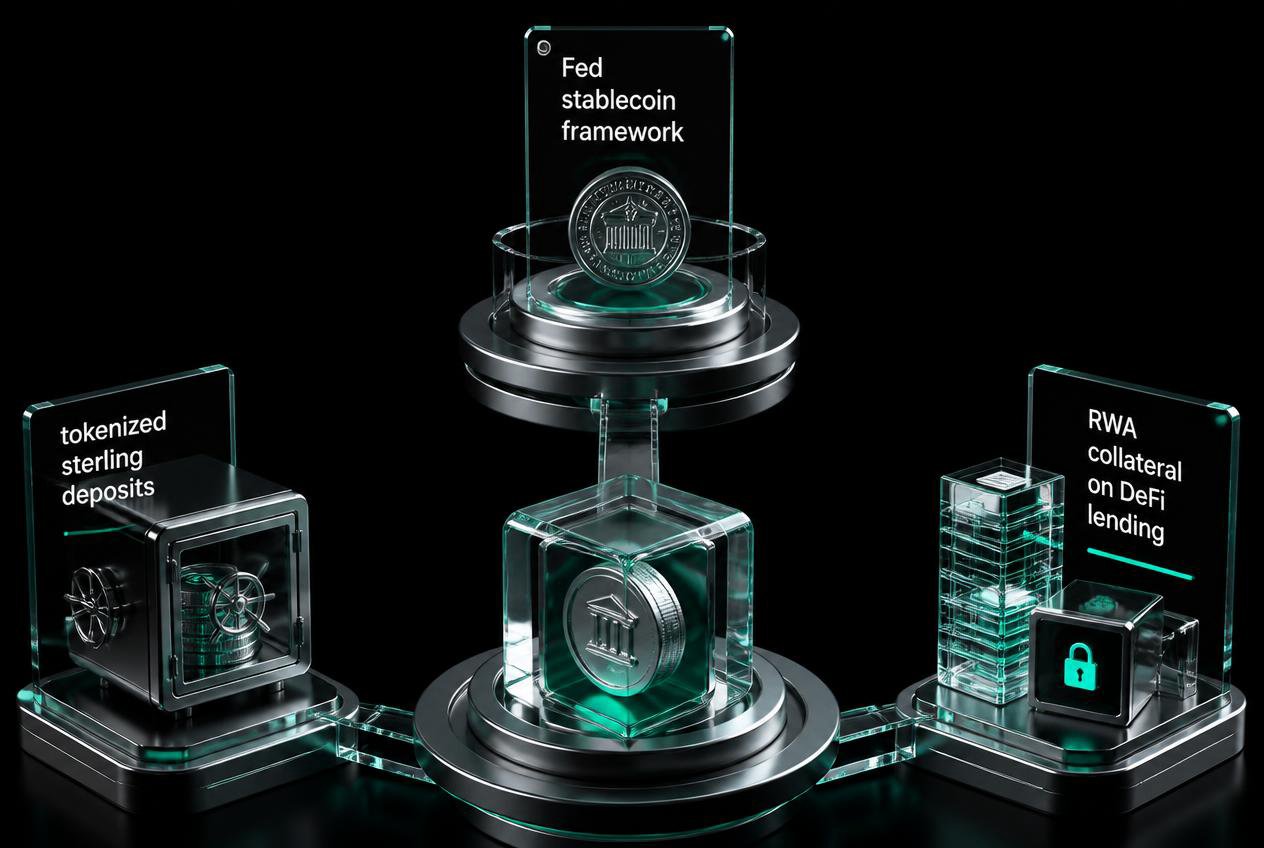
UK Banks Go Live With Tokenized Deposits; Fed Unveils Stablecoin Rules
On-Chain RWA Market Cap
$40.9B
▲ +4.24% MoM
RWA Asset Holders
4.75M
▲ +60.43% MoM
Stablecoin Market Cap
$306.2B
▲ +1.12% MoM
Cross-Border Stablecoin Flows (12m)
$220.3B
▲ +78% YoY · Crypto -37%
Seven UK Banks Complete the World’s First Live Interbank Tokenized-Sterling Deposit Transactions
Seven UK banks (Barclays, HSBC UK, Lloyds Banking Group, Monzo, Nationwide, NatWest and Santander) completed the first live customer transactions using tokenized sterling deposits that moved between separate institutions, under the Great British Tokenised Deposit (GBTD) initiative convened by UK Finance. The transactions ran on a platform built by Quant as shared UK industry infrastructure for tokenized commercial bank money, with EY handling project management and Linklaters drafting the legal framework and rulebooks. The first set included two remortgage completions, where funds were locked and released automatically at completion, and a consumer marketplace payment in which money was released only once the goods changed hands.
- The breakthrough is the word “interbank”: earlier trials kept money inside a single bank, while this run proved programmable commercial bank money can settle across firms
- A tokenized deposit remains a liability of the issuing bank and keeps deposit protection, sitting on a different regulatory balance sheet from a stablecoin
- In the remortgage case, locked funds kept earning interest in the customer’s own account until completion — something a stablecoin structure cannot offer, as the Fed the same week proposed a presumption against issuers paying holders even indirectly
- Next, the group will settle digital assets with tokenized customer money and plans to issue and settle three digital bonds by early 2027, with coupons paid in tokenized deposits
Payment Form
Conditional payments reach retail use: locking and auto-releasing funds cuts counterparty risk and manual checks
Regulatory Split
Tokenized deposits keep money inside the banking system, a structural difference from stablecoins that can pull funding out
Institutions Aligned
Quant supplies the platform, EY runs the project and Linklaters writes the rules, aligning banks, law firms and tech providers
Source: Scottish Financial News · PYMNTS · September 24, 2026
The Federal Reserve Proposes Its First Payment-Stablecoin Framework Under the GENIUS Act
The Federal Reserve proposed its first regulatory framework for payment stablecoins, implementing the GENIUS Act signed into law in July 2025. The proposal would require issuers to hold reserves sufficient to meet redemptions, limited to eligible assets such as short-dated Treasury bills, alongside capital and risk-management standards. A second proposal sets out application, hearing and appeal procedures for banks that want to issue through a subsidiary. Governor Michael Barr said a token deserves the name stablecoin only if holders can get par value back promptly under different market conditions, and the Fed sought comment on interest-rate and foreign-currency risk. Meanwhile, the CFTC moved on tokenization from the other direction, clarifying when tokenized versions of already-eligible investments can be used for customer funds and margin when legal equivalence holds. The two tracks now divide by function: the Fed defines dollar redemption, the CFTC governs assets on-chain.
- The Fed track: reserve composition, capital rules and risk management, with a 60-day comment period after Federal Register publication, plus a separate issuer-licensing process
- The CFTC track: futures commission merchants and clearing organizations may invest customer funds in tokenized government money market fund shares, but payment stablecoins remain excluded from permitted investments
- Blockchain records can satisfy CFTC recordkeeping duties, but firms must still retrieve and produce records even if the network is unavailable or inaccessible
- The industry group CCI has asked New York’s Department of Financial Services to pause its state-level stablecoin rule and wait for the federal framework to settle
Division of Labor
One agency asks what makes a dollar-linked token redeemable; the other asks when an already-permitted asset can move onto blockchain rails
Institutional Impact
Tokenized money market funds can count toward customer funds while stablecoins stay outside margin rules, making the boundary clear
Timeline
Neither proposal is final, and more work will follow as GENIUS Act implementation continues
Source: TheChainPost · Guavy · September 25, 2026
Bitwise Tokenizes Real-World Assets Through Ember Protocol as Collateral on Bluefin
Bitwise has tokenized real-world assets through Ember Protocol, enabling those tokenized assets to serve as collateral on the Bluefin lending platform. The move brings traditional asset classes into DeFi lending frameworks and is seen as a step toward institutional DeFi lending that goes beyond crypto-native assets. It lands amid rapid growth in RWA perpetual trading on decentralized exchanges: CryptoRank data shows RWA perpetual DEX volume reached $365 billion in Q3 2026 to date, up 32% quarter over quarter, with public equities generating about $175 billion, or nearly 48%. Monthly volume started 2026 at just $23.1 billion, peaked at a record $141 billion in July (up 513% from the start of the year) and eased 13.5% to $122 billion in August.
- Tokenized RWAs used as collateral connect the yield characteristics of traditional assets with on-chain borrowing demand
- RWA perpetuals are synthetic exposure rather than physical holdings: they offer leverage, shorting and trading outside conventional market hours
- Risks to watch include reliance on external price feeds, corporate actions and mismatches in trading-session timing
- Hyperliquid recorded about $210 billion in overall perpetual volume in August with a 38% share, and stock-linked contracts made up 67% of its HIP-3 volume, overtaking commodities
Collateral Evolution
The collateral set expands from crypto-native assets to tokenized RWAs, widening lending-market options
Demand Mix
Traders increasingly favor synthetic equity exposure, with equities rising from 36.4% to 51.1% of RWA perpetual volume
Risk Note
Synthetic structures depend on external price feeds; on-chain liquidity is not the deliverability of the underlying asset
Source: CoinAlertNews · CryptoRank · September 25, 2026
Mantle Passes 1,473 Tokenized Assets as On-Chain RWA Value Jumps 110% in 30 Days
Mantle announced back-to-back all-time highs on two core benchmarks: the total number of tokenized assets crossed 1,473, up from 71 at the start of the year, a more than twentyfold increase per Blockworks Research; and Distributed Asset Value for RWAs climbed to $476 million, a 110% increase over 30 days per RWA.xyz. Growth was driven by institutional-grade issuers including xStocks for tokenized equities and ETFs, Securitize for tokenized index funds, Ethena for yield-bearing stablecoins and Paxos for regulated dollar issuance via USDG, which connects Mantle to the Global Dollar Network and more than 150 partners. Milestones include the on-chain listing of tokenized SpaceX equity (SPCXx) alongside the SpaceX IPO and Franklin Templeton’s USPX ETF (USPXx), among the first tokenized ETFs from a top-tier asset manager on an Ethereum Layer 2.
- Mantle is the largest chain running ZK validity proofs on Ethereum, positioning itself around verifiable settlement and institutional-grade security
- Assets trade 24/7 through Fluxion’s hybrid AMM and Atomic RFQ and are reachable via both Bybit and on-chain venues
- Tokenized ETFs and a regulated stablecoin (USDG) sit on the same chain, combining “asset plus settlement” in one place
- Distributed Asset Value doubling in 30 days reflects both the scale of individual launches and deepening liquidity behind them
On-Chain Competition
An Ethereum L2 is using ZK proofs and institutional compliance to compete for RWA issuance share, shifting the contest to specialized distribution stacks
Issuer Ecosystem
Equities, index funds, yield-bearing stablecoins and a regulated dollar aggregate on one network, cutting cross-asset friction
Liquidity Design
Assets plug into yield products and DeFi integrations on landing, making “productive from day one” the default
Source: The Digital Track / PR Newswire · Cryptovka · September 25, 2026
Chainalysis: Cross-Border Stablecoin Flows Rose 78% to $220.3B Even as Crypto Shrank
Chainalysis data shows cross-border stablecoin flows rose about 78% to $220.3 billion in the year through June, even as total crypto market capitalization fell 37% to $2.1 trillion. Some 4,708 new cross-border corridors were identified, carrying $2.64 billion combined, though the largest corridors still accounted for 96.1% of total value. Chainalysis said much of the growth came from transfers averaging about $3,000, a pattern more consistent with trade settlement, remittances and savings than speculation. Tether economist Philip Gradwell described a “steady rhythm” typical of business use, while StraitsX CEO Tianwei Liu pointed to demand for dollar access, inflation protection and ways around capital controls.
- Stablecoin payment demand grew against a sharp crypto drawdown, clearly decoupling from the price cycle
- An average transfer size of about $3,000 points to genuine economic use rather than large speculative flows
- Corridors are highly concentrated: the largest account for 96.1% of value, while the long tail is numerous but small
- Adoption is accelerating alongside regulatory clarity — the U.S. GENIUS Act, the EU’s MiCA and Hong Kong’s licensing regime
Demand Character
Data confirms stablecoins’ payment and settlement role, with growth no longer dependent on rising crypto prices
Geography
Demand for dollar access and inflation hedges in emerging markets leads, while corridor concentration stays high
Infrastructure
As a settlement and collateral layer for RWAs, stablecoins’ real usage growth underpins the liquidity base for tokenized asset management
Source: FinWire · Chainalysis · September 25, 2026
发表回复