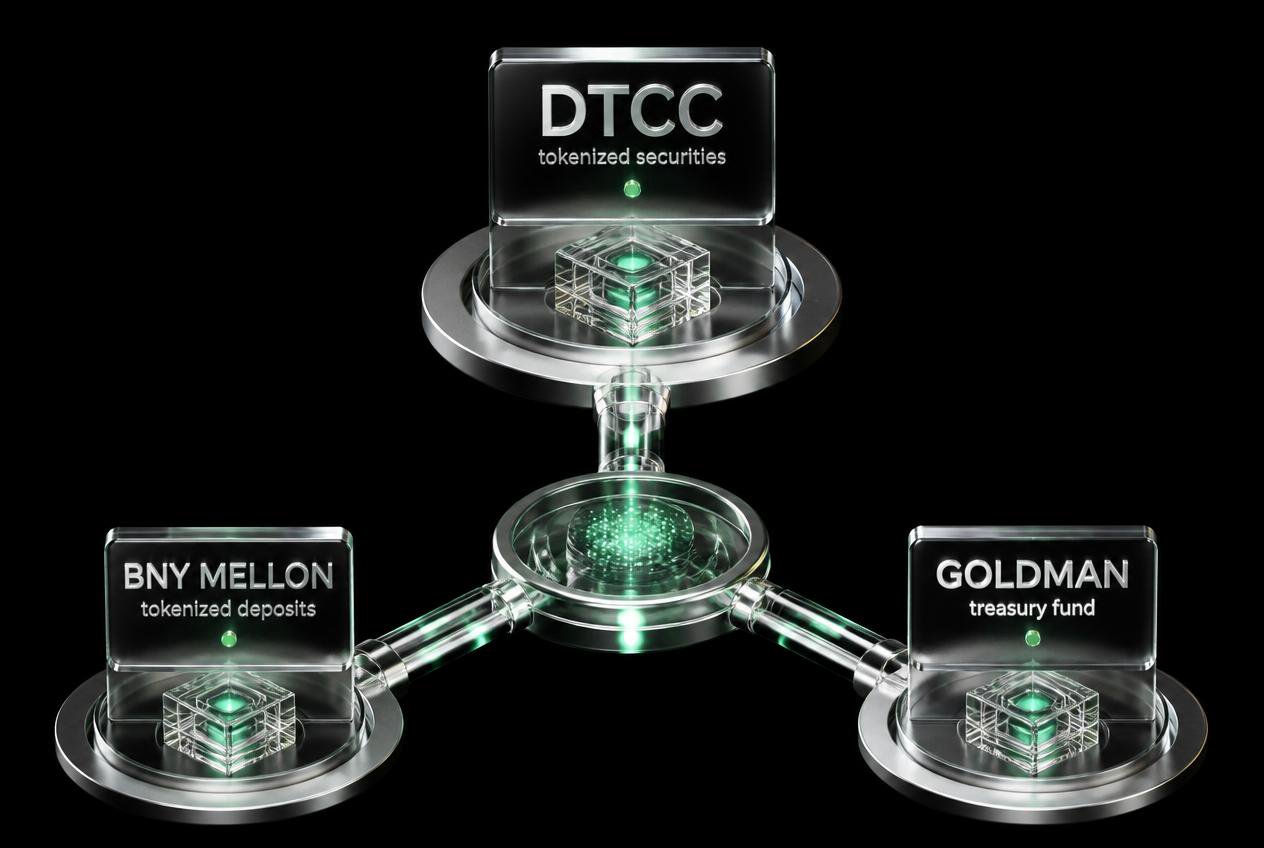
DTCC Tokenization Goes Live as Wall Street’s $114T Pipeline Moves On-Chain
DTCC Assets Under Custody
$114T
DTC-held · tokenizable
Tokenized RWA Market
$331.8B
Pantera · 671 assets
Tokenized Equity DEX 30D
$2.09B
Uniswap 60.1%
GS Treasury Fund AUM
$105B
FTIXX via Lynq
DTCC Tokenization Service Goes Fully Live This Month, Bringing Russell 1000, Major ETFs and US Treasuries On-Chain
DTCC, the clearing and settlement core of US capital markets, announced its tokenization service will move from pilot to full production in October 2026, bringing roughly $114 trillion of DTC-custodied assets into scope for on-chain representation. Coverage includes Russell 1000 constituents, ETFs tracking major indices, and US Treasury bills, notes and bonds. The service rests on a December 2025 SEC staff no-action letter (a three-year window from launch); DTCC completed its first real tokenized trades in a July 15 pilot with 50-plus institutions. This marks the first time America’s settlement layer has directly adopted blockchain rails.
- Covers the $114T DTC custody pool, with 50+ participants (BlackRock, Goldman, JPMorgan, Vanguard and more)
- Dual-chain approach: Canton Network and Hyperledger Besu for settlement, with Stellar set to join in H1 2027 as the first public chain
- Backed by an SEC no-action letter, a three-year window from launch that can be withdrawn at any time and does not renew automatically
- In the pilot, JPMorgan tokenized part of its Invesco QQQ holdings; Microsoft shares and Treasury ETFs moved on-chain through the clearinghouse for the first time
Industry Milestone
The clearinghouse itself moves on-chain, turning tokenization from edge experiment into core US market infrastructure
Settlement Efficiency
On-chain settlement approaches real time, freeing margin and collateral locked in the T+1 cycle
Reference Architecture
European and Asian clearing utilities will use this as the global template for tokenized settlement
Source: RWAToday · Tokenising Startups · September 30, 2026
BNY Mellon Launches Institutional Tokenized Deposits, Counting ICE, Citadel and Circle Among First Clients
BNY Mellon, the world’s largest custodian bank, has officially launched tokenized deposit services for institutional clients, creating digital representations of assets held at the institution on the blockchain. The service enables funds to be used as collateral in secured and margin transactions and supports 24/7 instant payments that bypass traditional fiat channel limits. First clients include Intercontinental Exchange (ICE), Citadel Securities, DRW Holdings, Ripple Prime, Baillie Gifford and Circle. Observers largely attribute US institutions’ interest to the GENIUS Act, which has fueled demand for compliant on-chain yield.
- Tokenized deposits are created within the existing banking system and can bear interest, unlike fiat-pegged stablecoins
- First clients span exchanges, market makers, proprietary trading and crypto-native firms across the full value chain
- Citi, HSBC, Standard Chartered and 14 other banks are simultaneously advancing Swift 24/7 cross-border tokenized-deposit pilots
Banking Signal
A custodian giant formally enters the space, moving institutional on-chain deposits from experiment to commercial product
Settlement Path
Tokenized deposits and stablecoins run on parallel tracks, accelerating bank-crypto convergence
Regulatory Driver
The GENIUS Act stablecoin framework gives banks a clear legal footing for on-chain products
Source: ForkLog · Bloomberg · October 1, 2026
Goldman Sachs Routes Its $105B Treasury Fund Into Lynq, Opening a Compliant Yield Channel for Crypto Institutions
Goldman Sachs is making its Financial Square Treasury Instruments Fund (FTIXX) available to qualified US participants through Lynq, a real-time settlement and treasury-management network for digital-asset institutions. The fund held approximately $105 billion in net assets at the end of August 2026; once integrated, crypto-native trading firms can park idle cash in an established US Treasury money market fund between transactions while retaining access to capital when needed. It is one of the first cases of an ultra-large money market fund opening directly to the crypto trading ecosystem.
- FTIXX holds roughly $105B in net assets, with institutional scale and maturity
- Lynq enables real-time settlement and treasury management that fits digital-asset institutions’ cash rhythm
- Alongside Circle and Swift on-chain deposit channels, it forms one of several routes for institutional “cash management on-chain”
Capital Efficiency
Idle crypto-institution cash shifts from zero yield to readily accessible Treasury returns
Product Complement
Traditional money market funds and on-chain tokenized Treasuries form parallel cash-management options
Institutional Reach
Ultra-large funds proactively connect to crypto rails, marking a further opening of the supply side
Source: MEXC · Goldman Sachs · September 30, 2026
Pantera Report: Tokenized Issuance Has Matured, But Compliant High-Liquidity Secondary Markets Remain the Core Bottleneck
Pantera Capital published its “State of Tokenization” report, tracking 671 tokenized assets with a combined market of $331.8 billion. The report finds that on-chain issuance has matured, but compliant, highly liquid secondary markets remain the industry’s core bottleneck: permissioned products account for 59% of sampled market value yet contribute just 0.2% of spot trading volume, while open-access products carry 41% of value and drive 99.8% of spot activity. Meanwhile, tokenized-equity DEX volume reached roughly $2.09 billion over the past 30 days, a liquidity milestone, with Uniswap contributing 60.1%.
- Tokenized US Treasuries grew from $13B to $16.5B (+$3.5B); private credit expanded from $4.1B to $5.1B
- Of 48 whitelisted products, 46 post monthly turnover below the 1% liquidity threshold; permissioning and KYC hard limits suppress secondary liquidity
- The maturity index TPI averages just 2.04, with most products still on-chain mirrors of off-chain assets and native on-chain capability lagging
- Issuance is no longer the challenge; accessibility determines spot trading, and liquidity varies sharply across assets
Industry Pain Point
The shift from “getting issued” to “turning over” makes secondary liquidity the key growth variable
Open Access
Open products carry 41% of value yet 99.8% of spot trading; accessibility is liquidity
Structural Read
The tokenized-equity secondary market is accelerating, moving on-chain trading from issuance toward active trading
Source: TechFlow Post · Pantera Capital · September 30, 2026
发表回复