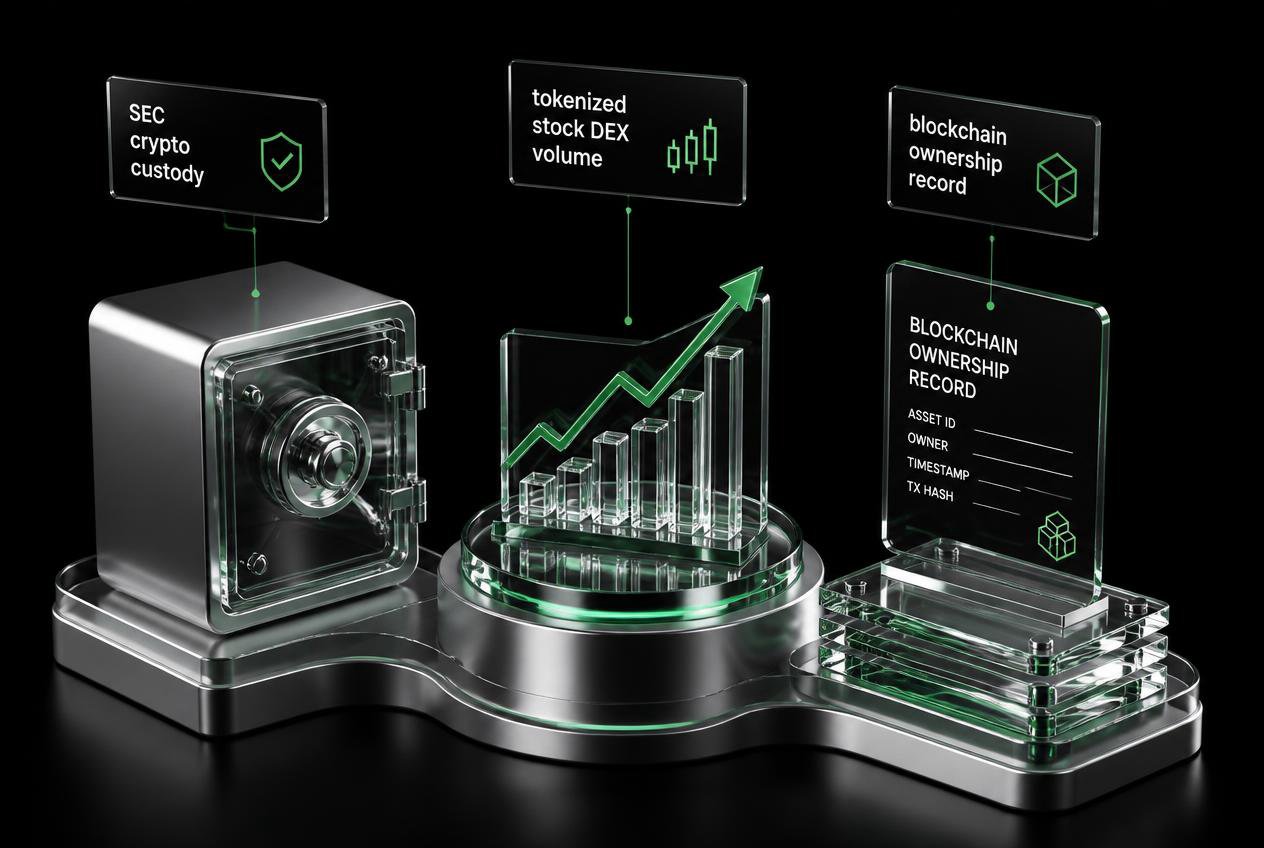
SEC Opens Custody Path as Tokenized-Stock Value Lags a Tenfold Volume Surge
Tokenized stock DEX volume
$48.7B
+10,163.7% (YoY)
Tokenized stock distributed value
$3.2B
Under 7% of volume
XRPL 30-day net inflows
$1.1B
Overtakes Ethereum
SEC custody proposal
760-page
60-day comment period
SEC Proposes 760-Page Crypto Custody Framework, Allowing Self-Custody and State Trust Custodians
On October 1, the U.S. Securities and Exchange Commission (SEC) released a 760-page crypto asset custody rule proposal, establishing a clear regulatory framework for registered investment advisers and regulated funds to custody crypto assets. The proposal would allow advisers to self-custody client assets when they meet specific conditions (possessing crypto-custody expertise and having no qualified third-party custodian available), and would permit state trust companies to serve as qualified custodians. SEC Chair Paul Atkins said the proposal provides advisers and funds with a compliant pathway where none existed before.
- Self-custody must be re-assessed quarterly and requires that advisers demonstrate crypto-custody expertise with no qualified third-party custodian available
- Current rules only permit banks or broker-dealers as qualified custodians, which fails to keep pace with rapid crypto asset innovation
- The proposal also modernizes decades-old custody rules under the Investment Advisers Act and Investment Company Act of 1940
Institutional significance
Custody is the biggest obstacle to large-scale digital asset allocation; a clear framework lowers the barrier to entry
Status
Enters a 60-day public comment period after Federal Register publication; a proposal, not yet a final rule
Direction
Continues the regulatory modernization theme, forming a system with tokenized securities and Reg Crypto proposals
SEC Proposes Blockchain as Official Ownership Record for Tokenized Stocks, Cutting Reconciliation and Legal Risk
The SEC proposed allowing electronic recordkeeping systems, including blockchain ledgers, to serve as the authoritative record of securities ownership. This would let an on-chain ledger act as the master securityholder file for tokenized stocks, reducing duplicate reconciliation and lowering legal and operational risk. The proposal does not remove transfer agents: the control book and transfer journal remain, and blockchain-based securities stay subject to existing securities laws. Industry voices stress that 1:1 backed is not the same as 1:1 ownership.
- Tokenized stocks currently carry two parallel records — an on-chain wallet ledger and an off-chain register held by a transfer agent — which can trigger ownership disputes in scenarios such as bankruptcy
- Transfer agents still maintain the control book and transfer journal; the change eliminates duplicate ownership registers, not all securities-administration databases
- Fairmint CEO notes investors must understand whether a token conveys direct legal ownership or economic exposure via an intermediary
Legal certainty
Establishing the blockchain as authoritative registry lowers reconciliation and ownership-dispute risk
Regulatory alignment
Advances in parallel with custody-rule revisions, expected at OIRA review within October
Industry focus
The distinction between 1:1 asset-backed and 1:1 ownership becomes a core disclosure issue
Tokenized-Stock DEX Volume Jumps Tenfold to $48.7B, but Distributed Value of Just $3.2B Flags Liquidity Risk
On-chain data shows tokenized-stock DEX volume reached $48.7B over the past year, up 10,163.7% year over year, with Uniswap leading at $17.1B. Yet the actual distributed value of tokenized stocks (issued and allocated tokens in circulation) stood at just $3.2B — under 7% of trading volume. Binance Research’s broader on-chain equities measure was $4.43B, still only 0.0029% of the estimated $151.9 trillion global listed-equity market. The volume-to-value gap is raising questions about liquidity and speculation.
- A single asset, QQQb, accounts for 28.9% of DEX volume; ETF-linked products capture 44.0% of volume by reference stock — trading is highly concentrated
- Equity perpetuals on Hyperliquid and Lighter totaled about $67.8B in June, roughly 16,000x the $4.2M in tokenized-equity spot trades
- Token Terminal counts 4.3 million tokenized-stock owners, about 43x last year, though these are addresses, not verified individuals
Structural risk
Trading activity far exceeds real supply, with high turnover driven by a few assets while most trade thinly
Institutional view
Shallow spot markets mean large institutional orders risk slippage or adverse price moves
Long-term scope
Citi’s base case sees a $5.5T tokenized-asset market by 2030; moving 10% of U.S. retail could create about $2.6T in demand
Sources: CryptoCoinShow · CoinAlert · October 3, 2026
XRP Ledger Posts $1.1B in 30-Day Net Inflows, Overtaking Ethereum as Capital Rotates to Settlement Networks
RWA.xyz data shows the XRP Ledger led all major blockchains (excluding stablecoins) with roughly $1.1B in net capital inflows over the past 30 days, overtaking Ethereum’s about $879M. Stellar posted $643M and BNB Chain $539M over the same period, while Solana saw -$111M, Base -$101M, Mantle -$25M and Arbitrum -$19M in outflows. Analysts see the inflows as driven by real use cases such as payments, tokenization and settlement rather than short-term speculation.
- About $333M in U.S. Treasury debt has already been tokenized on the XRP Ledger, an early signal of adoption in a traditionally conservative market
- Ripple’s cross-border payments push positions XRPL as a near-instant, infrastructure-grade alternative to SWIFT
- The flow divergence confirms an ongoing capital reallocation cycle, with the XRPL ecosystem gaining relevance in digital finance
Cross-chain competition
XRPL shifts from a payments chain toward a settlement-plus-RWA hub, overtaking Ethereum as a capital magnet
Institutional signal
Tokenized Treasuries landing on-chain signal institutional acceptance of XRPL as a credible deployment environment
Flow divergence
Outflows from Solana and Base show capital concentrating toward networks focused on settlement and payments
Sources: BitcoinEthereumNews · CoinPaper · October 3, 2026
发表回复