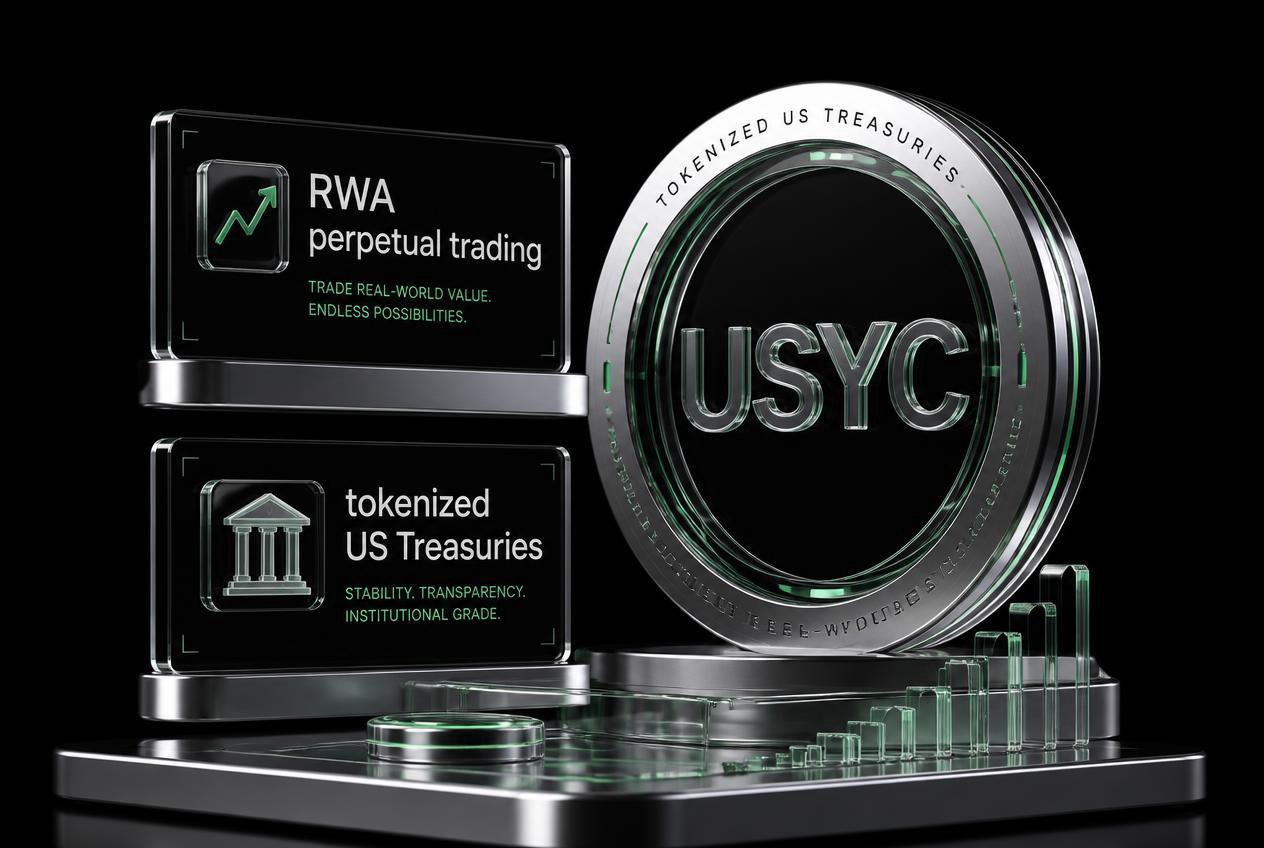
RWA Perps Overtake Crypto-Native Trading as Tokenized Treasuries Cross $10.8B
RWA perps share of Hyperliquid weekly volume
52%
First time above crypto-native · $25.1B in Q3
Tokenized US Treasuries market cap
$10.8B+
Over $1B added YTD
USYC tokenized Treasury fund size
$2.41B
Now the largest single fund
Hyperliquid cumulative protocol revenue
$1.4B
$1.26B used to buy back HYPE
Hyperliquid RWA Perps Hit 52% of Weekly Volume, Overtaking Crypto-Native Trading for the First Time
RWA perpetual contracts reached 52% of weekly trading volume on Hyperliquid, overtaking crypto-native trading for the first time and becoming the dominant use case on decentralized exchanges. Onchain data shows RWA perps recorded $25.1B in Q3 2026, with roughly $1B traded per day. Meanwhile, Hyperliquid’s cumulative protocol revenue topped $1.4B, with over $1.26B used to buy back HYPE on the open market, giving the platform more than 56% of onchain perp market share by open interest.
- Traders are betting on real-world asset prices through DEXs without holding the underlying assets, revealing far larger demand for leveraged RWA exposure than previously assumed
- 95% of protocol fees fund HYPE buybacks; about 47.9M tokens (14.4% of circulating supply) now sit in the Assistance Fund, with open interest at a record $9B
- The Builder Codes mechanism lets third-party wallets plug into the venue: Phantom has earned over $25M and MetaMask over $10.5M
- Papertrade launched a HyperEVM perps venue with up to 1000x leverage ($85.3M in deposits), starting to fragment the competitive field
Market Impact
RWA perps overtaking crypto-native trading signals real-asset price discovery migrating to onchain DEXs
Structural Trend
Leveraged RWA exposure without ownership is now a standalone paradigm alongside spot tokenization
Risk Note
High-leverage entrants (Papertrade 1000x) plus $1.29B weekly ETF outflows add near-term volatility
Tokenized US Treasuries Cross $10.8B as Circle USYC Becomes the Largest Single Fund
The tokenized US Treasury market crossed $10.8B in total market capitalization, adding more than $1B this year. Circle’s USYC reached $2.41B to become the largest single tokenized Treasury fund, edging past Ondo’s USDY ($2.3B) and BlackRock’s BUIDL ($2.25B). Token Terminal data shows the broader tokenized fund market has grown to $35.1B (11.7x in three years), with Treasury funds up 47x to $13.9B — yet only 8.9% of tokenized fund capital sits in DeFi protocols.
- USYC represents shares in the Hashnote International Short Duration Fund, combining US Treasury bills with reverse repos backed by short-term government securities, deployed on Ethereum, Solana and BNB Chain
- RWA.xyz puts tokenized Treasury-fund distributed value at $14.95B (Oct 9) across 109 assets and 86,210 holders, with sector 7-day APY near 3.62%
- US Treasury funds have just 0.4% of capital in DeFi ($58.6M); approved-wallet transfer restrictions limit compatibility with permissionless protocols
- Ethena’s sUSDe drives 40% of tokenized-fund DEX volume ($5.65B), with yield and credit products dominating onchain activity
Market Impact
USYC’s stablecoin distribution network wins the top spot, showing deep-chain deployment matters more than brand alone
Structural Trend
Tokenized funds are 35x larger than three years ago, but DeFi adoption stays low — issuance and liquidity remain two gates
Institutional Signal
BlackRock pitched fund shares as instant onchain collateral at TOKEN2049, extending Treasury use toward the collateral layer
Sources: TokenPost · Coinspress · October 9-10, 2026
DTCC Goes Commercial With Tokenized US Treasuries in October, Running Canton and Besu Chains in Parallel
DTCC entered commercial operation on its tokenization platform in October 2026, launching with US Treasury securities on a dual-chain architecture spanning Canton Network and LFDT Besu. As the settlement backbone for most of the US securities market, DTCC’s shift from pilot to production forces every custodian, broker and asset manager to decide how and when to connect. Around the same time, Nasdaq CEO Adena Friedman said at TOKEN2049 that tokenizing Treasuries, equities and money market funds could unlock “tens of billions of dollars” in capital currently trapped as collateral.
- The platform covers DTC-custodied assets (Russell 1000 constituents, major ETFs, US Treasuries) under a December 2025 SEC no-action letter valid for three years
- BlackRock has filed for two new tokenized money market funds (one Ethereum-native, one multi-chain), echoing the DTCC launch
- Friedman said retail investors are about ten years ahead of institutions in wanting 24/7 trading, with AI digital agents handling continuous risk management
- The GENIUS Act gives the settlement layer under tokenized assets a working stablecoin regulatory benchmark
Market Impact
DTCC’s commercial launch draws a tokenization roadmap for US markets, making chain selection an industry dividing line
Structural Trend
From pilot to production, custody, settlement and collateral enter an engineering phase
Institutional Signal
A Nasdaq CEO publicly sizing tokenization’s trapped-capital opportunity marks a first for exchange operators
Sources: FinanceX · GetFinanceBrief · Early October 2026
CFTC Opens Crypto Market Structure Rulemaking as the SEC Advances Its Parallel Framework
On October 5, the CFTC released an Advance Notice of Proposed Rulemaking covering Regulation CTX (crypto asset transactions) and Regulation CAM (crypto asset markets), seeking comment on a federal framework for retail crypto commodity trading and baking in FTX-era lessons on customer fund segregation and proof of reserves. Meanwhile, the SEC’s Regulation Crypto Assets proposal heads into its final comment stretch before the October 20 deadline, running alongside the temporary exemption for tokenized securities venues issued in September.
- The CFTC framework is opt-in: exchanges may choose a unified federal regime, with on-exchange requirements applying only to retail leverage/margin trades (including fully paid positions until actual delivery)
- The CLARITY Act is effectively stalled after a 49-50 Senate defeat, leaving rulemaking and exemptive action as the near-term path
- The SEC proposal includes two registration exemptions (startups up to $5M over four years; broad raises up to $75M per 12 months) plus a conditional safe harbor for token classification
- The SEC also proposed crypto custody rules on October 1, allowing advisers and funds to self-custody and to use state trust companies as qualified custodians
Market Impact
A dual-track regime fills the legislative vacuum, giving tokenized securities and crypto markets a clear federal path
Structural Trend
CFTC handles markets by function while the SEC oversees issuance and custody, clarifying institutional participation
Risk Note
Both frameworks remain in consultation; compliance costs stay uncertain until final rules land
Sources: Mondaq · Coinalertnews · October 5-8, 2026
Institutional Settlement Stack Goes Live in One Week: Ripple Joins Canton, Chainlink Expands Vaults Across 80+ Chains
Institutional-grade RWA infrastructure landed within a single week: Ripple Custody integrated the Canton Network, XRPL activated PermissionDelegation for delegated institutional account management, and Chainlink launched CCIP Vault Adapters supporting 80+ chains. Together these upgrades let institutions custody permissioned assets, delegate compliance roles and deposit into vaults across chains within days, consolidating previously fragmented processes into standardized rails.
- Ripple Custody x Canton lets institutions hold tokenized assets on a permissioned network, echoing DTCC’s settlement-chain choice
- Chainlink CCIP 2.0 went live September 28, letting institutions distribute tokenized assets across blockchains via a single integration with their own compliance frameworks
- Ondo Finance expanded into pre-IPO equity tokenization (combined TVL over $3.7B), and Hedera launched its own tokenized stock product
- Custody, settlement, cross-chain interoperability and regulatory delegation all matured within the same week
Market Impact
The institutional RWA stack is no longer experimental — custody, settlement and interoperability mature together
Structural Trend
Connecting private networks (Canton) with public rails (CCIP across 80+ chains) is the next infrastructure phase
Institutional Signal
Ripple, Chainlink, Ondo and Hedera all double down; secondary-market liquidity is the next test
发表回复