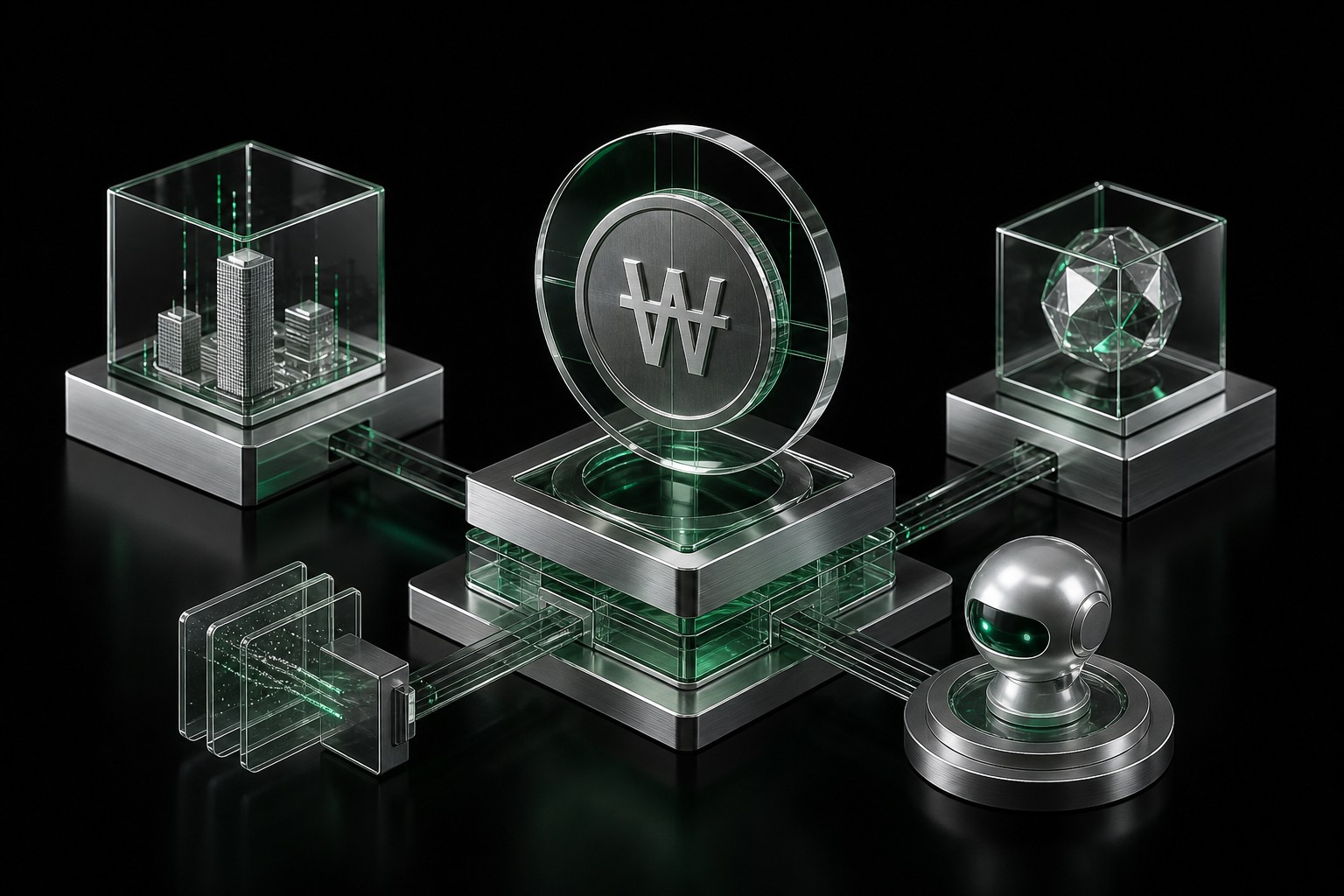
Korea’s KRW1 Stablecoin Enters Injective RWA Settlement, Testing a Rebound
Korea moves its home currency into the onchain settlement layer: KRW1 becomes the exclusive won settlement asset for Injective RWAs, while the legislative window and corporate account opening remain the real watersheds.
On October 20, Injective signed a memorandum of understanding with South Korean digital asset custodian BDACS, designating KRW1, a Korean won-backed stablecoin, as the exclusive won settlement asset for RWA and tokenization activity on the Injective network. Institutions can now trade and settle tokenized assets directly in Korean won without converting into dollar stablecoins first. The same week, KOSDAQ-listed Square Tech signed an MOU with GOAT Network to explore AI-agent stablecoin payments in Korea, while two SBI subsidiaries reached an agreement with South Korea’s Shinhan Card to test stablecoin cross-border payments.
Three events in the same week point in one direction: Korea is building a financial rail onchain that is independent of the dollar, from the local settlement layer to the AI-agent payment application layer.
1. Why It Matters: Money Is Leaving While the Rules Lag
The global stablecoin market hit a record $322 billion in May, and Citi projects $1.9 trillion by 2030, but more than 98% of it is dollar-denominated. Korea is the absent player in this market: since January 2025, the five major exchanges have posted 18 consecutive months of net stablecoin outflows, totaling roughly $10.4 billion to offshore platforms. Chosun estimates the global stablecoin market at about KRW 440 trillion, while Korean companies can neither open accounts for trading nor access a won stablecoin, forcing them to route payments through subsidiaries in Hong Kong and Japan.
One Hanyang University professor calculated that Samsung Electronics alone could save up to KRW 147.5 billion a year on internal remittances by using stablecoins. Demand is real; supply is blocked by regulation.
2. The State of Play: KRW1 Moves From Cross-Chain Skeleton to Settlement Scenarios
KRW1 is issued by BDACS, fully backed 1:1 by Korean won held in escrow at Woori Bank, with reserves verified in real time through banking APIs instead of quarterly attestations. It completed a proof-of-concept on Avalanche in September 2025, then expanded to Ethereum and BNB Chain via LayerZero’s OFT standard, building the cross-chain skeleton first. Today it lands its first RWA settlement scenario on Injective. As of October 20, KRW1 onchain supply stood at approximately 13.67 million tokens; minting and redemption are limited to approved institutional partners and remain subject to regulatory approval.
Injective is a fitting home for this rail: it has processed more than $7.5 billion in RWA volume with over $1 billion in tokenized assets issued; in July, POSCO International and LG CNS selected it to issue, transfer and settle trade receivables tied to international commerce; and Injective Institutional Services is an SEC-registered transfer agent.
3. Why the Local Settlement Layer Is the Unavoidable Step
4. Investment View: The Catalyst List Matters More Than Current Scale
INJ rose about 5.4% to $8.96 on the day KRW1 landed on Injective, with the market reading the partnership as a structural positive rather than a one-off event. The catalyst list ahead is clear: the Digital Asset Basic Act draft moving to National Assembly debate in November; the roughly 3,500 approved corporate virtual-asset accounts actually opening; and KRW1 spreading to more onchain trading scenarios beyond Injective. For onchain financial infrastructure assets, legislative rhythm and account-opening progress matter more for valuation than today’s 13.67 million token supply.
5. User View: Tourist Payments Are Korea’s First AI-Agent Scene
The foreign tourist stablecoin project developed by Square Tech with Lordsystem embeds AI-agent payments in a concrete scenario: visitors complete identity verification with a mobile passport, and an AI agent finds merchants, calls payment rails and settles on their behalf in dollar stablecoins. GOAT Network demonstrated an interactive AI-agent shopping experience at Korea Blockchain Week in Seoul. For ordinary users, the first step of this technology is not abstract digital assets but a phone passport making payment feel seamless.
The bigger variable sits at the enterprise side. Allium data shows stablecoin payment and settlement volume between Korea-linked companies reached $620 million from 2021 through September this year, and that is before corporate accounts opened. Once that gate opens, stablecoins turn from a trading tool into a corporate cash pipeline, and AI agents qualify to enter corporate payment-decision chains.
6. Conclusion: What Won Onchain Lacks Is Rules, Not Technology
KRW1’s technical path is already proven: Woori Bank escrowed reserves, real-time API verification, LayerZero cross-chain, Injective RWA settlement. What holds back Korea’s onchain finance is not infrastructure but two gates: the Digital Asset Basic Act and corporate account opening. For practitioners, two timings are worth tracking: whether the draft reaches the National Assembly in November, and when the approved corporate accounts actually open. Eighteen months of stablecoin outflows say demand has not disappeared; it is waiting for a local rail.
- Injective – Collaborates with BDACS to Bring Korea’s First Won-Backed Stablecoin to Onchain RWAs
- Crypto Briefing – Injective brings Korean won settlement to tokenized asset markets with BDACS
- BlockBeats – Injective partners with BDACS to bring KRW1 into RWA market settlement
- Foresight News – Square Tech and GOAT Network sign MOU to advance Korean AI-agent stablecoin payments
- Chosun – South Korea Lags in 440 Trillion Won Stablecoin Market Amid Delays
- DigitalToday – FSS says digital asset integrated supervision framework to be set up
- World Payments Monitor – South Korea Payments Regulation Monitor
- TechFlow – SBI subsidiaries sign MOU with Shinhan Card for stablecoin cross-border payments
发表回复