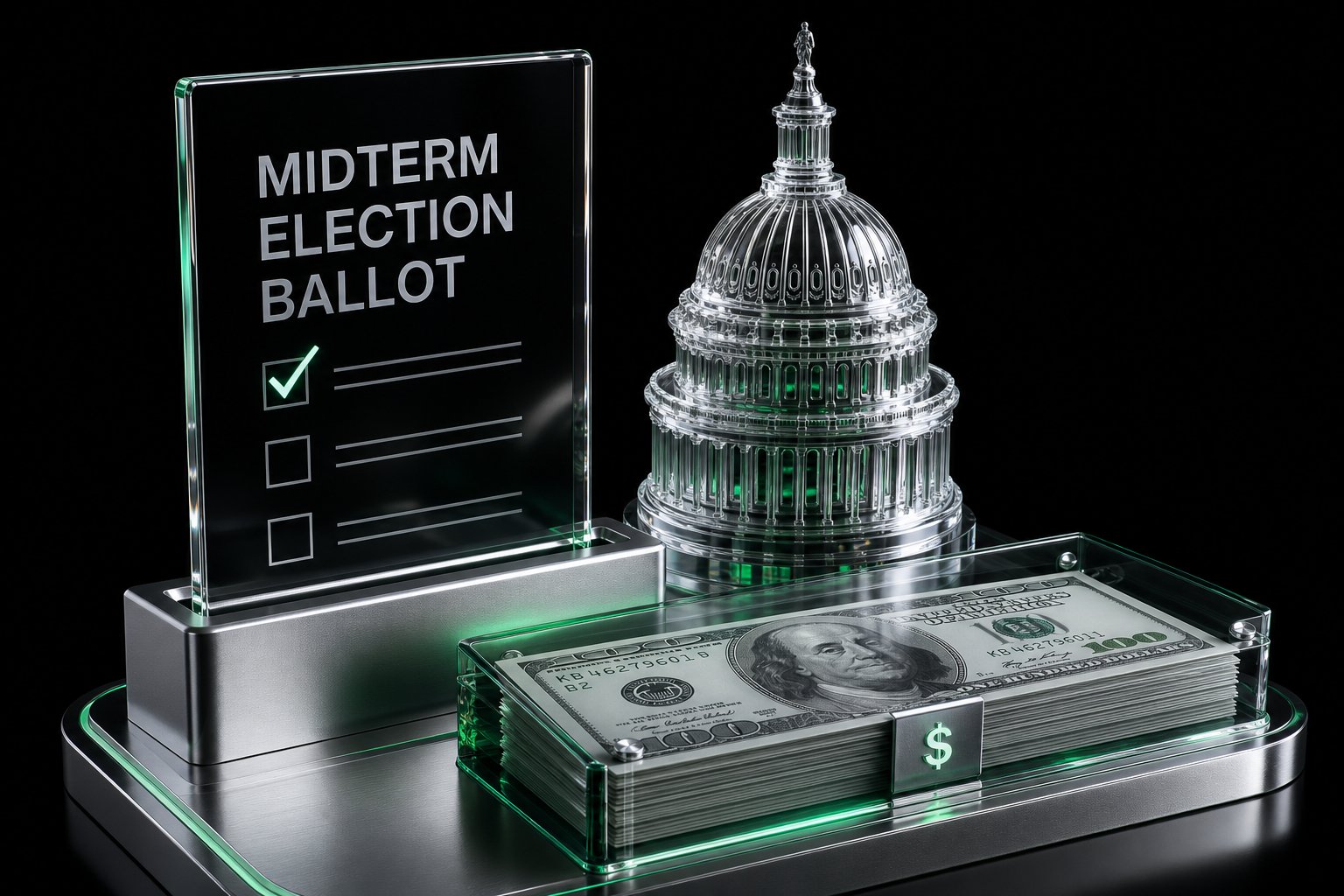
A $200 Million Bet on Congress: The Crypto Industry Faces Its Midterm Test
On November 3, American voters will decide all 435 House seats and 35 Senate seats. The crypto industry has poured more than $200 million into the campaign, the largest single-issue super PAC effort in history. At stake is the fate of the CLARITY Act, and whether agency rules can be made permanent by the next Congress.
Key Takeaways
The November 3 US midterms see the crypto industry deploy more than $200 million in political spending, the largest single-issue super PAC cohort in history, with Fairshake and its affiliates spending roughly $154 million and the Ohio race alone drawing about $63 million. The CLARITY Act failed 49-50 in the Senate on September 15, and Tillis has filed a motion to reconsider, leaving a 61-day window in the 119th Congress. The 60-vote Senate threshold does not change regardless of the election outcome; even all 53 Republicans fall seven votes short. Agency rules from the SEC and CFTC can be issued, but the next administration can reverse them. Other major financial centers, including the UK FCA, the EU under MiCA, Japan and Hong Kong, China, have already written their rules into law; only the United States still depends on the administrative path and an election gamble to shape the next five years.
The Largest Single-Issue PAC in History: $200 Million on Congress
On November 3, American voters decide all 435 House seats and 35 Senate seats. For the crypto industry, this is more than an election; it is the biggest test yet of its influence in Washington. According to Public Citizen, crypto-affiliated organizations have donated more than $200 million in this election cycle, outspending online betting and data center development groups, making them the largest single-issue super PAC cohort in US history. The industry is trying to repeat its 2024 playbook, when super PACs spent $250 million to help elect pro-crypto lawmakers and reshape the balance of power in Congress.
Fairshake and its affiliated super PACs remain the main force, spending about $154 million this cycle and keeping $56 million for the next election. It backs 33 House candidates, including 19 Republicans and 14 Democrats, and has directed at least $1 million each to six incumbents in both parties. Coinbase contributed $79 million to federal races in 2024 and donated $25 million to Fairshake’s midterm efforts in 2025; Ripple gave $25 million as well. Coinbase co-founder Brian Armstrong personally donated $1 million to Fairshake in 2023. The industry frames the spending as bipartisan, aimed at electing crypto-friendly candidates rather than betting on a single party.
The investment is not without results to point to. Ripple Chief Legal Officer Stu Alderoty told CNBC, “I think compared to where the industry was two years ago to where the industry is today, yes, I would say that that is a very good return.” He cited the GENIUS Act, signed by President Trump in July 2025 as America’s first standalone crypto law, establishing a federal framework for dollar-pegged stablecoins. He also noted Ripple’s final OCC approval this week for Ripple National Trust Bank. But Alderoty acknowledged that agency guidance is not a substitute for congressional legislation, and the window for new laws is closing. Former New York governor Andrew Cuomo, now an OKX board member, put it bluntly: if Congress changes hands in January, “you’re going to have a Democratic Congress overseeing an administration, the Trump administration, where the regulators are making decisions under the scrutiny of a hostile Congress, and that is not a good place to be.”
Ohio: A $63 Million Fight for One Seat
The most-watched battleground is Ohio’s Senate seat, pitting Democratic nominee and former Senator Sherrod Brown against crypto-friendly Republican incumbent Jon Husted. Brown has long criticized the crypto industry, chaired the Senate Banking Committee, and in 2024 pushed tougher crypto regulation while stalling the House-passed market structure bill. Fairshake spent about $40 million to defeat him in 2024 and has poured $55 million into opposing his return this cycle. Adding about $7.2 million from the Winklevoss-backed Digital Freedom Fund, the industry has spent roughly $63 million in the state, more than $100 million over two years.
Polls show Brown with a narrow four-point lead over Husted, within the 4.5-point margin of error. Prediction market Kalshi gives Brown a 68% win probability and also prices a 68% chance that Democrats retake the Senate. If Democrats take the chamber, Brown could chair the Agriculture Committee and Elizabeth Warren could lead the Banking Committee, both key gateways for crypto market structure legislation. In 2024, defeating Brown was Fairshake’s highest-profile win; this year it is spending even more to repeat the result.
The CLARITY Act: A 61-Day Window and a 60-Vote Threshold
The election outcome will directly shape the fate of the CLARITY Act. The market structure bill, which would define the regulatory boundary for digital commodities and split jurisdiction between the SEC and the CFTC, failed on a 49-50 procedural vote in the Senate on September 15, falling short of the 60-vote cloture threshold. Republicans hold 53 seats, so even a unanimous vote falls seven short; the House passed the bill 294-134 on July 17, 2025, but no Democrat in the Senate voted to proceed. The bill is not formally dead. Senator Thom Tillis has filed a motion to reconsider, allowing leadership to call another vote. But the 119th Congress ends at noon on January 3, 2027, leaving a 61-day window after election day, with Thanksgiving and Christmas inside it.
The two disputes that stalled the bill have nothing to do with the technology: ethics provisions addressing federal officials’ personal crypto holdings, and stablecoin yield language that regional banks argue would accelerate deposit outflows. Four law enforcement organizations, representing more than 70,000 members, also wrote to the White House in June expressing concern about regulatory gaps for mixers, Tornado Cash and DeFi under the BRCA exemption. These disagreements are political, not technical. If the bill does not advance by year-end, the next Congress will have to restart market structure legislation from scratch, beginning again with a House vote.
— Scott Bessent, US Treasury Secretary, at Ripple’s Swell conference, October 27, 2026
How Far Can the Administrative Path Go: Rules Can Be Rewritten, Only Law Lasts
With legislation stalled, the agencies are stepping in. Treasury Secretary Scott Bessent said at Ripple’s Swell conference on October 27 that Treasury has “broad convening powers” and will push the SEC and CFTC to close the gaps through regulation. CFTC Chairman Michael Selig said in August that the agency would write crypto rules if the bill died, and that is the path Treasury now backs. The SEC’s Regulation Crypto Assets (proposed in August, comment period closed October 20) and the CFTC’s Regulation CTX/CAM (ANPR published in the Federal Register in October, comments due mid-December) are both moving forward.
But the fragility of the administrative path is structural. JPMorgan analysts warn that without a statute, agency rules made under the Trump administration can be reversed by the next one. 21Shares notes that the SEC’s existing interpretive and exemptive positions rest on existing statutory authority rather than new legislation, so a change in congressional control will not automatically undo them; the real threat is a change in the Commission’s own composition, which depends on the timing of appointments and resignations, not the midterms. Adrian Wall of the Digital Sovereignty Alliance wrote in The National Interest that a framework signed by three officials at the SEC and CFTC is only a “draft” that successors can rewrite, and only an act of Congress can make it permanent. More practically, the CFTC cannot force spot platforms to register without new legislation, nor can it amend the bankruptcy code to put customers first in line when a platform fails, the protection FTX customers lacked in 2022.
Global Comparison: Others Wrote It Into Law, America Is Still Betting on an Election
While the United States stakes its crypto rules on an election outcome, other major financial centers have already written theirs into law. The UK’s FCA opened its authorization gateway for crypto firms on September 30, with applications due by February 28 and the full regime taking effect in October 2027. The EU’s ESMA told licensed firms on October 8 to stop servicing stablecoins that do not comply with MiCA, with a final deadline of January 8. Japan has enacted a law moving crypto assets under its Financial Instruments and Exchange Act, effective in 2027. Hong Kong, China has issued its first stablecoin licenses to some of Asia’s largest banks. Each regime comes with dates a company can plan around.
By contrast, America’s key dates are either still open for comment or shift with each administration. The OCC finalized the first GENIUS Act rule on October 21, effective January 18, 2027, but the Fed’s proposal remains open for comment until November 30, and Treasury’s Section 3 rule is still in progress; SEC and CFTC rules can both be rewritten by the next commission. A company choosing where to build over the next decade is weighing those fixed timelines against American proposals that are still open for comment and could change with the next administration. The election outcome will decide whether the United States can close this gap.
Key Takeaways for Industry Professionals
Sources
- 1. Crypto industry pours more than $200 million into 2026 midterms to pressure Congress on favorable rules — CNBC, October 31, 2026
- 2. CLARITY Act crypto bill: 11 votes short before midterms — IntoKened, October 29, 2026
- 3. What the 2026 US midterms change for digital asset regulation — 21Shares, October 2026
- 4. Only Congress Can Make America’s New Crypto Rules Last — The National Interest, October 2026
- 5. 2026 US Midterm Elections Results Could Shift Crypto Market Outlook and US Digital Asset Policies — Coin Edition, October 2026
- 6. The crypto industry has invested over $200 million in positioning for the 2026 midterm elections — BlockBeats, October 31, 2026
- 7. How Crypto Platforms Are Adapting to New US Regulations — TalkMarkets, October 2026
- 8. Bitcoin and the US Midterms: A Trader’s Checklist for Nov. 3-11 — WEEX, November 2, 2026
发表回复