USDC Is the EU’s First Significant Stablecoin as Circle Lobbies to Rewrite Rules
The EBA has activated MiCA’s “significant e-money token” classification for the first time, placing USDC under dual supervision from November 12, while Circle simultaneously lobbies the European Commission to rewrite reserve rules, pushing European stablecoin regulation into a rulemaking battle.
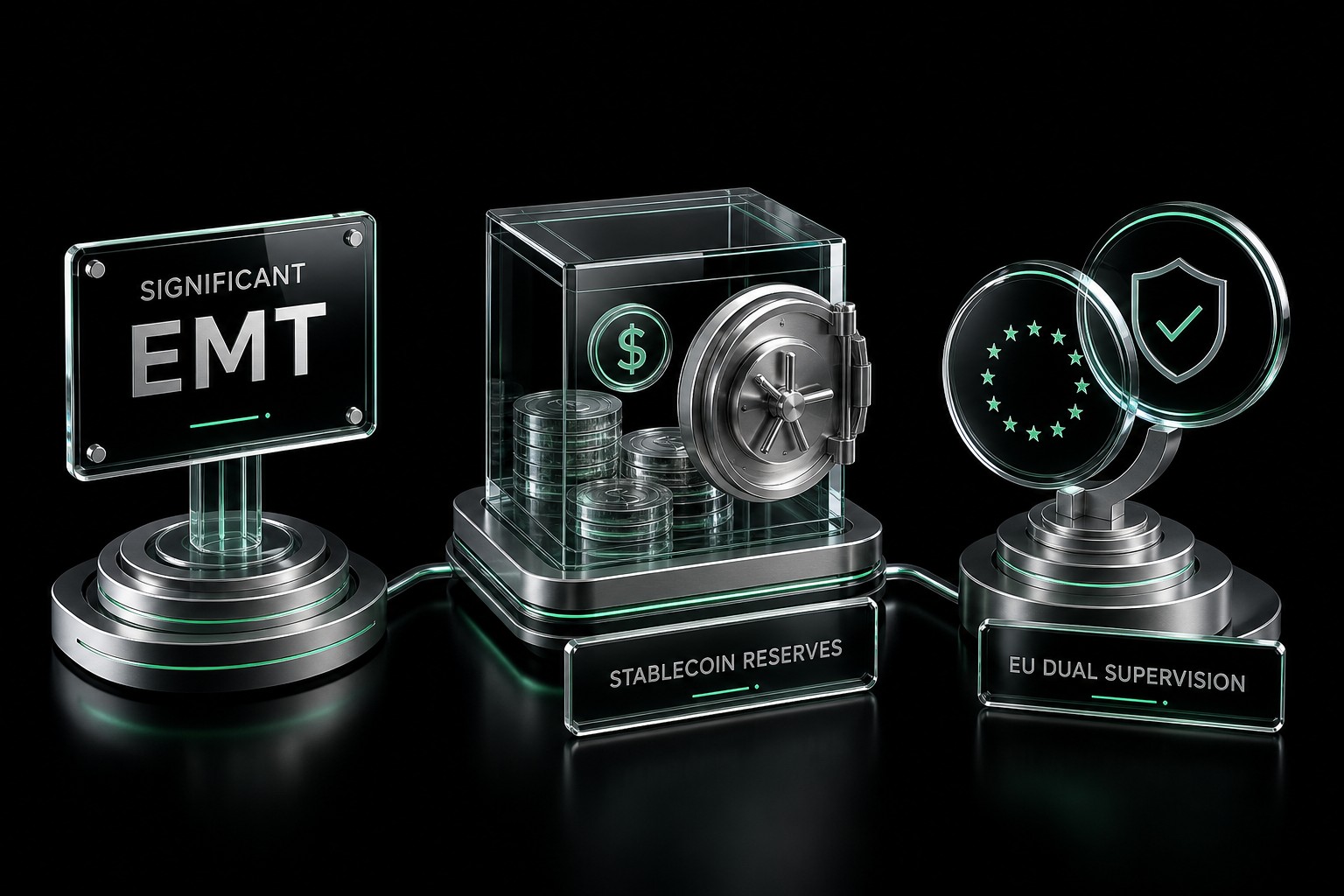
On October 14, the European Banking Authority (EBA) designated Circle’s USDC as the European Union’s first “significant e-money token.” Of the 45 e-money tokens notified under MiCA across the EU, only USDC entered this higher supervisory tier. From November 12, direct supervision of USDC’s reserve assets, own funds, liquidity requirements, and recovery and redemption plans moves to the EBA, while France’s Autorité de Contrôle Prudentiel et de Résolution (ACPR) retains governance, qualifying holdings, fit-and-proper assessments, and conflicts-of-interest oversight.
In the same window, Circle filed objections to the European Commission’s MiCA review consultation demanding a rewrite of reserve rules, while ESMA set a wind-down countdown for non-compliant stablecoins. Three threads point to the same conclusion: Europe is reclassifying stablecoins from “crypto products” into “financial infrastructure.”
1. The EBA Puts a “Significant” Label on USDC
The “significant” classification follows the significance indicators in Articles 43 and 56 of MiCA, though the EBA did not disclose which indicators were triggered. The status is not a permanent title: it is reassessed annually and can be withdrawn if the token no longer meets the criteria. For Circle, the label adds obligations rather than exemptions: significant e-money tokens must hold at least 60% of reserves in credit-institution deposits, versus 30% for standard e-money tokens.
To accommodate the cross-border issuance structure, the EBA signed a memorandum of understanding with the New York State Department of Financial Services (NYDFS), covering quarterly exchanges of reserve-asset, holder-structure, group-structure, and trading-volume data, plus coordinated on-site inspections and crisis coordination. The MoU was signed in late April and May and announced in June, but the document explicitly states it is not legally binding and never names Circle or USDC. It is a supervisory information corridor, not a joint enforcement mechanism. For EU distributors, the handover of supervisory power adds no direct obligations, but the issuer’s semiannual independent audits and lower counterparty risk will show up as added compliance paperwork at the channel level.
2. Circle Accepts the Takeover While Rewriting the Rules
Weeks before the “significant” label landed, Circle submitted its MiCA review feedback to the European Commission in early October, arguing that the mandatory 30%-to-60% bank-deposit floors should be replaced by more flexible liquidity standards. The rationale: rigid bank exposure ties stablecoin reserves to the commercial banking system and amplifies credit and counterparty risk, with USDC’s brief depeg in March 2023 after SVB deposits as the case in point. The European Central Bank’s September 22 consultation reply takes a similar line, proposing liquidity buckets with 1-working-day and 5-working-day maturity floors instead of fixed deposit minimums.
Circle also asked to preserve “multi-issuance,” in which an EU-authorized entity co-issues the same stablecoin with a foreign-regulated counterpart, and proposed an equivalence-and-recognition path for foreign-regulated stablecoins modeled on the U.S. GENIUS Act. The company cites data showing that only three of the world’s top 25 stablecoins by market cap — USDC, USDG and EURC — are MiCA-regulated. Here lies a structural contradiction: Circle is simultaneously seeking looser reserve rules and carrying heavier prudential supervision because of its “significant” status. Regulatory intensity itself is becoming a competitive moat, keeping USDT, which never applied for MiCA authorization, outside the market.
3. ESMA’s Countdown: Non-Compliant Stablecoins Must Leave by January 2027
In an opinion dated October 8, ESMA told MiCA-authorized service providers to stop offering services involving non-compliant asset-referenced and e-money tokens, covering trading, custody, transfers, investment advice, and portfolio management. Remaining client positions must be resolved within three months of the opinion, implying a deadline around January 8, 2027. The transition period allows only restricted exit actions: selling, converting, withdrawing, and transferring, with no new purchases.
Coinbase moved first, setting October 30 as the cutoff for EEA customers to withdraw affected stablecoins, after which remaining balances — including USDT, PAX, PYUSD, GUSD, GYEN, DAI, PAXG, USD1 and USDS — are automatically converted to USDC. USDT does not appear on ESMA’s updated EMT list, and Tether never applied for MiCA authorization. In Europe, who stays is decided by regulation: authorized tokens stay, and the USDC that stays now carries an added endorsement of direct EBA supervision.
4. Allium Data: Agent Payment Counts Double While Value Shrinks
Allium’s Q3 stablecoin report provides a sobering counterpoint. Stablecoin payments totaled $482 billion in the first three quarters, up 45% year on year, with payment count up 71% to 1.04 billion, yet total supply grew only 0.4% to $305 billion. Payments are getting more frequent and smaller, with the average payment falling from $544 to $462, as stablecoins converge toward small, everyday payment use. Stablecoin-linked card spending hit $3.9 billion in the first three quarters, roughly ten times the year-earlier level, with purchases under $50 contributing 84% of the increase.
The most-watched AI-agent payment metric shows a divergence: machine-initiated transfers reached 68.3 million in Q3, doubling from 34.1 million in Q2, but settlement value fell from $3.9 million to $3.7 million, averaging about 5 cents per transaction. Soaring counts alongside shrinking value suggest x402 and the Machine Payments Protocol have proven functional feasibility, but sustained paid demand has yet to show up at the merchant level. The issuance landscape is reshuffling in parallel: supply at Tether, Circle, and Ethena declined while other issuers added a net $6.9 billion, and the number of issuers holding more than $1 billion rose from 11 to 15, with growth shifting from the top tier to the second.
5. Deep Dive: Regulatory Intensity Becomes a Competitive Moat
6. Investment Perspective and Conclusion
For secondary markets, the EBA’s designation does not directly change USDC’s balance sheet, but it places Circle inside the EU’s prudential perimeter, lowering counterparty-risk premiums for hedge funds and custodians on the issuer side. ESMA’s wind-down window compresses the existing stock of non-compliant stablecoins in the EU, passively lifting the channel value of authorized tokens. Europe’s stablecoin regulatory intensity curve keeps rising, and compliance costs are becoming a structural force behind top-tier concentration.
For practitioners, three threads are worth tracking: first, the outcome of the MiCA revision, especially whether reserve rules shift from fixed ratios to liquidity buckets, which will directly determine issuers’ reserve composition and profitability; second, the execution details after dual supervision lands on November 12, since the EBA’s first direct supervision of a large stablecoin will become the template for future “significant” classifications; and third, when the gap between “doubling counts” and “delivered value” in machine payments closes, as the commercialization inflection point of x402 and the Machine Payments Protocol will determine when the payment foundation of the AI-native economy takes shape.
- Forkast — EBA Designates Circle’s USDC as Europe’s First ‘Significant’ MiCA EMT
- Cyprus Mail — What the EBA’s USDC decision means for stablecoin supervision in Europe
- VoxVine — Circle urges EU to revise stablecoin reserve rules in MiCA review
- BSCN — Why Are EU MiCA Rules Putting Stablecoins Under Pressure?
- TokenPost — Coinbase Plans to Convert EEA Customers’ Affected Stablecoin Balances Oct. 30
- Eurasia Review — Reserve Composition And Design In Stablecoin Regulation
- Agora — Stablecoins Enter the Distribution Era: Takeaways from Allium’s Q3 2026 Report
- CoinGeek — Stablecoin payments grow as banks retain influence over adoption
- Norriwire — Stablecoin Deadline 28.10.2026: CASP Watchlist
发表回复