Wall Street Writes AI Agents and Tokenization Into Operating Budgets
DTCC opens up $30 trillion of custodial securities, BlackRock wires a chain-native pipeline for stablecoin reserves, and Citi puts 180,000 employees on AI agents. Three years of pilots are over; the tech is moving from research budgets into operating budgets.
The clearest statement of the week came from DTCC. On October 28 its tokenization service (DTS) went live, opening roughly $30 trillion of the $114 trillion in assets held by its depository subsidiary to tokenization, with 20 institutions signed at launch, running on the Canton Network and a private Besu chain. This is not another whitepaper: the central clearinghouse of US securities settlement has moved “custody” itself onto a ledger, with an SEC no-action letter from December 2025 as its regulatory foundation.
The same week, BlackRock filed with the SEC for two chain-native money market funds designed specifically as reserve assets for stablecoin issuers. The hundreds of billions in Treasuries and overnight repo held by Circle, Tether and others get an on-chain, yield-bearing vehicle that can be transferred, pledged or redeemed around the clock. a16z crypto flagged tokenization and stablecoins as its two big themes for 2026; this filing is exhibit A.
Banks shifted gears too. Citi has rolled its Arc platform out to 180,000 employees across 85 countries this quarter, with 40,000 developers running Cognition’s Devin and legacy migration time cut from 12 months to four weeks. Anthropic made its S-1 public on October 26 and is slated to list in mid-November, with a valuation center around $1.5 trillion and a raise of $80-100 billion. Finance has handed agents 180,000 desks, and handed their builder the second-largest IPO in US history.
1. This Week at a Glance
DTCC Tokenization Service goes live: DTC’s $114T custody opens up, 20 institutions sign at launch (JPMorgan, Citi, BofA, Fidelity, Morgan Stanley, UBS, Barclays, BNP Paribas, Citadel Securities), covering Russell 1000 names, major index ETFs and US Treasuries; more chains planned for 2027.
BlackRock files for chain-native reserve funds: Two tokenized MMFs designed for stablecoin issuers, letting reserves be transferred and redeemed 24/7, moving short-end Treasury liquidity on-chain.
Citi Arc goes firm-wide: 180,000 employees under one risk framework, 40,000 developers writing agent code with Devin, a $5B program largely self-funded through efficiency gains.
Anthropic IPO advances: S-1 public under ticker ANT, roadshow from Nov 9, JPMorgan investor briefing Nov 13, valuation range $1.25-1.75T, raising $80-100B.
Hammack flags the regulatory gap: Cleveland Fed president said on Nov 5 that AI agents using stablecoins would mark a major shift in money movement, but current rules do not cover smart contracts or agentic AI payments, with GENIUS rules due by January 2027.
Shopify opens checkout to agents: Fall ’26 Edition lets any AI agent search, fill a cart and pay with Shop Pay.
Europe and Asia keep pace: Boerse Stuttgart won Europe’s first DLT trading and settlement licence, Spiko’s SAFO overtook BUIDL as the largest tokenized fund; Hong Kong is pushing forward with tokenization of 400-ounce gold bars.
Tokenized-stock friction grows: 59 companies object to their shares trading on OKXICE, Nasdaq says it does not support the venue, and the SEC responds with a 30-day notice rule.
2. Top 3 Events of the Week
1. DTCC’s tokenization service goes live: $114T of custody opens. The US central depository lets clients mint digital certificates against custodied securities, convertible in both directions and transferable to digital wallets, with ownership rights and investor protections intact. The trust anchor of on-chain finance has moved from the chain to the depository, and the ceiling on tokenization has switched from issuance narratives to national settlement infrastructure.
2. BlackRock builds the chain-native pipeline for stablecoin reserves. Two tokenized MMFs target stablecoin issuers directly, so reserves are no longer static assets sitting in legacy accounts. Once reserves are on-chain, collateral can move, be pledged and be redeemed 24/7, and dollar short-end rates share one balance sheet with on-chain liquidity for the first time.
3. Citi Arc and the Anthropic IPO: agents go into production at banks. 180,000 employees, a unified risk framework, every agent auditable: Citi turns agentic AI from slogan into daily operations. Anthropic goes to public markets with an $81B ARR and $895B in compute commitments. Together they answer the same question: how much finance is paying for machines to do the work.
3. Trend Watch
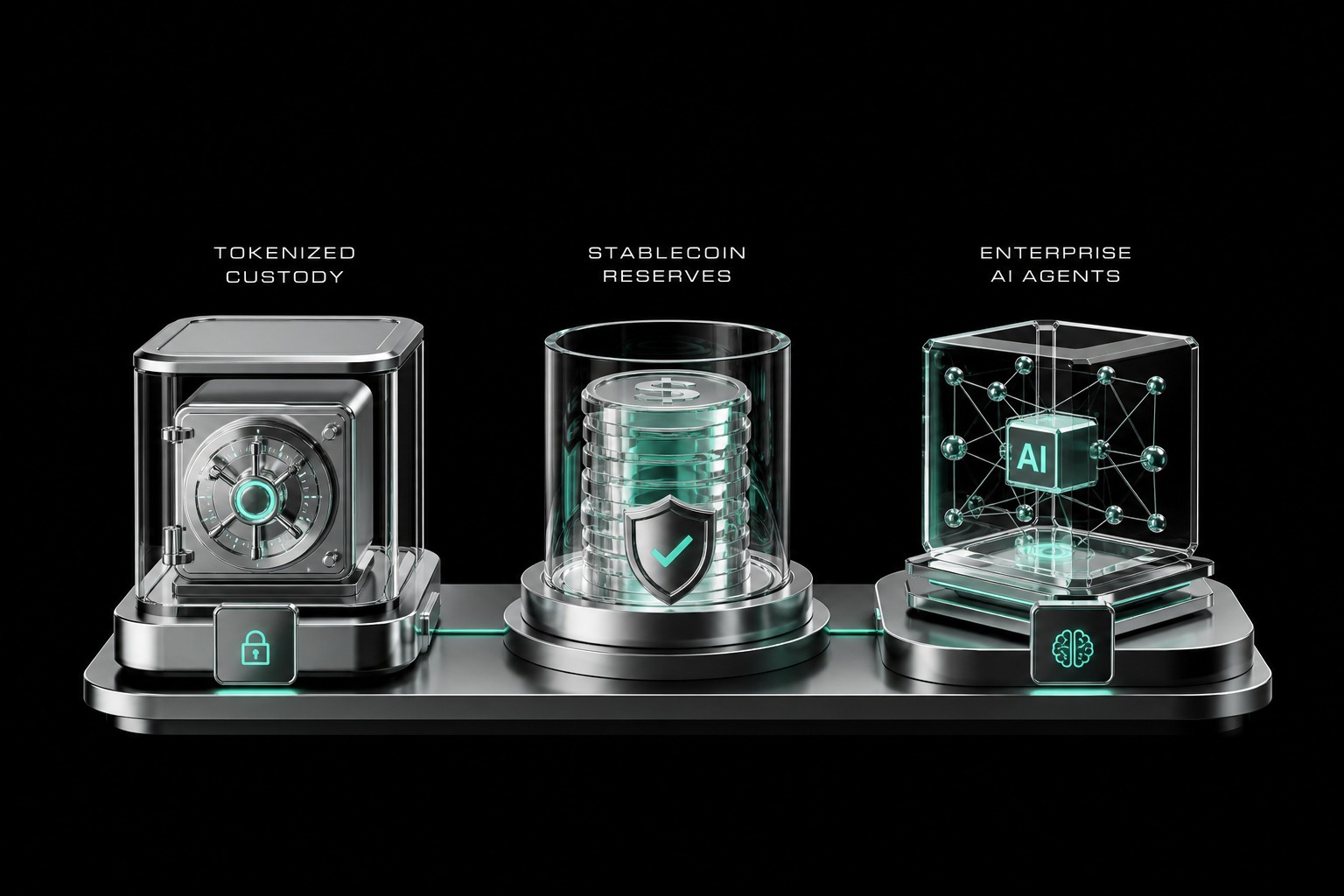
Three lines point to the same destination: custody, reserves and execution in on-chain finance were all taken over by depository-grade players this week. DTCC owns custody, BlackRock owns reserves, Citi owns execution. The center of gravity in tokenization has moved from supply to infrastructure access, and the competition is now over settlement networks and custody licences rather than issuing platforms.
On the agent side, banks have opened 180,000 desks for agents, but regulation has not kept up. Hammack put the contradiction plainly: stablecoins can run smart contracts and support agentic workflows, and those two features are exactly where demand comes from, and also where the rules have no answer. The GENIUS Act covers payment stablecoins only; smart contracts and agent-initiated payments still sit in a gray zone, and Hammack said that gap could hold US institutions back.
Resistance is building too. 59 companies oppose tokenized versions of their shares trading on OKXICE, Nasdaq has said it does not consider that path the best one, and the SEC answered with a 30-day notice rule. Depository-grade infrastructure and crypto-native exchanges are now pulling at the same question: whose tokenization gets to sit at the table.
4. What to Watch Next Week
Anthropic roadshow and pricing: Formal roadshow starts Nov 9, JPMorgan holds its investor briefing Nov 13, listing expected before Thanksgiving. Where the valuation lands inside the $1.25-1.75T range is a direct test of market appetite for AI capex.
GENIUS rule countdown: New federal rules are due by January 2027 at the latest; whether smart contracts and agentic AI payments are folded in decides the pace of US stablecoin institutionalization.
Tokenization expansion pace: DTCC’s 2027 multi-chain plan, Hong Kong’s gold-bar pilot and Boerse Stuttgart’s DLT licence are all on the agenda for the coming weeks.
- DTCC Opens $114 Trillion in Custody to Tokenized Securities
- Morgan Stanley Confirms It Is Among the First Banks to Use DTCC’s Tokenization Service
- From Pilots to Production: BlackRock’s Tokenised Funds, Citi’s Agent Army
- Anthropic IPO Could Raise $80-100B at Up to $1.75T Valuation
- Anthropic Updates Prospectus: Full Picture of the Largest IPO Emerges
- Fed’s Hammack says AI agents using stablecoins would mark a major shift
- New keepers for old duties: custody, freezes and checkout
- Major Companies Are Suddenly Rejecting Crypto Token Efforts
发表回复