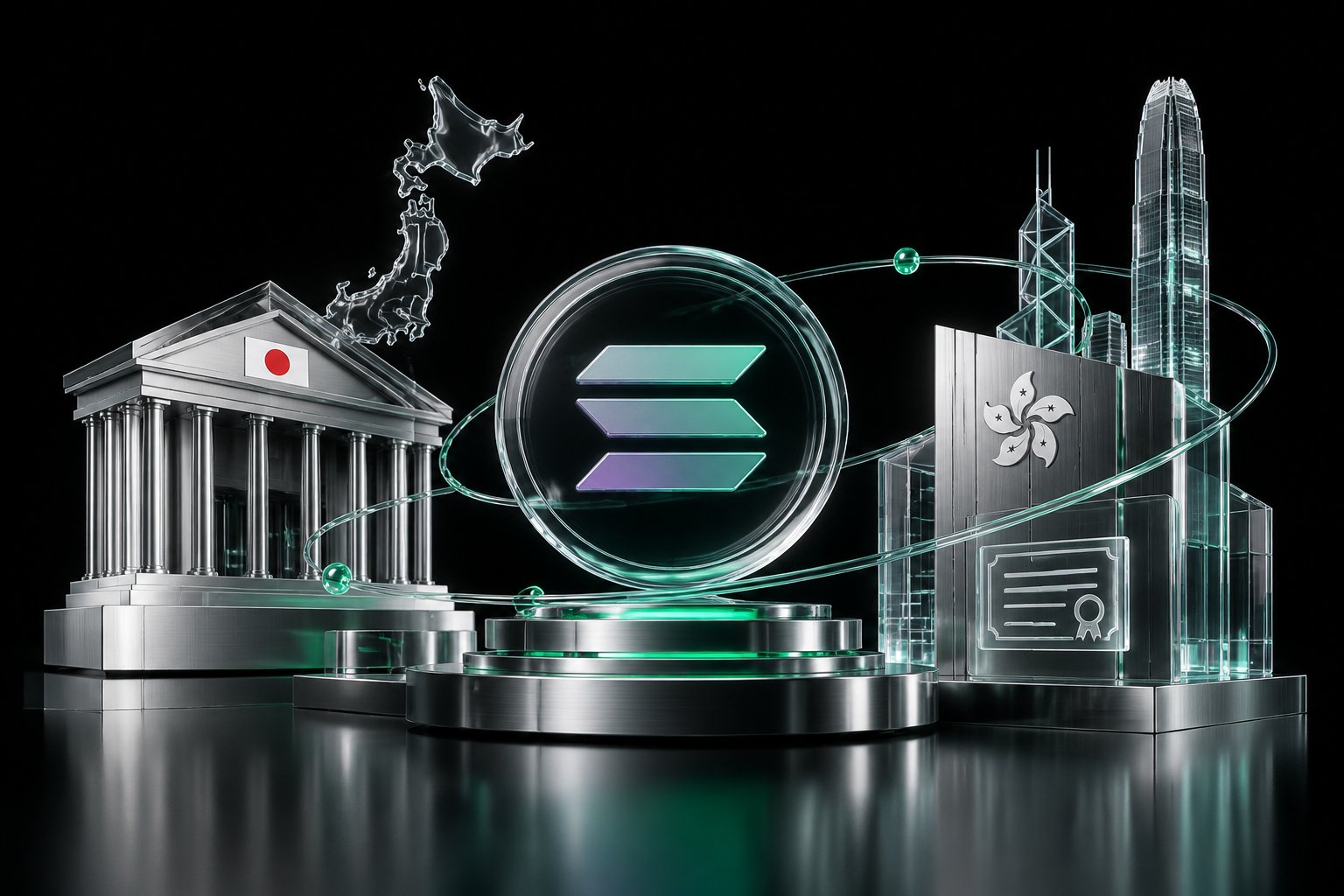
Japan’s Banking Giants Bet on Solana as Hong Kong Goes On-Chain for Bonds
On-Chain RWA Total
$28.17B
SpectreAI · 11/25
Tokenized T-Bills / MMFs
$11.87B
BNB Chain 37.3% leads
CMU Assets in Custody
HK$6T+
end-Sep 2026
SBI + SMFG AUM
$2.3T
80M+ customers
SBI and SMFG Join Solana Foundation to Launch Tokenization Joint Venture
Japan’s two financial giants, SBI Holdings and Sumitomo Mitsui Financial Group (SMFG), finalized agreements with the Solana Foundation to restructure SBI R3 Japan into a full-scale joint venture, SBI Solana Global, betting on public-chain infrastructure for tokenization and stablecoin payments. The two groups manage roughly $2.3 trillion in combined assets and serve over 80 million customers, marking a notable shift of Japan’s tier-one institutions from private consortium chains toward public ledgers.
- Four business lines: cross-border stablecoin remittance, AI-agent micropayments, issuance and distribution of tokenized bonds and funds, and on-chain asset management
- SBI had already listed USDC via SBI VC Trade in March 2025 and launched the yen-backed JPYSC with Startale in June 2026
- Moving away from the Corda-based SBI R3 Japan to the high-throughput Solana public ledger reflects growing institutional preference for open networks
Strategic Signal
Japan’s top banks anchor enterprise-grade tokenization on a public chain rather than a private one
Ecosystem Impact
Solana gains an institutional Asia-Pacific narrative; yen stablecoins and tokenized bonds may accelerate
Watch Point
No capital commitment or revenue figures disclosed; adoption hinges on regulatory approvals
Source: Basis Desk · CoinTelegraph · November 25, 2026
HKMA Launches CMU Digital Asset Platform for 24/7 Tokenized Bonds
The Hong Kong Monetary Authority officially launched the CMU Digital Asset Platform (CMU DAP), developed and operated by CMU OmniClear. The DLT-based platform brings the full lifecycle of bond issuance, secondary settlement, coupon payments and redemption onto the ledger, using on-chain atomic delivery-versus-payment (DvP) settlement with cash tokens enabling 24-hour multi-currency clearing. HSBC, Standard Chartered, Bank of China (Hong Kong) and DBS are among the ten banks joining as first direct participants.
- Settlement in HKD, RMB, USD and EUR, directly linked to RTGS systems and CBDCs (e-HKD, e-CNY)
- CMU held more than HK$6 trillion of assets at end-September 2026; existing bonds can be converted into token form
- Roadmap: expand to funds and real-world assets, connect tokenized deposits and regulated stablecoins
Infrastructure
A central-bank-grade depository builds its own DLT settlement layer, ending fragmented bank-led venues
Regional Race
Joins Singapore’s SG Digital Ledger and Europe’s T2S pilots in a three-track race
Validation
First live issuance volumes in 2027 will show whether issuers follow
Source: HKMA · Asia Fintech · November 25, 2026
Fed’s Waller Warns of “Zombie Chains” Stranding Tokenized Assets
Federal Reserve Governor Christopher Waller coined the term “zombie chains” at The Clearing House Annual Conference in New York: blockchains with little developer activity and daily use that, if they stop functioning, could leave tokenized bonds stranded, raising questions about who owns the assets and how to prove it. He cited smart-contract failures, lost private keys and erroneous transfers, arguing technology alone cannot solve these problems without a sound legal framework covering ownership and custody rights.
- Regulators and markets need clearer rules on tokenized claims, settlement records, custody, insolvency and failed-system resolution
- Central bank money must remain foundational; stablecoins and traditional networks will coexist rather than replace one another
- Privacy and governance flagged as priorities for systemically important transactions
Regulatory Stance
A Fed official systematically flags chain-failure risk, setting legal preconditions for institutional entry
Industry Implication
“Choosing the right chain” becomes an institutional-grade decision; long-term network maintenance is a filter
Policy Outlook
Clearer ownership and custody frameworks would materially lower institutional participation barriers
BlackRock Debuts $100M HKD Tokenized Money Fund With Stablecoin Access
BlackRock launched its first tokenized money market fund in Hong Kong and the Asia-Pacific region on November 24, the BlackRock HKD Digital Liquidity Fund, with roughly $100 million in assets as of November 20, seeded by Standard Chartered and Ant International. It is the first Hong Kong-domiciled money market fund offering a constant net asset value (CNAV) to both institutional and retail investors; professional investors can subscribe and redeem using regulated stablecoins such as HKDAP, while retail investors subscribe in Hong Kong dollars.
- Standard Chartered serves as custodian, administrator, trustee and tokenization agent; Ant International gains 24/7 cash management
- HKD becomes the fourth currency in BlackRock’s tokenized lineup after USD, EUR and GBP (BUIDL ~$1.55B)
- CNAV structure requires at least 99.5% of assets in government-backed money market instruments; 7-day net yield 2.03%
Market Signal
The world’s largest asset manager closes a stablecoin settlement loop in Hong Kong, validating its licensing system
Competitive Landscape
Alongside HSBC’s RedCoin money fund (retail since 11/19), Hong Kong’s tokenized MMF ecosystem takes shape
Watch Point
Whether the liquidity facility moves from pilot to standing arrangement determines true 24/7 cash
Source: The Block · FinanceFeeds · November 24, 2026
SEC Panel to Weigh Tokenized Stocks as Senators Demand Exemption Reversal
The SEC’s Investor Advisory Committee will hold a virtual public meeting on December 3, devoting 90 minutes to tokenized trading of US public company shares under the September 17 “Innovation Exemption.” Panelists include OKX deputy general counsel Andree Goldsmith, Securitize president Brett Redfearn and former CFTC chairman Timothy Massad. The same day, senators led by Elizabeth Warren sent two letters to SEC Chair Paul Atkins demanding withdrawal of the exemption for Tokenized Securities Venues and certain liquidity providers, and rescission of the proposed Regulation Crypto Assets rule.
- The exemption lets retail investors trade directly on qualifying TSVs without a broker-dealer; per-venue volume caps at 0.25% of average daily volume (S&P 500 / Russell 1000) or 2.5% for other stocks
- Issuers can opt out; 67 companies including Apple, Microsoft and Nvidia have filed objections
- The Warren-led letter cites weakened investor protections, loopholes enabling securities-law evasion and reduced state oversight
Regulatory Tug-of-War
The exemption framework enters public review; the Dec. 3 session is a policy barometer
Compliance Cost
Rising political headwinds mean TSV operators face heavier disclosure and scrutiny
Industry Watch
OKXICE (launched 11/23) and the Nasdaq-Kraken 2027 Q2 model are both in scope
发表回复