North Dakota’s Digital Dollar: Bank Stablecoins Move from White Papers into Production
Fiserv brings a bank stablecoin platform online, making Roughrider Coin its first production use case, but the “stablecoin” versus “tokenized deposit” label dispute reveals a structural tension between the banking channel and private issuers one year after the GENIUS Act.
Article Insight
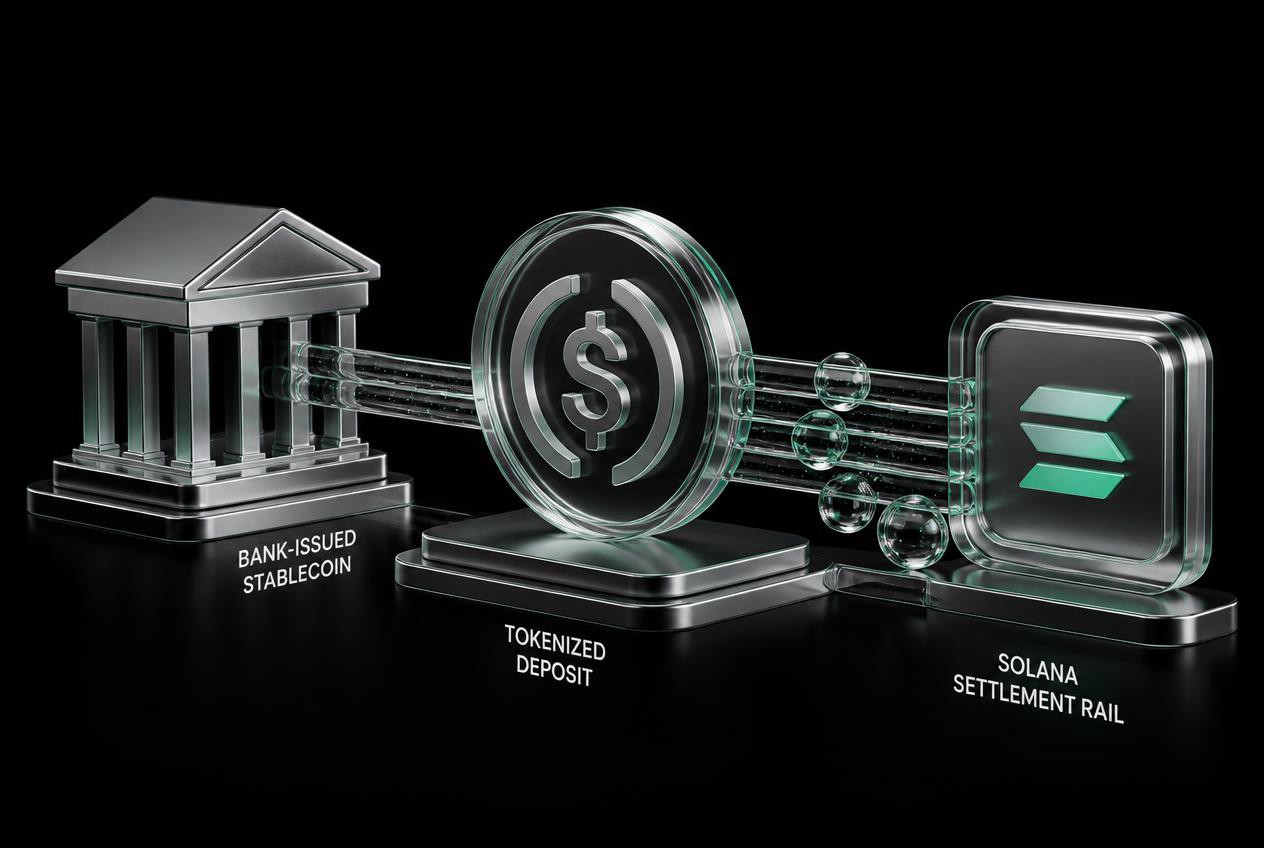
On October 1, 2026, payments giant Fiserv announced that its digital asset platform had gone live, with Bank of North Dakota’s Roughrider Coin as the first production use case: more than 90 community banks and credit unions can now settle interbank transfers on Solana in roughly 400 milliseconds through their existing banking software, replacing overnight ACH. It is the second state-issued stablecoin in the US and the first bank-issued token embedded in mainstream banking infrastructure. But the project’s back-and-forth between “stablecoin” and “tokenized deposit” labels exposes a structural tension between the banking channel and private issuers one year after the GENIUS Act, answering a key question for the RWA industry: who is qualified to put dollars on-chain.
400 ms vs. Overnight: A Bank Stablecoin Reaches “Production” for the First Time
On October 1, 2026, Fiserv (NASDAQ: FISV), the payments technology giant that processes transactions for roughly 10,000 US financial institutions, announced that its digital asset platform had gone live with bank clients. The platform’s first production use case is Roughrider Coin, the US dollar stablecoin issued by Bank of North Dakota (BND), the only state-owned bank in the nation (chartered in 1919). More than 90 banks and credit unions in North Dakota can now access the token through Fiserv’s existing Commercial Center commercial online banking system and complete interbank transfers on the Solana blockchain.
The most striking feature of this architecture is not the word “stablecoin” but its settlement speed and embedding approach. Participating institutions do not need to install a new wallet or a separate blockchain login; treasury teams can simply see the token in the system they already use every day. Traditional ACH requires overnight batch processing and wire transfers need a same-business-day window; Roughrider Coin reaches final settlement on Solana in about 400 milliseconds and runs 24/7. BND’s own comparison prices a transfer at roughly one cent, against $2 to $35 for a traditional wire.
This is a four-party division of labor: Bank of North Dakota handles governance and oversight; VersaBank USA, N.A. (the OCC-chartered US subsidiary of Canada’s VersaBank) serves as issuer, handling minting, burning, custody and reserve management; Fireblocks provides enterprise-grade wallet and tokenization infrastructure; and Solana is the settlement layer. The entire flow is routed through Finxact, the cloud-native core banking system Fiserv acquired for $650 million in 2022, so stablecoin settlement shares the same accounting infrastructure as ordinary deposits and transfers, rather than operating as a silo.
The project’s rollout timeline is also telling: it was first announced on October 8, 2025, Phase I received regulatory approval on March 25, 2026, and it went live roughly six months later. Roughrider Coin is the second state-issued stablecoin in the US, after Wyoming’s Frontier Stable Token launched in August 2025, but its difference lies in distribution: rather than letting residents buy a coin in their wallets, it pre-wires the settlement capability of an entire state’s interbank network into existing banking software. Solana processed more than $650 billion in stablecoin transfers in February 2026 alone, and as of mid-2026 had gone 16 consecutive months without a major network outage, a technical prerequisite for institutional adoption.
, Sunil Sachdev, Head of Embedded Finance and Digital Assets, Fiserv, Oct 1 2026
But “production” does not equal “in use.” That is the point that needs the most sober assessment in this case. BND’s ecosystem page shows that North Dakota has 61 FDIC-insured institutions (about $64.9 billion in assets in Q1 2026) and 29 federally insured credit unions. Fiserv’s “more than 90 participating institutions” refers to who can access the rail, not who is actively transacting, and neither a list of active users, completed transaction counts, nor time savings against existing rails has been published. Access is not the same as usage, two concepts that must be distinguished when evaluating this use case.
“Stablecoin” or “Tokenized Deposit”? The Regulatory Fork Behind a Label
The most intriguing part of this project is that the same thing carries two names in different parties’ official language. In the 6-K VersaBank filed with the SEC, Roughrider Coin is explicitly defined as “a U.S. dollar-backed stablecoin designed exclusively for bank-to-bank payments.” But Bank of North Dakota’s own page uses almost the same sentence, swapping the final noun for “token deposit,” and stresses that the program “follows GENIUS Act framework.”
This is not a word game. Under the GENIUS Act (signed July 18, 2025, the first US federal stablecoin legislation), a payment stablecoin and a bank’s tokenized deposit are two different instruments with different claim structures behind them: the former typically corresponds to a reserve asset, while the latter corresponds to a deposit claim against the issuing bank. Their reserve requirements, disclosure obligations, and bankruptcy treatment differ. And in this project, which right a receiving bank actually holds in the moment between the burn and the ACH credit, neither party answers clearly; even BND’s own glossary files Tether and Circle under token deposits.
Behind this ambiguity lies room for regulatory arbitrage, and it is also the real driver of rapid bank stablecoin expansion. Tracing BND’s logic: it defensively argues that as digital payments spread, deposits may drift toward private token deposit issuers, and a shared interbank settlement rail can keep those deposits inside the state’s banking system. That is the essence of Fiserv’s business model, embedding stablecoin capability into software banks already use so institutions can plug in without building their own crypto stack, then replicating this “North Dakota playbook” in other states. Fiserv has made clear that future use cases include stablecoin cards, cross-border payments, programmable commerce, treasury automation and tokenized deposits.
Zooming out, this case sits at a larger industry inflection point. OriginBrief’s weekly report defines this week as the watershed where “stablecoins moved from regulatory design to live production deployment”: besides Fiserv’s Roughrider Coin, there is Visa’s business payment adoption data, Stripe’s stablecoin infrastructure push, and the CFTC’s September 29 approval of Coinbase Clearing LLC as a derivatives clearing organization (completing the FCM/DCM/DCO stack for USDC-collateralized derivatives clearing). Regulators are moving in parallel: the SEC proposed crypto custody rules on October 1, ESMA called for MiCA revision on September 30, and Japan’s FSA approved a major bank consortium stablecoin trade-finance sandbox on September 29, with multiple jurisdictions acting almost simultaneously. Stablecoin competition has moved from “who issues first” to “who lays the rails into production first.”
, David Taylor, Founder and President, VersaBank, Oct 1 2026
Looking closer at the settlement design, it is actually a pragmatic compromise with “on-chain finance.” Roughrider Coin’s lifecycle is very short: only after a bank moves funds from its operating account into a designated for-benefit-of (FBO) account at VersaBank and that is confirmed is a token minted; it is burned automatically when it reaches the receiving institution’s wallet. All flows between participants’ FBO custody accounts are netted daily against a concentration account at Bank of North Dakota, then pushed and pulled through ACH files. In other words, the interbank transfer is final on-chain within seconds, but the dollars behind it still move once a day on traditional rails. This is a hybrid architecture of “on-chain ledger plus off-chain settlement,” which proves the efficiency of on-chain settlement without fully escaping reliance on traditional clearing.
On the technology side, there is another layer worth noting: Roughrider Coin is a permissioned asset on Solana with built-in freeze and clawback functions, strictly restricted to financial institutions and not open to retail. Solana compresses finality to about 400 milliseconds through a Proof of History plus Proof of Stake consensus mechanism, which is its core advantage over overnight ACH clearing and same-business-day wire windows.
Key Takeaways for Practitioners
Sources
- 1. Fiserv Digital Asset Platform Goes Live with Financial Institution Clients , Fiserv Press Release, Oct 1 2026
- 2. VersaBank 6-K: Partnership with Fiserv for Bank of North Dakota’s Roughrider Coin , SEC EDGAR, Oct 1 2026
- 3. Fiserv’s Digital Asset Platform goes live with North Dakota’s Roughrider Coin , CryptoBriefing, Oct 2026
- 4. North Dakota’s bank coin runs on Solana. Follow the dollar back , Crypto News, Oct 2026
- 5. North Dakota’s Roughrider Coin Goes Live on Solana , Solana Compass, Oct 2026
- 6. Fiserv Stablecoin Platform Activates for 10,000 Banks: 400ms Settlement , Tech Times, Oct 2 2026
- 7. Fintech & Payments Weekly Report , OriginBrief, Oct 5 2026
- 8. United States Stablecoin Crypto Policy Tracker 2026 , APAC FINSTAB, Oct 2026
发表回复