作者: MzaZobV4JT53byg

  • North Dakota’s Digital Dollar: Bank Stablecoins Move from White Papers into Production

    North Dakota’s Digital Dollar: Bank Stablecoins Move from White Papers into Production

    North Dakota’s Digital Dollar: Bank Stablecoins Move from White Papers into Production

    Fiserv brings a bank stablecoin platform online, making Roughrider Coin its first production use case, but the “stablecoin” versus “tokenized deposit” label dispute reveals a structural tension between the banking channel and private issuers one year after the GENIUS Act.

    Article Insight

    On October 1, 2026, payments giant Fiserv announced that its digital asset platform had gone live, with Bank of North Dakota’s Roughrider Coin as the first production use case: more than 90 community banks and credit unions can now settle interbank transfers on Solana in roughly 400 milliseconds through their existing banking software, replacing overnight ACH. It is the second state-issued stablecoin in the US and the first bank-issued token embedded in mainstream banking infrastructure. But the project’s back-and-forth between “stablecoin” and “tokenized deposit” labels exposes a structural tension between the banking channel and private issuers one year after the GENIUS Act, answering a key question for the RWA industry: who is qualified to put dollars on-chain.

    400 ms vs. Overnight: A Bank Stablecoin Reaches “Production” for the First Time

    On October 1, 2026, Fiserv (NASDAQ: FISV), the payments technology giant that processes transactions for roughly 10,000 US financial institutions, announced that its digital asset platform had gone live with bank clients. The platform’s first production use case is Roughrider Coin, the US dollar stablecoin issued by Bank of North Dakota (BND), the only state-owned bank in the nation (chartered in 1919). More than 90 banks and credit unions in North Dakota can now access the token through Fiserv’s existing Commercial Center commercial online banking system and complete interbank transfers on the Solana blockchain.

    The most striking feature of this architecture is not the word “stablecoin” but its settlement speed and embedding approach. Participating institutions do not need to install a new wallet or a separate blockchain login; treasury teams can simply see the token in the system they already use every day. Traditional ACH requires overnight batch processing and wire transfers need a same-business-day window; Roughrider Coin reaches final settlement on Solana in about 400 milliseconds and runs 24/7. BND’s own comparison prices a transfer at roughly one cent, against $2 to $35 for a traditional wire.

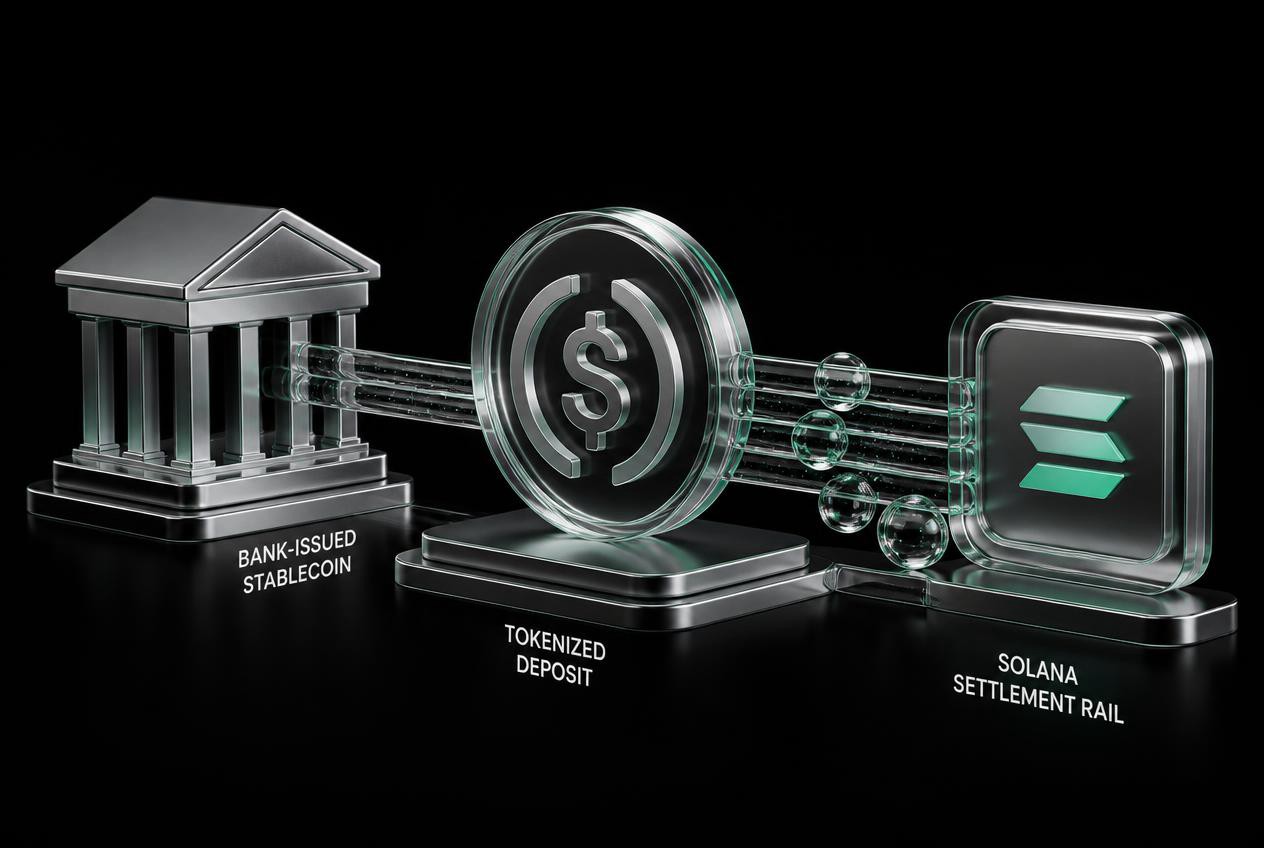
    This is a four-party division of labor: Bank of North Dakota handles governance and oversight; VersaBank USA, N.A. (the OCC-chartered US subsidiary of Canada’s VersaBank) serves as issuer, handling minting, burning, custody and reserve management; Fireblocks provides enterprise-grade wallet and tokenization infrastructure; and Solana is the settlement layer. The entire flow is routed through Finxact, the cloud-native core banking system Fiserv acquired for $650 million in 2022, so stablecoin settlement shares the same accounting infrastructure as ordinary deposits and transfers, rather than operating as a silo.

    Party Role Responsibility
    Bank of North Dakota Governance Oversight and governance; provides the state settlement concentration account
    VersaBank USA, N.A. Issuer OCC-chartered US bank; minting/burning/custody/reserve management
    Fiserv Platform Digital asset platform + Commercial Center front end + Finxact core accounting
    Fireblocks Infrastructure Enterprise-grade key management and tokenization infrastructure
    Solana Settlement layer Public chain, ~400ms final settlement, with freeze/clawback functions

    The project’s rollout timeline is also telling: it was first announced on October 8, 2025, Phase I received regulatory approval on March 25, 2026, and it went live roughly six months later. Roughrider Coin is the second state-issued stablecoin in the US, after Wyoming’s Frontier Stable Token launched in August 2025, but its difference lies in distribution: rather than letting residents buy a coin in their wallets, it pre-wires the settlement capability of an entire state’s interbank network into existing banking software. Solana processed more than $650 billion in stablecoin transfers in February 2026 alone, and as of mid-2026 had gone 16 consecutive months without a major network outage, a technical prerequisite for institutional adoption.

    “By moving from concept to production with leading institutions, we are helping clients unlock new efficiencies in banking and payments while maintaining the trust, security and regulatory standards they expect.”
    , Sunil Sachdev, Head of Embedded Finance and Digital Assets, Fiserv, Oct 1 2026

    But “production” does not equal “in use.” That is the point that needs the most sober assessment in this case. BND’s ecosystem page shows that North Dakota has 61 FDIC-insured institutions (about $64.9 billion in assets in Q1 2026) and 29 federally insured credit unions. Fiserv’s “more than 90 participating institutions” refers to who can access the rail, not who is actively transacting, and neither a list of active users, completed transaction counts, nor time savings against existing rails has been published. Access is not the same as usage, two concepts that must be distinguished when evaluating this use case.

    “Stablecoin” or “Tokenized Deposit”? The Regulatory Fork Behind a Label

    The most intriguing part of this project is that the same thing carries two names in different parties’ official language. In the 6-K VersaBank filed with the SEC, Roughrider Coin is explicitly defined as “a U.S. dollar-backed stablecoin designed exclusively for bank-to-bank payments.” But Bank of North Dakota’s own page uses almost the same sentence, swapping the final noun for “token deposit,” and stresses that the program “follows GENIUS Act framework.”

    This is not a word game. Under the GENIUS Act (signed July 18, 2025, the first US federal stablecoin legislation), a payment stablecoin and a bank’s tokenized deposit are two different instruments with different claim structures behind them: the former typically corresponds to a reserve asset, while the latter corresponds to a deposit claim against the issuing bank. Their reserve requirements, disclosure obligations, and bankruptcy treatment differ. And in this project, which right a receiving bank actually holds in the moment between the burn and the ACH credit, neither party answers clearly; even BND’s own glossary files Tether and Circle under token deposits.

    Behind this ambiguity lies room for regulatory arbitrage, and it is also the real driver of rapid bank stablecoin expansion. Tracing BND’s logic: it defensively argues that as digital payments spread, deposits may drift toward private token deposit issuers, and a shared interbank settlement rail can keep those deposits inside the state’s banking system. That is the essence of Fiserv’s business model, embedding stablecoin capability into software banks already use so institutions can plug in without building their own crypto stack, then replicating this “North Dakota playbook” in other states. Fiserv has made clear that future use cases include stablecoin cards, cross-border payments, programmable commerce, treasury automation and tokenized deposits.

    Zooming out, this case sits at a larger industry inflection point. OriginBrief’s weekly report defines this week as the watershed where “stablecoins moved from regulatory design to live production deployment”: besides Fiserv’s Roughrider Coin, there is Visa’s business payment adoption data, Stripe’s stablecoin infrastructure push, and the CFTC’s September 29 approval of Coinbase Clearing LLC as a derivatives clearing organization (completing the FCM/DCM/DCO stack for USDC-collateralized derivatives clearing). Regulators are moving in parallel: the SEC proposed crypto custody rules on October 1, ESMA called for MiCA revision on September 30, and Japan’s FSA approved a major bank consortium stablecoin trade-finance sandbox on September 29, with multiple jurisdictions acting almost simultaneously. Stablecoin competition has moved from “who issues first” to “who lays the rails into production first.”

    “Pairing Fiserv’s scale with VersaBank’s regulated digital asset capabilities gives the industry a trusted foundation to bring stablecoins into established banking and payment systems.”
    , David Taylor, Founder and President, VersaBank, Oct 1 2026

    Looking closer at the settlement design, it is actually a pragmatic compromise with “on-chain finance.” Roughrider Coin’s lifecycle is very short: only after a bank moves funds from its operating account into a designated for-benefit-of (FBO) account at VersaBank and that is confirmed is a token minted; it is burned automatically when it reaches the receiving institution’s wallet. All flows between participants’ FBO custody accounts are netted daily against a concentration account at Bank of North Dakota, then pushed and pulled through ACH files. In other words, the interbank transfer is final on-chain within seconds, but the dollars behind it still move once a day on traditional rails. This is a hybrid architecture of “on-chain ledger plus off-chain settlement,” which proves the efficiency of on-chain settlement without fully escaping reliance on traditional clearing.

    On the technology side, there is another layer worth noting: Roughrider Coin is a permissioned asset on Solana with built-in freeze and clawback functions, strictly restricted to financial institutions and not open to retail. Solana compresses finality to about 400 milliseconds through a Proof of History plus Proof of Stake consensus mechanism, which is its core advantage over overnight ACH clearing and same-business-day wire windows.

    Key Takeaways for Practitioners

    1
    “Access” and “Usage” Are Two Completely Different Metrics
    Roughrider Coin’s “more than 90 participating institutions” is an access metric, not a transaction metric. When evaluating any bank stablecoin use case, always demand several key data points: the number of actually active institutions, transaction counts, and the real time and cost savings against traditional rails. “Production” in marketing language does not equal “scaled,” and practitioners need to build their own verification framework.

    2
    The Stablecoin-versus-Tokenized-Deposit Label Fight Is an Arbitrage Entry Point
    The same token is called a “stablecoin” by its issuer and a “tokenized deposit” by the state bank, which is not an oversight. Under the GENIUS Act, the two are instruments with different rights structures and disclosure obligations. Who is qualified to put dollars on-chain, and whether the receiving party holds a reserve claim or a bank deposit claim, will determine liquidation priority and risk allocation. Compliance teams need to clarify their product’s exact positioning under the Act rather than being led by the counterparty’s wording.

    3
    Bank Entry Shifts the Competitive Dimension of Stablecoins
    When an OCC-chartered bank like VersaBank enters as issuer and custodian, stablecoin competition shifts from “first-mover advantage” to “regulatory credibility” and “channel embedding.” Banks put stablecoins inside the core banking systems institutions already use, removing the biggest friction in institutional adoption, namely whether to install a new wallet. For private issuers, this means confronting a reality: federally chartered banks are seizing settlement rails with stronger regulatory backing.

    4
    The Hybrid Settlement Architecture Is the “Most Honest” Form Today
    Roughrider Coin’s architecture of “seconds-final on-chain plus daily off-chain netting” shows that fully on-chain settlement detached from traditional clearing is not yet mature. For RWA practitioners, this suggests a pragmatic path: do not chase a one-step move to full on-chain, but first deliver production-grade efficiency gains within the regulatory boundaries, then gradually expand the on-chain share. The North Dakota model (state backing plus bank issuance plus fintech platform embedding) may become a replicable public template.

  • 北达科他州的“数字美元”:银行稳定币第一次从白皮书走进生产环境

    北达科他州的“数字美元”:银行稳定币第一次从白皮书走进生产环境

    北达科他州的”数字美元”:银行稳定币第一次从白皮书走进生产环境

    Fiserv 上线银行稳定币平台,Roughrider Coin 成为首个生产级用例,但”稳定币”与”代币化存款”的标签之争,恰恰揭示了 GENIUS 法案落地一年后银行通道与私有发行商之间的结构性张力。

    文章解读

    2026 年 10 月 1 日,支付巨头 Fiserv 宣布其数字资产平台正式上线,北达科他州银行的 Roughrider Coin 成为第一个生产级用例:90 多家社区银行与信用合作社可通过其现有银行软件,在 Solana 上用约 400 毫秒完成银行间结算,取代隔夜 ACH。这是美国第二枚州级稳定币、也是第一枚嵌入主流银行基础设施的银行发行代币。但项目在”稳定币”与”代币化存款”之间的标签摇摆,暴露了 GENIUS 法案落地一年后银行通道与私有发行商之间的结构性张力,这一案例为 RWA 行业回答了一个关键问题:谁才有资格把美元搬上链。

    400 毫秒对隔夜:银行稳定币第一次”生产级”落地

    2026 年 10 月 1 日,为约 10,000 家美国金融机构处理业务的支付技术巨头 Fiserv(NASDAQ: FISV)宣布,其数字资产平台已随银行客户正式上线。平台第一个生产级用例,是北达科他州银行(Bank of North Dakota, BND)发行的美元稳定币 Roughrider Coin,该州是全国唯一一家州有银行(1919 年成立)。超过 90 家北达科他州银行与信用合作社,现在可以通过 Fiserv 现有的 Commercial Center 商业网上银行系统接入该代币,在 Solana 区块链上完成银行间转账。

    这套架构最大的看点不是”稳定币”这个说法,而是它的结算速度与嵌入方式。参与机构无需安装新钱包、无需单独的区块链登录,银行司库团队在每天已经在用的系统里,就能看到这个代币。传统 ACH 需要隔夜批量处理,电汇需要当日窗口;Roughrider Coin 在 Solana 上约 400 毫秒即可确认最终结算,且 7×24 小时全天候运行。BND 自己的对比显示,单笔转账成本约 1 美分,而传统电汇单笔要 2 到 35 美元。

    这是一张四方的架构分工表:北达科他州银行负责治理与监督;VersaBank USA, N.A.(加拿大 VersaBank 的 OCC 注册美国子行)作为发行人,承担铸造、销毁、托管与储备管理;Fireblocks 提供企业级安全钱包与代币化基础设施;Solana 是结算层。整个流程通过 Fiserv 在 2022 年以 6.5 亿美元收购的 Finxact 云原生核心银行系统路由,稳定币结算与普通存款、转账共用同一套记账基础设施,而不是一个孤岛。

    参与方 角色 职责
    Bank of North Dakota 治理方 监督与治理,提供州际结算枢纽(concentration account)
    VersaBank USA, N.A. 发行人 OCC 注册美国银行,负责铸造/销毁/托管/储备管理
    Fiserv 平台方 数字资产平台 + Commercial Center 前端 + Finxact 核心记账
    Fireblocks 基础设施 企业级密钥管理与代币化基础设施
    Solana 结算层 公开链,约 400ms 最终结算,含冻结/回收功能

    这个项目的推进时间线也很能说明问题:2025 年 10 月 8 日首次对外宣布,2026 年 3 月 25 日 Phase I 获得监管批准,随后约六个月落地上线。Roughrider Coin 是美国第二枚州级稳定币,仅次于怀俄明州 2025 年 8 月推出的 Frontier Stable Token,但它的不同之处在于分发方式:它不是让居民在钱包里买币,而是把整个州际银行网络的结算能力预先接到了现有银行软件里。Solana 在 2026 年 2 月单月就处理了超过 6500 亿美元的稳定币转账,且到 2026 年年中已连续 16 个月未发生重大网络宕机,这是机构级采用的技术前提。

    “By moving from concept to production with leading institutions, we are helping clients unlock new efficiencies in banking and payments while maintaining the trust, security and regulatory standards they expect.”
    , Sunil Sachdev, Head of Embedded Finance and Digital Assets, Fiserv, Oct 1 2026

    但”生产级”不等于”被使用”。这是整个案例里最需要冷静对待的一点。BND 的生态页面显示,北达科他州有 61 家 FDIC 承保机构(2026 年一季度资产约 649 亿美元)和 29 家联邦承保的信用合作社。Fiserv 说的”90 多家参与机构”是”可接入”的数量,不是”实际交易”的数量,无论是参与机构名单、已完成交易笔数,还是相对传统轨道的省时数据,都没有被公布。访问不等于使用,这是评估该用例时应当区分的两个概念。

    “稳定币”还是”代币化存款”?一张标签背后的监管分岔

    这个项目最值得玩味的地方,是同一件事在不同主体的官方措辞里出现了两个名字。VersaBank 向 SEC 提交的 6-K 文件里,Roughrider Coin 被明确定义为”专为银行间支付设计的美元稳定币”(a U.S. dollar-backed stablecoin designed exclusively for bank-to-bank payments)。而北达科他州银行自己的页面几乎用了同样的句式,只是把最后一个名词换成了”代币化存款”(token deposit),并且强调该项目”遵循 GENIUS 法案框架”。

    这不是文字游戏。在 GENIUS 法案(2025 年 7 月 18 日签署,美国第一部稳定币联邦立法)框架下,支付稳定币与银行的代币化存款是两种不同的工具,背后是不同的求偿权结构:前者通常对应一笔储备资产,后者对应的是对发行银行的存款债权。两者的储备要求、披露义务、破产处理顺序都不一样。而在这个项目里,收款银行在”销毁”到”ACH 入账”之间的那一瞬,到底持有的是哪一种权益,两方都没有明确回答,连 BND 自己的术语表都把 Tether 和 Circle 归入”代币存款”类别。

    这种模糊背后是监管套利的空间,也是银行稳定币快速扩张的真正驱动力。回溯 BND 的算账逻辑:它防御性地认为,随着数字支付普及,存款可能会流向私有代币存款发行商;而一条共享的银行间结算轨道,能把存款留在本州的银行体系内。这正是 Fiserv 商业模式的精髓,把稳定币能力嵌入银行已经在用的软件里,让银行无需自建加密栈就能接入,再把这个”北达科他州剧本”复制给其他州。Fiserv 明确表示,后续用例包括稳定币卡片、跨境支付、可编程商务、国库自动化和代币化存款。

    把视角拉远,这个案例其实处在一个更大的产业拐点上。OriginBrief 的周报把本周定义为”稳定币从监管设计跨入生产部署”的分水岭:除了 Fiserv 的 Roughrider Coin,还有 Visa 的商业支付采用数据、Stripe 的稳定币基础设施布局、CFTC 9 月 29 日批准 Coinbase Clearing LLC 成为衍生品清算机构(完成 USDC 抵押衍生品清算的 FCM/DCM/DCO 全栈)。监管层也在同步推进:SEC 10 月 1 日提出加密托管规则、ESMA 9 月 30 日呼吁修订 MiCA、日本 FSA 9 月 29 日批准主要银行财团稳定币贸易融资沙盒,多个司法管辖区几乎同时动手。稳定币竞争已经从”谁先发币”进入了”谁先把轨道铺进生产环境”的阶段。

    “Pairing Fiserv’s scale with VersaBank’s regulated digital asset capabilities gives the industry a trusted foundation to bring stablecoins into established banking and payment systems.”
    , David Taylor, Founder and President, VersaBank, Oct 1 2026

    再看结算设计的细节,会发现它其实是对”链上金融”的一次务实妥协。Roughrider Coin 的生命周期很短:只有在银行把资金从运营账户转入 VersaBank 指定的托管账户(FBO)并确认后,代币才会被铸造;当它到达收款机构的钱包时会被自动销毁。各参与方的 FBO 托管账户之间的全部流动,每天都会在北达科他州银行的集中账户(concentration account)里净额轧差,再通过 ACH 文件在各方之间划拨。也就是说,银行间的转移在链上几秒钟内即为最终状态,但背后的美元仍然每天通过传统轨道移动一次。这是一条”链上记账 + 链下结算”的混合架构,它证明了链上结算的效率,却没有完全摆脱传统清算的依赖。

    技术层面还有一层值得关注:Roughrider Coin 是 Solana 上的许可资产,内置冻结(freeze)与回收(clawback)功能,且严格限制在金融机构之间使用,不对零售开放。Solana 依靠 Proof of History 与 Proof of Stake 结合的共识机制,将最终确认时间压缩到约 400 毫秒,这是它相比 ACH 隔夜清算和电汇当日窗口的核心优势。

    对从业者的一些启示

    1
    “可接入”与”被使用”是两个完全不同的指标
    Roughrider Coin 的”90 多家参与机构”是接入口径,不是交易口径。评估任何银行稳定币用例时,一定要追问几项关键数据:实际活跃机构数、成交笔数、以及相对传统轨道的真实省时省成本。营销语言里的”生产级”并不等于”已规模化”,从业者需要建立自己的验证框架。

    2
    稳定币与代币化存款的标签之争,就是监管套利的入口
    同一个代币被发行人叫”稳定币”、被州银行叫”代币化存款”,这并非无心之失。在 GENIUS 法案下两者是不同权利结构、不同披露义务的工具。谁有权把美元搬上链、收款方持有的是储备债权还是银行存款债权,这些问题的答案将决定清算顺序与风险归属。合规团队需要厘清自己产品在法案里的确切定位,而不是被对方的措辞带着走。

    3
    银行的进入改变了稳定币的竞争维度
    当 VersaBank 这样的 OCC 注册银行作为发行人与托管人进入,稳定币的竞争就从”先发优势”转向”监管可信度”与”渠道嵌入”。银行把稳定币塞进金融机构已经在用的核心银行系统,消除了”要不要装新钱包”这个机构采用的最大摩擦。对私有发行商而言,这意味着需要正视一个现实:联邦特许银行正在用更强的监管背书抢占结算轨道。

    4
    混合结算架构是当下”最诚实”的落地形态
    Roughrider Coin 采用”链上几秒最终 + 链下每日净额轧差”的架构,说明完全脱离传统清算的纯链上结算尚未成熟。对 RWA 从业者而言,这提示了一个务实路径:不必追求一步到位的全链上,而是先在监管接受的边界内做出生产级的效率提升,再逐步扩大链上份额。北方达科他州模式(州政府背书 + 银行发行 + 科技平台嵌入)或将成为可复制的公共模板。

  • OKX and NYSE Parent ICE File for a 24/7 Tokenized Stock Venue as Wall Street Goes Always-On

    OKX and NYSE Parent ICE File for a 24/7 Tokenized Stock Venue as Wall Street Goes Always-On

    A
    Aurellix
    October 6, 2026
    1 min read

    Focus of the Day
    OKXICE, the joint venture between OKX and NYSE parent ICE, filed with the SEC for a 24/7 tokenized securities venue where more than 60 blue chips trade against stablecoins on XLayer, triggering a 30-day objection window. BNB Chain’s tokenized stocks and ETFs crossed $1.1B for about a third of the industry, while Solana’s onchain RWA supply hit a $2.7B high as exchanges and crypto platforms accelerate always-on equity trading.

    Industry Briefing

    10 items

  • OKXICE files with the SEC for a 24/7 tokenized stock venue – The OKX-ICE joint venture applied under the Innovation Exemption to run an always-on venue where 60+ blue chips trade against USDC, USDG and USDT in permissioned Uniswap v4 pools on XLayer, triggering a 30-day objection window as Cerebras filed the first issuer objection.
  • Blockchain.com signs an MOU with NYSE Group to distribute tokenized stocks – The pair will explore distributing tokenized US-listed equities and ETFs through NYSE’s planned digital ATS with two-way market data, reaching 44M+ verified accounts; Citi sees a $5.5T base case for tokenized assets by 2030.
  • BNB Chain tokenized stocks and ETFs cross $1.1B, about a third of the industry – RWA.xyz shows total tokenized stock/ETF supply near $3.7B with BNB Chain at roughly 30%, Ethereum at $828M (22%) and Solana at $738M (20%); roughly 1.8M addresses hold tokenized stocks, about 45% of industry holders.
  • Solana onchain RWA distribution hits a $2.7B all-time high – RWA Foundation data shows BlackRock, Paxos, Anchorage, Ethena and Maple expanding on the network, spanning tokenized treasuries, stablecoin infrastructure, credit and yield products as high throughput and low fees draw TradFi adoption.
  • Franklin Templeton and Animoca Brands publish tokenization research, up to $30T by 2033 – Their joint “Future of Tokenization” series focuses on the “tokenization tipping point,” with RWA up 5x since 2023 and another 3x in 2025-2026 as regulatory clarity becomes the core catalyst.
  • Goldman Sachs plugs its $100B Treasury fund into institutional crypto plumbing – Active RWA AUM rose from $28.9B to $31.8B in a week; Franklin’s tokenized fund went live on Bybit as collateral while Petrobras tested Cardano for sustainable fuel tracking.
  • Payward (Kraken) and Singapore Gulf Bank launch 24/7 USD settlement – Using the bank’s SGB Net, the pair offer instant USD settlement to institutional clients in Asia and the Gulf, cutting counterparty and settlement risk while advancing always-on fiat rails for crypto markets.
  • Nasdaq invests $100M in Payward to co-build the Nasdaq Equity Token – The two are developing the NET framework so investors can hold onchain versions of public equities while keeping shareholder rights, supporting faster settlement and always-on trading; Nasdaq also supplies surveillance across markets.
  • OpenChainBench launches the first public benchmark for tokenized assets – Reading directly from public chains rather than asking issuers, it shows Solana’s tokenized RWA supply near $1.83B while $967.6M of BUIDL has no public pool as a restricted fund; weekend tests show AMM prices drifting sharply when Nasdaq is closed.
  • South Korea advances a tokenized securities regulatory framework – A proposal brings stocks, bonds and funds into a regulated token-securities regime with a 100M-won annual retail cap and a 4B-won capital requirement for direct-managed accounts, with public comment open through November 11.
  • OKX 联手纽交所母公司申报 24/7 代币化美股场——华尔街进入全时交易时代

    OKX 联手纽交所母公司申报 24/7 代币化美股场——华尔街进入全时交易时代

    A
    Aurellix
    2026年10月6日
    1 分钟阅读

    今日焦点
    OKX 与纽交所母公司 ICE 合资的 OKXICE 向 SEC 申报 24/7 代币化证券场,60 余只蓝筹股在 XLayer 上以稳定币配对交易,触发 30 天异议期。BNB Chain 代币化股票与 ETF 突破 $11 亿 占行业约三成,Solana 链上 RWA 供给创 $27 亿 新高,交易所与加密平台加速布局全时股权交易。

    行业速报

    共 10 条

  • OKXICE 向 SEC 申报 24/7 代币化美股场 — OKX 与纽交所母公司 ICE 的合资公司依「创新豁免」申请运营全时代币化证券场,60 余只蓝筹股在 XLayer 许可制 Uniswap v4 池中与 USDC、USDG、USDT 配对交易,触发 30 天异议期,Cerebras 已递交首个发行人异议。
  • Blockchain.com 与纽交所集团签 MOU,分销代币化美股 — 双方合作通过纽交所数字 ATS 分销代币化美股与 ETF,双向互通市场数据,覆盖 4,400 万+ 已验证账户;Citi 预测 2030 年代币化资产基准场景达 $5.5 万亿。
  • BNB Chain 代币化股票与 ETF 突破 $11 亿,占行业约三成 — RWA.xyz 显示行业总规模约 $37 亿,BNB Chain 约 30%、以太坊 $8.28 亿(22%)、Solana $7.38 亿(20%);约 180 万地址持有代币化股票,占全行业持有人约 45%。
  • Solana 链上 RWA 分布创 $27 亿历史新高 — RWA Foundation 数据,贝莱德、Paxos、Anchorage、Ethena、Maple 等机构持续布局,覆盖代币化国债、稳定币基建、信贷与收益产品,高吞吐低费率吸引 TradFi 采用。
  • 富兰克林邓普顿 × Animoca 发布代币化研究,2033 年或达 $30 万亿 — 联合《代币化与金融的未来》系列聚焦「代币化临界点」,RWA 自 2023 年增长 5 倍、2025-2026 再增 3 倍,监管清晰化成为核心催化剂。
  • Goldman Sachs 将 $1000 亿国债基金接入机构加密管线 — 代币化 RWA 活跃 AUM 一周内从 $289 亿增至 $318 亿;富兰克林代币化基金上线 Bybit 作抵押品,Petrobras 用 Cardano 试水可持续燃料追踪。
  • Payward(Kraken)与新加坡海湾银行推 24/7 美元结算 — 通过 SGB Net 面向亚洲与海湾机构客户提供即时美元结算,降低对手方与结算风险;Kraken 母公司同步推进全时法币轨道的机构应用。
  • 纳斯达克向 Kraken 母公司 Payward 投 $1 亿,共研 Nasdaq Equity Token — 双方联合开发 NET 框架,投资者可持链上版美股并保留股东权利,支持更快结算与全时交易;纳斯达克还提供跨加密与代币化市场的监管技术。
  • OpenChainBench 上线首个代币化资产公开基准 — 直接从公链读取而不询问发行方,Solana 上代币化 RWA 供给约 $18.3 亿,$9.676 亿 BUIDL 因属受限基金无公开池;实测周末 Nasdaq 休市期间 AMM 价格显著游走。
  • 韩国推进代币化证券监管框架 — 拟将股票、债券与基金纳入受监管代币证券体系,设个人年度净购 1 亿韩元上限并要求直接管理账户的合格发行人持 40 亿韩元资本,公评期至 11 月 11 日。
  • America Builds the Rails and Writes the Rules for Machine Payments

    America Builds the Rails and Writes the Rules for Machine Payments

    America Builds the Rails and Writes the Rules for Machine Payments

    Solana teams up with Google Cloud on Pay.sh, Cloudflare and the XRP Ledger expand in parallel, while the SEC draws the boundary for this new rail with custody rules and an AI czar.

    Pay.sh launch (Solana x Google Cloud)
    Oct3
    Wallet-to-agent onboarding in 60s

    Cumulative XRP Ledger x402 payments
    10.9M
    Over 600K settled daily

    SEC custody proposal (Release 2026-100)
    Oct1
    Conditional self-custody + state trust firms

    Agentic commerce estimate (McKinsey)
    $3-5T
    Global by 2030

    America is doing two things at once: building the rails for machine payments and writing the rules for those rails. In the first week of October, three machine-payment infrastructures scaled together. The Solana Foundation and Google Cloud launched Pay.sh on October 3, letting AI agents pay per API call with stablecoins. Cloudflare opened a USDC monetization gateway for agent payments on Base on October 2. And the XRP Ledger crossed 10 million x402 payments on October 1. In the same week, the SEC released a crypto custody rule proposal and the White House named former SEC chairman Clayton as AI czar. Rails and rules are converging on the same timeline.

    1. Why It Matters: Machine Payments Move From Narrative to Production Infrastructure

    Past discussions of AI-agent payments mostly stayed in white papers. This week, three companies shipped deployable products. Pay.sh, the Solana and Google Cloud effort, is an API proxy built on Google Cloud: a developer links a Solana wallet to Gemini, Claude Code, or Codex and onboards funds in about 60 seconds. From then on, the wallet acts as the agent’s identity and payment instrument, with no need to open a cloud account or provision keys. Each API call triggers a stablecoin micropayment that settles on Solana in seconds, while providers are paid on the fiat side.

    Cloudflare took a different route. On October 2 it opened a closed beta of its Monetization Gateway, letting website and API owners charge agents per request, query, or token, with settlement in USDC on Base and payment instructions embedded directly in resource requests via the HTTP 402 status code. Early adopters include Ceramic.ai, Stocktwits, and API2PDF.

    2. Industry Status: The Scale of the x402 Ecosystem Begins to Show

    Underlying both rails is x402, which revives the HTTP 402 “Payment Required” semantics so a machine client can fetch a price and payment instructions, pay automatically, and retry with no traditional checkout. The XRP Ledger numbers best capture the scale: roughly 10.9 million x402 payments settled cumulatively through October 1, spread across 161 registered merchants, with daily settlement exceeding 600,000 and a jump from 1 million to 10 million in three months. Across the Coinbase-aligned x402 network, roughly 165 million agent transactions have been processed.

    Behind the volume lies a concrete demand signal. ARK Invest CEO Cathie Wood said at the Robinhood Summit that investors should track the agent rather than the developer, watching where millions of AI agents spend money across software, services, and financial networks. McKinsey pegs agentic commerce at $3-5 trillion globally by 2030.

    3. Deep Dive: Why America Is Landing the Rules in the Same Week

    When rails run fast, rules have to keep up or capital stays out. On October 1 the SEC issued Release 2026-100, a crypto custody proposal covering registered investment advisers, registered investment companies, and business development companies. Two elements stand out: conditional self-custody, allowed only when no third-party qualified custodian will hold the asset and subject to quarterly review; and making state-chartered trust companies qualified custodians. Chair Atkins said the existing custody provisions of the Investment Advisers Act and Investment Company Act predate the internet, and the proposal aims to close the gap for an asset class clients increasingly demand.

    The proposal’s direct impact is on the structural advantage of ETFs. Spot bitcoin ETFs absorbed $2.65 billion of net inflows in September, largely because the fund wrapper solves the custody problem for advisers. Once the SEC offers a direct custody path, the ETF’s convenience appeal erodes, and the beneficiaries become qualified custodians, state trust firms, and custody platforms. The timing matters too: the proposal lands as Hester Peirce departs, leaving the SEC with two sitting members, so a single future vote could shift the rule’s direction.

    The White House pushes rules higher up the stack. On October 4, Trump named former SEC chairman Clayton to lead the new Super Intelligence Force (SIF) while he continues as Director of National Intelligence. The SIF must deliver a report within 120 days covering AI agents, stablecoin payments, and dual-use technology. For the first time, regulators are treating how machines spend money as a national policy issue.

    Key signal: America completed both rail expansion and rule-setting in the same week. Pay.sh, Cloudflare, and the XRP Ledger proved machine payments can be industrialized; the SEC custody rules and the AI czar then laid a compliance foundation under that rail. Whoever holds the settlement layer before the rules land captures the first wave of agentic commerce.
    1
    The settlement layer, not the issuance layer, is the battlegroundAll three players are racing to become the settlement rail between agents, not to issue tokens. Stablecoins plus high-throughput chains are becoming the default base layer for machine-to-machine payments, and the Solana-versus-Base fight is less a Layer1/Layer2 contest than a contest over who runs the checkout for the agent economy.

    2
    Compliance becomes the entry ticket for machine paymentsThe SEC custody rules lay a compliant path under the stablecoin rail, and Cloudflare frames its gateway not as an anonymity tool but as a compliance abstraction layer. Agent payments will face the same anti-money-laundering, identity, and authorization checks as traditional finance.

    3
    Institutional capital is being repricedIf the SEC custody rules land, advisers can custody crypto directly and the ETF’s convenience edge weakens; meanwhile the first batch of 3x leveraged crypto ETPs was approved, giving high-risk capital an amplification tool that may deepen volatility.

    4. Investment View: Rule Expectations Are Rewriting Flows

    Capital is already pricing in rule landing. Bitcoin rose about 1.6% overnight after the SEC custody proposal, a reaction to looser capital entry rather than the proposal itself. Spot bitcoin ETFs absorbed $2.65 billion in September, showing institutions still favor the fund wrapper; but once the self-custody path opens, the valuation logic for custody providers and state trust firms shifts in tandem. The ICBA lawsuit against the OCC over crypto trust charters adds policy uncertainty to that path.

    The approval of 3x leveraged crypto ETPs widens short-term speculation. Cboe BZX was cleared to list six Volatility Shares products tracking the single-day triple performance of bitcoin, ether, gold, silver, crude oil, and natural gas, with the crypto products gaining leverage through futures contracts. These tools amplify price swings and signal a regulator leaning toward an expanding toolkit rather than tightening.

    5. User View: An Agent’s Spending Authority Becomes a New Problem

    For end users, the change is not in the wallet interface but in the authorization boundary. Former BlackRock digital assets head Joseph Chalom argues AI agents need controllable, revocable, and traceable payment permissions, such as authorizing an agent to spend up to $500 on a hotel booking while keeping the right to revoke and review every transaction. Open blockchains like Ethereum could become a shared financial network for agents, apps, and enterprises, avoiding a single bank or tech company as intermediary.

    6. Conclusion: The Race Between Rails and Rules Is the Theme of the Year Ahead

    The biggest lesson this week: machine payments no longer lack a how; they lack a who-can-do-it and who-can-be-trusted. Pay.sh solved onboarding speed, the SEC solved the compliance path, and the AI czar put machine payments on the national agenda. For practitioners, two variables are worth tracking: the direction of the SEC custody proposal’s 60-day comment period, and how the SIF’s 120-day report frames stablecoins and AI-agent payments. The ownership of the settlement layer will be decided by these two documents in the year ahead.

  • 美国同时铺轨道和定规则:机器支付进入合规基础设施战

    美国同时铺轨道和定规则:机器支付进入合规基础设施战

    美国同时铺轨道和定规则:机器支付进入合规基础设施战

    Solana 携手 Google Cloud 上线 Pay.sh,Cloudflare 与 XRP Ledger 同步扩容,SEC 则用托管新规与 AI Czar 给这条新轨道画边界。

    Pay.sh 上线(Solana×Google Cloud)
    10/3
    60秒完成钱包到agent接入

    XRP Ledger x402 累计支付
    1,090万笔
    日结算超60万笔

    SEC 加密托管提案(Release 2026-100)
    10/1
    允许有限自托管+州信托公司

    Agentic Commerce 市场预估(McKinsey)
    $3-5万亿
    2030年全球规模

    美国正在同时做两件事:给机器支付铺轨道,给轨道定规则。10月第一周,三条机器支付基建同时扩容——Solana 基金会与 Google Cloud 在10月3日上线 Pay.sh,让 AI agent 用稳定币按 API 调用付费;Cloudflare 于10月2日在 Base 上开启面向 agent 支付的 USDC 变现网关;XRP Ledger 在10月1日跨过1000万笔 x402 支付。同一周,SEC 抛出加密资产托管规则提案,白宫又任命前SEC主席 Clayton 出任 AI Czar。轨道与规则在同一条时间线上汇合。

    一、为什么关注:机器支付从叙事变成生产基建

    过去讨论 AI agent 支付,大多停留在协议白皮书。这一周,三家公司把它做成了可部署的产品。Solana 与 Google Cloud 的 Pay.sh 是一个建在 Google Cloud 上的 API 代理:开发者把 Solana 钱包链接到 Gemini、Claude Code 或 Codex,60秒内完成入金,此后钱包就是 agent 的身份和支付工具,无需再开云账号、配密钥。agent 每次调用 API 即触发一笔稳定币微支付,结算在 Solana 上数秒完成,provider 在另一边按法币结算。

    Cloudflare 走的则是另一条路。10月2日它开放 Monetization Gateway 封闭测试,让网站和 API 所有者按请求、查询或 token 数量向 agent 收费,支付通过 Base 链以 USDC 结算,利用 HTTP 402 状态码把支付指令直接嵌进资源请求。早期采用者包括 Ceramic.ai、Stocktwits 和 API2PDF。

    二、行业现状:x402 生态的量级开始显现

    支撑这两条轨道的底层协议是 x402——把 HTTP 402「Payment Required」语义复活,让机器客户端在拿到价格和支付指令后自动付款重试,全程无需传统结账流程。XRP Ledger 的数据最能说明规模:截至10月1日累计结算约1090万笔 x402 支付,注册商户161家,日结算量超过60万笔,三个月内从100万笔跳到1000万笔。Coinbase 系的 x402 全网已处理约1.65亿笔 agent 交易。

    量变背后是需求端的确凿信号。ARK Invest CEO Cathie Wood 在 Robinhood Summit 上提出,投资者未来要「跟踪代理」而非「跟踪开发者」,观察上百万 AI agent 把钱花在哪些软件、服务和金融网络上。McKinsey 估算 agentic commerce 到2030年可达3万亿到5万亿美元。

    三、深度分析:为什么美国这次把规则放在同一周落地

    轨道跑得快,规则就得跟上,否则资金不敢进去。SEC 于10月1日抛出 Release 2026-100 加密资产托管规则提案,覆盖注册投资顾问、注册投资公司和商业发展公司,核心是两处:一是有限自托管——只有当第三方合格托管人确实无法托管某资产时才允许顾问自行托管,且必须每季度复核;二是把州特许信托公司纳入合格托管人。主席 Atkins 称现行《投资顾问法》《投资公司法》托管条款「早于网络诞生」,提案旨在为这个「客户日益需求的多万亿美元资产类别」补上合规路径。

    这份提案的直接冲击是 ETF 的结构性优势。9月现货比特币 ETF 净流入26.5亿美元,很大程度上因为基金结构替顾问解决了托管问题。一旦 SEC 给了直接托管路径,ETF 的「省心」卖点就被稀释,受益者将是合格托管人、州信托公司和托管服务商。提案落地时间点恰逢 Hester Peirce 卸任,SEC 只剩两位在任委员,未来一票可能改变规则走向。

    白宫的动作则把「规则」推到更高的层面。10月4日,特朗普任命前SEC主席 Clayton 领导新设的「超级智能部队」(SIF),兼任国家情报总监的同时推进 AI 政策,120天内要产出一份覆盖 AI 代理、稳定币支付与双用途技术的报告。监管者第一次把「机器怎么花钱」作为一个国家级政策议题来系统性审视。

    关键信号:美国这一周同时完成了「轨道扩容」与「规则划线」两件事。Pay.sh、Cloudflare、XRP Ledger 让机器支付实现生产化;SEC 托管新规与 AI Czar 则给这条轨道铺上合规地基。谁能在规则落地前占住结算层话语权,谁就吃下 agentic commerce 的第一波红利。
    1
    结算层是主战场,不是发行层三家公司都在抢「agent 之间的结算轨」而非发币叙事。稳定币+高吞吐链成为机器到机器支付的默认底层,Solana 与 Base 的定位从 Layer1/L2 之争变成 agent 经济的收银台之争。

    2
    合规成为机器支付的入场券SEC 托管新规给稳定币轨铺了合规路径,Cloudflare 强调网关「不是匿名工具而是合规抽象层」。agent 支付将同传统金融一样接受反洗钱、身份与授权校验。

    3
    机构资本开始重估SEC 托管新规若落地,投资顾问可直接托管加密资产,ETF 的「省心」优势被削弱;同时首批3倍杠杆加密 ETP 获批上市,高风险资金有了放大工具,波动可能加剧。

    四、投资视角:规则预期正在改写资金流

    资金已经开始为「规则落地」定价。SEC 托管提案发布后比特币隔夜涨约1.6%,更多是对资金入口放宽的提前反应,而非提案本身。9月现货比特币 ETF 吸金26.5亿美元,说明机构依然偏爱基金结构;但一旦自托管路径开通,托管服务商、州信托公司的估值逻辑会同步改变。ICBA 起诉 OCC 挑战加密信托银行牌照,则给这条路径增加了政策不确定性。

    3倍杠杆加密 ETP 的获批放大了短线博弈空间。Cboe BZX 获准上市 Volatility Shares 旗下6只产品,追踪比特币、以太坊、黄金、白银、原油和天然气的单日三倍表现,其中加密产品通过期货合约提供杠杆敞口。这些工具放大了价格波动,也让监管层对加密衍生品的态度进一步转向「工具箱扩容」而非「收紧」。

    五、用户视角:agent 的「花钱权限」成为新问题

    对终端用户而言,变化不在钱包界面,而在授权边界。前贝莱德数字资产负责人 Joseph Chalom 提出,AI agent 需要「可控、可撤销、可追踪」的支付权限——例如授权代理最多花500美元订酒店,同时保留随时撤销和查看交易记录的能力。以太坊等开放区块链可能成为不同 agent、应用和企业共享的金融网络,避免单一银行或科技公司充当中介。

    六、结论:轨道与规则的赛跑,是未来一年的主旋律

    这一周最大的启示是:机器支付不再缺「怎么做」,而开始缺「谁能做、谁能被信任」。Pay.sh 解决了接入速度,SEC 解决了合规路径,AI Czar 则把机器支付提上国家议程。对从业者而言,值得跟踪两个变量:一是 SEC 托管新规60天意见期的走向,二是 Clayton 领导的 SIF 120天报告对稳定币与 AI agent 支付的定调。结算层的归属,将在未来一年内被这两份文件决定。

  • OKX×纽交所:CLARITY 失败后,行政路径长成了华尔街本身

    OKX×纽交所:CLARITY 失败后,行政路径长成了华尔街本身

    OKX×纽交所:CLARITY 失败后,行政路径长成了华尔街本身

    当国会放弃立法,SEC 的一纸豁免就让 63 只美股进入 24/7 链上交易:代币化从”能不能”进入”怎么落地”,而接棒的正是交易所自己。

    文章解读

    10 月 4 日,OKX 与纽交所母公司 ICE 的合资公司 OKXICE 向 SEC 提交通知,要在 SEC 9 月 17 日授予的五年”创新豁免”下,用 Uniswap v4 流动性池把 Nvidia、Tesla、Apple 等 63 只美股变成 24/7 链上交易。这一动作把 CLARITY 法案失败后的行政路径从”监管蓝图”变成了”运营实体”:不是监管机构亲自下场,而是传统交易所与加密交易所在豁免框架内自行接轨。75 个标的上限、0.25% 成交量硬约束、30 天发行人否决权,共同勾勒出一条”有限但真实”的华尔街上链路径。

    63 只美股、24/7、无订单簿:OKXICE 到底要做什么

    10 月 4 日晚,前纽约州州长安德鲁·科莫(Andrew Cuomo)在 X 上宣布了一个”里程碑”:由他担任联席主席的 OKXICE:OKX 与纽交所母公司洲际交易所(ICE)各占 50% 的合资公司:已向 SEC 提交通知,拟在 SEC 9 月 17 日授予的五年”创新豁免”下,运营一个 24 小时、每周 7 天不间断的代币化证券交易场所。科莫称这是”迈向真正全球性、24/7 华尔街的标志性一步”。

    这份注明日期为 10 月 4 日的通知,列出了首批 63 只股票代币,涵盖 Nvidia、Tesla、Apple、Microsoft、Amazon、JPMorgan、Goldman Sachs,以及 Coinbase、Strategy、Circle、Robinhood 等加密关联公司。每只代币将与 USDC、USDG 或 USDT 三种稳定币之一配对交易。机制上,交易通过 X Layer(OKX 的公链)上的许可制 Uniswap v4 流动性池运行,价格由各池的自动做市商公式决定,没有订单簿,也没有外部价格源进入智能合约。只有持有不可转让”soulbound token”的钱包才能交易或提供流动性:该代币需在 OKX 关联实体完成身份、反洗钱、制裁与钱包审查,并经 tokenizer 批准后发放。

    代币本身来自一个通知中未具名的第三方 tokenizer,该机构通过 SEC 注册的经纪自营商一对一持有基础股票,持有者获得与普通股东同等的股息与投票权。股票在其挂牌交易所停牌时,对应代币交易同步停止。ICE 与 OKX 于 6 月成立合资公司,此前 ICE 在 3 月投资 OKX,估值 250 亿美元。

    豁免不是白给:75 标的上限与 0.25% 的硬约束

    理解 OKXICE 的关键,在于理解 SEC 这项豁免的边界。9 月 17 日,SEC 依据《交易法》第 36(a)(1) 条授予五年临时豁免,允许合格场所(Tokenized Securities Venue)在未注册为”交易所”(3(a)(1))的前提下从事链上代币化证券交易,同时让”covered firm”豁免于”dealer”(3(a)(5))定义。这距 CLARITY 法案在参议院以 49:50 折戟仅两天,Atkins 彼时的表态是”无论有无立法,我们都会行动”。

    约束项 具体限制 行业含义
    标的上限 每个场所最多 75 个符号(主要来自标普500/罗素1000) 只允许头部股票上链,长尾被排除在豁免外
    成交量约束 单只代币交易量 ≤ 该股上月均量的 0.25%,重复超限触发 3 个月停摆 链上价格发现被人为压制成”影子市场”,难以撼动场内定价
    发行人否决权 场所须提前 30 天通知公司,公司可反对代币化 企业掌控自身股权上链的开关,Cerebras 已率先反对
    期限 5 年,至 2031 年 9 月 依赖机构裁量而非成文法,随时会被新一届委员会改写

    OKXICE 在通知中承认已收到一家公司的反对:Cerebras Systems 提交了发行人否决通知,而它并不在 OKXICE 的 63 只名单上。这个细节暴露出豁免机制的真实运作方式:第三方可以在企业不知情的情况下把股权代币化,企业唯一能做的就是在 30 天窗口内说”不”。截止到发稿,OKXICE 未给出上线日期,任何启动都需先走完反对期等监管程序。

    为什么是 OKX×ICE:接棒的不是监管,而是市场基础设施本身

    OKXICE 这件事最有分量的地方,不在于一家加密交易所想上链股票,而在于它背后的股东结构。洲际交易所(ICE)是纽交所的母公司,是掌管着 24/7 全球大宗商品与衍生品清算的传统市场基础设施巨头。当 ICE 选择与 OKX 各出一半资本去搭一个”24/7 代币化股票场所”,这等于在传统交易所与加密市场之间架起了一座正式的桥。DTCC、NYSE、Nasdaq 此前的代币化布局,多数停留在结算与托管层面;OKXICE 则直接切入二级市场交易本身。

    “This is a landmark step toward a truly global, 24/7 Wall Street. Tokenized securities are part of what comes next.”
    – Andrew Cuomo, OKXICE Co-Chair, X announcement, Oct 4, 2026

    这一信号被市场立即捕捉。Coinbase 早在 8 月就为合格的海外客户上线了代币化美股;9 月 DEX 数据显示代币化股票平均占 DEX 总交易量的 11%;而整个代币化股票市场规模已达约 32 亿美元,过去一个月增长 15%。OKX 本身已通过离岸规则上架 70 多个此类 ticker,只是美国投资者买不到。OKXICE 的价值在于把这一切搬到岸上、纳入 SEC 监管轨道,让代币化股票享有与普通股票同等的股息与投票权。

    不只是股票:行政路径正在铺满整张监管拼图

    把镜头拉远,OKXICE 只是 CLARITY 法案折戟后行政路径全面接管的一环。围绕稳定币,美联储在 9 月 24 日发布两份 GENIUS 法案规则提案:第一份要求受美联储监管的合格支付稳定币发行人(PPSI)维持严格 1:1 储备,只用现金、国库券、央行储备等高流动性资产,明确禁止再抵押,并按其业务模式而非传统银行风险加权设定资本要求;第二份为已投保州成员银行的子公司铺设了进入该领域的申请通道,承诺 120 天审批窗口。目前美联储监管下仅有 703 家已投保州成员银行,业界估计最终只有 5 到 10 家会申请 PPSI 子公司牌照:准入门槛被刻意抬高,稳定币被当作”银行级负债”而非实验性数字资产来对待。

    监管时间表正在同步收紧。财政部 Section 3 发行标准意见截止 10 月 19 日,SEC Reg Crypto Assets 披露框架意见截止 10 月 20 日,美联储的稳定币规则意见则到 11 月 30 日。三层规则分别对应发行、发行与销售、运营管道:到 2027 年 1 月 18 日 GENIUS 法案实质性生效日之前,美国稳定币市场将被装配成一套”银行级合规管道”。而 SEC 这边,专员 Hester Peirce 于 10 月 2 日离任,委员会只剩主席 Paul Atkins 与专员 Mark Uyeda 两人,任何监管行动都需两人一致,安全港条款的未来系于两位委员的共识:行政路径因此既高效又脆弱。

    对从业者的一些启示

    1
    行政路径不是过渡,而是新常态,别再等立法
    OKXICE 用一份通知说明:在 CLARITY 失败后,机构裁量足以支撑真实业务上线。SEC 的五年豁免、Fed 的 GENIUS 规则、Treasury 的发行标准,正在拼成一套可执行的监管框架。从业者应把合规重心从”游说国会”转向”逐条满足各机构的 NPRM”,因为每一项意见征集窗口(10 月 19 日、10 月 20 日、11 月 30 日)都是影响最终规则的机会。

    2
    发行人否决权是代币化最大的隐藏门槛
    OKXICE 的名单上,企业拥有 30 天否决权,Cerebras 已经行使。这意味着代币化股票能否上线,取决于每一家发行人的态度,而不是场所单方面决定。想推进 RWA 证券代币化的机构,需要把”发行人同意”当作与合规同等重要的前置条件,提前建立与上市公司的沟通与授权机制。

    3
    稳定币正被重定义为”银行级负债”,准入门槛是设计使然
    美联储的 PPSI 框架用 1:1 高流动性储备、禁止再抵押、业务模式资本要求,把稳定币发行锁进了银行体系。703 家州成员银行里预计只有个位数申请,说明这不是普惠通道,而是精英通道。想成为发行人,需按银行标准筹备储备与资本;不想自己发,则要评估合作持牌银行子公司这一替代路径。

    4
    成交量 0.25% 上限:先做”影子市场”,再做主市场
    SEC 豁免刻意压制链上价格发现的规模,让代币化交易短期内无法撼动场内定价。对从业者而言,这意味着上链初期的主要价值是清算与结算效率、股息派发与所有权可编程,而非价格发现。布局代币化基础设施时,应围绕”效率与合规”讲故事,而非”更便宜的定价”。

    5
    SEC 两委员局面放大了行政路径的脆弱性
    Peirce 离任后 SEC 只剩两人,任何行动需一致通过,这意味着既有豁免随时会被重新解释或撤销。OKXICE 等先发者的商业价值,本质上押注于这套机构裁量在未来一届委员会下继续存活。从业者宜做两手准备:既抓住当前窗口,也为 2031 年豁免到期与可能的立法回归预留方案。

  • OKX x NYSE: After the CLARITY Setback, the Administrative Path Is Turning Into Wall Street Itself

    OKX x NYSE: After the CLARITY Setback, the Administrative Path Is Turning Into Wall Street Itself

    OKX x NYSE: After the CLARITY Setback, the Administrative Path Is Turning Into Wall Street Itself

    When Congress abandoned legislation, a single SEC exemption moved 63 U.S. stocks into 24/7 onchain trading — tokenization has shifted from “whether it can happen” to “how it lands,” and the exchanges themselves are the ones picking it up.

    Article Takeaways

    On October 4, OKXICE, the joint venture between OKX and NYSE parent ICE, notified the SEC that it plans to turn 63 U.S. stocks, including Nvidia, Tesla and Apple, into 24/7 onchain trading via Uniswap v4 liquidity pools under the five-year “Innovation Exemption” granted on September 17. The move turns the administrative path forged after the CLARITY Act setback from a “regulatory blueprint” into an “operating entity” — not regulators acting directly, but traditional exchanges and crypto exchanges wiring themselves together within the exemption framework. A 75-symbol cap, a hard 0.25% volume constraint, and a 30-day issuer veto together sketch a “limited but real” path for Wall Street to go onchain.

    63 Stocks, 24/7, No Order Book: What OKXICE Actually Wants to Do

    On the evening of October 4, former New York Governor Andrew Cuomo announced a “milestone” on X: OKXICE — the 50-50 joint venture between OKX and New York Stock Exchange parent Intercontinental Exchange (ICE), which he co-chairs — had notified the SEC of its intent to operate a tokenized securities venue trading 24 hours a day, seven days a week under the five-year “Innovation Exemption” granted on September 17. Cuomo called it “a landmark step toward a truly global, 24/7 Wall Street.”

    The notice, dated October 4, lists an initial 63 stock tokens covering Nvidia, Tesla, Apple, Microsoft, Amazon, JPMorgan, Goldman Sachs, plus crypto-linked companies such as Coinbase, Strategy, Circle and Robinhood. Each token will trade in a pair with one of three stablecoins: USDC, USDG or USDT. Mechanically, trading runs through permissioned Uniswap v4 liquidity pools on X Layer, OKX’s public blockchain. Prices come from each pool’s automated market maker formula, with no order book and no external price feed inside the smart contracts. Only wallets holding a non-transferable “soulbound token” can trade or supply liquidity — that token is issued only after identity, anti-money-laundering, sanctions and wallet checks run by an OKX affiliate, followed by tokenizer approval.

    The tokens themselves come from an unnamed third-party tokenizer that holds the underlying shares one-for-one through an SEC-registered broker-dealer, giving holders the same dividends and voting rights as ordinary shareholders. Trading in a token halts whenever its underlying stock is halted on its listing exchange. ICE and OKX formed the venture in June, following ICE’s March investment in OKX at a $25 billion valuation.

    The Exemption Is Not Free: A 75-Symbol Cap and a Hard 0.25% Constraint

    Understanding OKXICE requires understanding the boundaries of this SEC exemption. On September 17, the SEC granted a five-year temporary exemption under Section 36(a)(1) of the Exchange Act, allowing qualifying venues (Tokenized Securities Venues) to conduct onchain trading of tokenized securities without registering as an “exchange” (3(a)(1)), while letting “covered firms” avoid the “dealer” definition (3(a)(5)). The action landed just two days after the CLARITY Act failed a Senate procedural vote 49:50, and Atkins’ message at the time was “with or without legislation, we will act.”

    Constraint Specific Limit Industry Implication
    Symbol cap At most 75 symbols per venue (mostly S&P 500 / Russell 1000 members) Only leading stocks can go onchain; the long tail is left out of the exemption
    Volume constraint Single-token volume ≤ 0.25% of that stock’s prior-month average volume; repeated breach triggers a 3-month pause Onchain price discovery is deliberately compressed into a “shadow market” that cannot yet move venue pricing
    Issuer veto A venue must notify a company at least 30 days in advance; the company can object to tokenization Companies control the switch for tokenizing their own equity; Cerebras has already objected
    Duration 5 years, until September 2031 Relies on agency discretion rather than statute; can be rewritten by a future commission at any time

    OKXICE acknowledged in its notice that it has already received one corporate objection: Cerebras Systems filed an issuer veto notice, and it is not on OKXICE’s list of 63. The detail exposes how the exemption mechanism really works — a third party can tokenize a company’s equity without the company’s knowledge, and the company’s only recourse is to say “no” within a 30-day window. As of this writing, OKXICE has given no launch date; any launch must first clear the objection window and other regulatory steps.

    Why OKX x ICE: The Handoff Is Not to Regulators, but to Market Infrastructure Itself

    What is most weighty about OKXICE is not that a crypto exchange wants to list stocks onchain, but the shareholder structure behind it. Intercontinental Exchange (ICE) is the parent of the NYSE, a traditional market-infrastructure giant that already runs 24/7 global commodity and derivatives clearing. When ICE chooses to co-fund, fifty-fifty with OKX, a “24/7 tokenized stock venue,” it effectively builds a formal bridge between traditional exchanges and crypto markets. Earlier tokenization efforts by the DTCC, NYSE and Nasdaq mostly stayed at the settlement and custody layer; OKXICE moves directly into secondary-market trading itself.

    “This is a landmark step toward a truly global, 24/7 Wall Street. Tokenized securities are part of what comes next.”
    – Andrew Cuomo, OKXICE Co-Chair, X announcement, Oct 4, 2026

    The market caught the signal immediately. Coinbase had already launched tokenized U.S. equities for qualifying offshore clients back in August; September DEX data showed tokenized stocks averaging an 11% share of total DEX trading volume; and the entire tokenized-stock market has reached roughly $3.2 billion, up 15% in the past month. OKX itself already lists more than 70 such tickers under offshore rules, just unavailable to U.S. investors. The value of OKXICE is in bringing all of that onshore and into the SEC’s regulatory track, so tokenized stocks carry the same dividends and voting rights as ordinary shares.

    More Than Equities: The Administrative Path Is Filling the Entire Regulatory Mosaic

    Pull the lens back, and OKXICE is only one piece of the administrative path taking over after the CLARITY Act’s collapse. On stablecoins, the Federal Reserve published two GENIUS Act rule proposals on September 24: the first requires Board-supervised Permitted Payment Stablecoin Issuers (PPSIs) to maintain a strict 1:1 reserve using only high-quality liquid assets such as U.S. currency, Treasury bills and central bank reserves, explicitly bans rehypothecation, and sets capital requirements tailored to the issuer’s business model rather than traditional bank-style risk-weighted metrics; the second paves an application channel for subsidiaries of insured state member banks, promising a 120-day approval window. Only 703 insured state member banks currently sit under Fed supervision, and industry estimates suggest just 5 to 10 will ultimately seek PPSI subsidiary approval — the barrier to entry is intentionally high, treating stablecoins as “bank-grade liabilities” rather than experimental digital assets.

    The regulatory clock is tightening in sync. The Treasury’s Section 3 issuance standards have an October 19 comment deadline, the SEC’s Regulation Crypto Assets disclosure framework closes October 20, and the Fed’s stablecoin rules run to November 30. The three layers correspond respectively to issuance, offer and sale, and operating plumbing — by the time the GENIUS Act’s substantive effective date of January 18, 2027 arrives, the U.S. stablecoin market will be assembled into a “bank-grade compliance pipeline.” Meanwhile at the SEC, Commissioner Hester Peirce departed on October 2, leaving only Chair Paul Atkins and Commissioner Mark Uyeda. Any regulatory action now requires the two of them to agree, and the future of the safe-harbor provisions Peirce championed rests on the consensus of two people — which makes the administrative path both efficient and fragile.

    Key Takeaways for Practitioners

    1
    The administrative path is not a transition, it is the new normal — stop waiting for legislation
    OKXICE proved with a single notice that agency discretion is enough to support real business going live after the CLARITY failure. The SEC’s five-year exemption, the Fed’s GENIUS rules and the Treasury’s issuance standards are coming together into an executable regulatory framework. Practitioners should shift compliance focus from “lobbying Congress” to “satisfying each agency’s NPRM item by item,” because every comment window (October 19, October 20, November 30) is a chance to shape the final rules.

    2
    The issuer veto is the biggest hidden hurdle in tokenization
    On OKXICE’s list, companies hold a 30-day veto, and Cerebras has already exercised it. That means whether a tokenized stock can launch depends on each issuer’s attitude, not on the venue’s unilateral decision. Institutions pushing RWA securities tokenization need to treat “issuer consent” as a precondition as important as compliance, and build communication and authorization channels with listed companies in advance.

    3
    Stablecoins are being redefined as “bank-grade liabilities,” and the barrier is by design
    The Fed’s PPSI framework locks stablecoin issuance into the banking system through 1:1 high-liquidity reserves, a rehypothecation ban and business-model capital requirements. Of the 703 state member banks, only a handful are expected to apply, signaling this is an elite channel, not an inclusive one. To become an issuer, prepare reserves and capital to bank standards; if you do not want to issue yourself, evaluate partnering with a licensed bank subsidiary as an alternative route.

    4
    The 0.25% volume cap: first a “shadow market,” then the main market
    The SEC exemption deliberately suppresses the scale of onchain price discovery, so tokenized trading cannot displace venue pricing in the short term. For practitioners, that means the early value of going onchain lies mainly in clearing and settlement efficiency, dividend distribution and programmable ownership, not price discovery. When building tokenization infrastructure, tell the story around “efficiency and compliance,” not “cheaper pricing.”

    5
    The two-commissioner SEC amplifies the fragility of the administrative path
    With Peirce gone, the SEC has only two people, and any action needs unanimity, meaning existing exemptions can be reinterpreted or revoked at any time. The commercial value of first movers like OKXICE is essentially a bet that this agency discretion survives the next commission. Practitioners should prepare for both outcomes: seize the current window, and reserve a plan for the 2031 exemption expiry and a possible legislative return.

  • BlackRock Wraps a Whole Strategy in One Token as RWA Enters ‘Strategy as Token’

    BlackRock Wraps a Whole Strategy in One Token as RWA Enters ‘Strategy as Token’

    A
    Aurellix
    October 5, 2026
    1 min read

    Today’s Focus
    BlackRock tokenizes three model portfolios for Ondo, wrapping each entire strategy into a single token and opening a $9.8T model-portfolio market as tokenization shifts from “asset onchain” to “strategy as token.” Stellar captured 37% of 24h global RWA growth, BNB Chain tokenized stocks and ETFs topped $1B, and tokenized-credit holders rose +12.1%.

    Industry Flash

    10 items

  • BlackRock and Ondo tokenize three model portfolios — strategy as token — Designed high-yield, diversified-growth and high-growth strategies for Intelligent Portfolios, each wrapped as a single onchain token spanning stocks, bonds and Bitcoin ETFs, so investors hold one token for full portfolio exposure.
  • Stellar took 37% of 24h global RWA growth, taking the top spot — RWA Foundation, citing Token Terminal, says the top 10 chains added $96.5M in 24h, with $36.4M flowing to Stellar; combined with BNB Chain they took 62% of inflows, while the average lockup per project exceeds $48M.
  • Tokenized-credit market at $6.2B, holders +12.1% to 28,840 — RWA Foundation quarterly report: market cap slipped 2.8% since July but participation expanded against the trend; Tradable, Maple and Centrifuge hold over 60% combined, with Maple adding 2,160 holders, roughly 69% of net industry growth.
  • Binance Research: tokenized assets at $34.18B, stocks up 390.4% YoY — September tracking shows stocks make up 13% of tracked RWA; capital activation rose from 1.95% at the start of the year to 7.54%, as onchain assets move from “holding” toward lending, liquidity pools and collateral use.
  • BNB Chain tokenized stocks and ETFs cross $1B, about 30% of the global market — Token Terminal data on Oct 2 put it near $1.1B, ahead of Ethereum’s $828M and Solana’s $738M; up from about 13% share in January, with roughly 1.8M addresses holding tokenized stocks.
  • Pendle’s RWA stack tops $1B in TVL — The project announced the milestone on Oct 1, building onchain markets for future yields on real-world assets; meanwhile Token Terminal disclosed $46.2B tokenized industry-wide, 5.8M holders and $3.6B deposited in DeFi.
  • Centrifuge deploys Janus Henderson and New York Life funds to Circle’s Arc chain — JTRSY, JAAA and HYB cover US Treasuries, AAA CLOs and high-yield bonds, are ERC-4626 compliant and support USDC subscriptions, with direct fund access limited to non-US professional investors.
  • OpenWorld to acquire AI-agent platform Blocksight to advance RWA tokenization — The AI agents cover the full RWA-onchain lifecycle, including building deals, validating asset data, onboarding investors and daily reporting, supporting the institutional-grade OpenWorld Enterprise platform.
  • SoFi becomes the first bank to settle with stablecoins at scale, annualized volume over $25B — It settles Mastercard debit and credit card transactions with SoFiUSD, imperceptibly for users; Visa’s stablecoin settlement has topped a $20B annualized run rate across 160+ stablecoin-linked card programs.
  • SEC’s five-year ‘Innovation Exemption’ opens a limited compliance path for tokenized securities — It lets qualifying venues trade tokenized NMS stocks via permissioned market makers, but with volume and symbol caps and a requirement that tokens carry identical rights to underlying shares; the IMF warns cross-jurisdiction enforcement of the token-asset legal link remains unresolved.
  • 贝莱德把整套投资策略做成一个代币——RWA 进入「策略即代币」时代

    贝莱德把整套投资策略做成一个代币——RWA 进入「策略即代币」时代

    A
    Aurellix
    2026年10月5日
    1 分钟阅读

    今日焦点
    贝莱德为 Ondo 代币化三只模型组合,把整套投资策略封装为单一代币,打开 $9.8 万亿模型组合市场,代币化从「资产上链」跨入「策略即代币」。Stellar 拿下 24h 全球 RWA 增量 37%,BNB Chain 代币化股票与 ETF 首破 $10 亿,代币化信贷持有者数 +12.1%。

    行业速报

    共 10 条

  • 贝莱德联手 Ondo 代币化三只模型组合,策略即代币 — 为 Intelligent Portfolios 设计高收益、分散增长与高增长三策略,各封装为单一链上代币,涵盖股票、债券与比特币 ETF,投资者持一枚代币即可获得全组合敞口。
  • Stellar 拿下 24h 全球 RWA 增量 37%,稳居榜首 — RWA Foundation 引 Token Terminal 数据,过去 24h 头部 10 条链共增 $96.5 百万,Stellar 获 $36.4 百万,与 BNB Chain 合计占 62%;单项目平均锁仓超 $4,800 万。
  • 代币化信贷市场 $62 亿,持有者 +12.1% 至 28,840 — RWA Foundation 季度报告:市值较 7 月略降 2.8% 但参与者逆势扩张,Tradable、Maple、Centrifuge 前三名合计超六成,Maple 新增 2,160 个持有者约占行业净增 69%。
  • Binance Research:代币化资产 $341.8 亿,股票年增 390.4% — 9 月追踪显示股票占所追踪 RWA 13%,资本激活率从年初 1.95% 升至 7.54%,链上资产正从「持有」走向借贷、流动性池与抵押等真实用途。
  • BNB Chain 代币化股票与 ETF 首破 $10 亿,占全球 30% — Token Terminal 数据 10月2日约 $11 亿,领先以太坊 $8.28 亿与 Solana $7.38 亿;1月仅占 13%,年内份额快速提升,约 180 万地址持有代币化股票。
  • Pendle RWA 栈 TVL 破 $10 亿 — 10月1日项目方宣布里程碑,为真实世界资产未来收益建立链上市市场;同期 Token Terminal 披露全行业已代币化 $46.2 亿、持有人 580 万、$3.6 亿入 DeFi。
  • Centrifuge 将 Janus Henderson 与 NY Life 基金部署至 Circle Arc 链 — JTRSY、JAAA 与 HYB 三只产品覆盖美债、AAA CLO 与高收益债,ERC-4626 标准、支持 USDC 认购,直接基金通道限非美国专业投资者。
  • OpenWorld 拟收购 AI 智能体平台 Blocksight,推进 RWA 代币化 — 拟用 AI 智能体覆盖 RWA 上链全生命周期,包括构建交易、验证资产数据、引入投资者与每日报告,支撑机构级 OpenWorld Enterprise 平台发展。
  • SoFi 成为首家大规模用稳定币结算的银行,年化支付量超 $250 亿 — 用 SoFiUSD 结算 Mastercard 借记与信用卡交易,用户无感知;Visa 稳定币结算已超 $200 亿年化运行率,覆盖 160+ 稳定币关联卡项目。
  • SEC 五年期「创新豁免」为代币化证券打开有限合规通道 — 允许合格场所经许可做市商交易代币化 NMS 股票,但设交易量与符号上限、要求代币与底层股同权;IMF 警示代币与资产法律关联的跨辖区执行风险仍待解。