作者: MzaZobV4JT53byg

  • The 26% Survivors: GENIUS Reserve Tests Split the Stablecoin Map

    The 26% Survivors: GENIUS Reserve Tests Split the Stablecoin Map

    The 26% Survivors: GENIUS Reserve Tests Split the Stablecoin Map

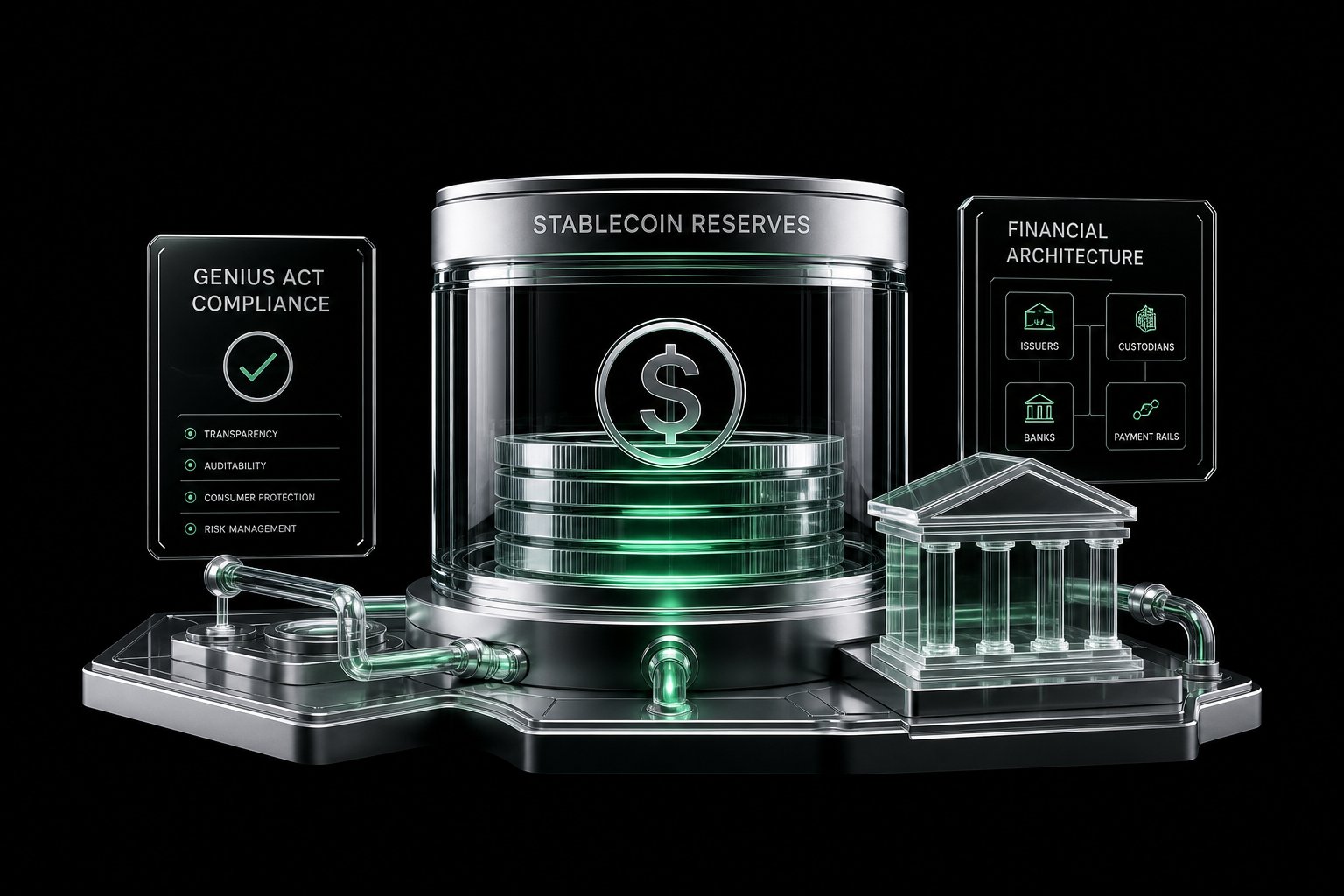
    A Bank Policy Institute study on Nov. 6 found that only two of the ten largest dollar stablecoins, representing 26 percent of outstanding tokens, meet the GENIUS Act’s reserve asset requirements — compliance is a gate, not a guarantee.

    Key Takeaway

    With the GENIUS Act taking effect on Jan. 18, 2027, reserve structure has become the compliance dividing line for stablecoins: only USDC and PYUSD (26 percent of outstanding tokens) among the ten largest dollar stablecoins currently meet the requirements, while USD1 and Ripple USD are dragged down by money market funds holding agency debt and longer-dated Treasuries, and USDT plus the crypto-backed USDS/DAI sit entirely outside the framework. In the same week, Nigeria’s central bank on Nov. 5 introduced its own stablecoin regime with a N15 billion capital floor, exporting reserve discipline from the United States to emerging markets. Reserve compliance is turning into the entry ticket for issuers and the proof of access for payment use cases.

    Out of Ten Stablecoins, Only Two Pass

    On Nov. 6, Bank Policy Institute (BPI) researchers Laurence Bristow and Eva Funaki published a note examining the reserve assets backing the ten largest dollar stablecoins by circulation as of June 30, 2026. These ten tokens account for 97 percent of all stablecoins outstanding — not a sample, but the market itself. The conclusion is blunt: only two coins, representing 26 percent of outstanding tokens, hold reserves that align with GENIUS Act requirements; another 2 percent are expected to come into compliance soon; the remaining 72 percent fall short, with offshore stablecoins accounting for 65 percent and crypto-backed stablecoins for 7 percent.

    The GENIUS Act’s reserve requirements for “payment stablecoins” are specific: U.S. Treasury securities with less than 93-day maturity, overnight reverse repurchase agreements secured by Treasuries, and bank deposits, among other highly liquid assets. Congress passed the Act in July 2025, the OCC finalized implementing rules on Oct. 21, and the regime takes effect on Jan. 18, 2027. With only about 70 days left until the effective date, the market’s existing reserve structures have already delivered the verdict — most top coins fail the test under their current asset mixes.

    Group Representative Coins Share Outstanding GENIUS Status
    Onshore compliant USDC, PYUSD 26% Already compliant
    Onshore, pending USD1, Ripple USD 2% Expected to be covered
    Offshore issuance USDT and others 65% Outside the framework
    Crypto-backed USDS, DAI 7% Outside the framework

    The four onshore coins are the focus. Circle’s USDC and Paxos’ PYUSD hold GENIUS-compliant reserves; World Liberty’s USD1 and Ripple USD do not, because both hold money market funds that in turn hold agency debt and longer-dated Treasuries. BPI also noted that World Liberty’s OCC conditional approval (Decision No. 1385) requires its stablecoin business to comply with the GENIUS Act, and Ripple USD’s state-trust framework is “subject to alignment with GENIUS requirements” — the question for both is not whether they will be covered, but when they will adjust their asset structures.

    “We find that only two of the 10 largest dollar stablecoins, representing 26 percent of tokens outstanding, currently align with GENIUS Act reserve asset requirements. We caution that complying with these reserve asset requirements does not mean that a stablecoin always will maintain its value.”
    — BPI, “Not All Stablecoins Will Follow GENIUS Reserve Asset Requirements”, Nov 6, 2026

    USDC is the largest onshore stablecoin, with over $73 billion in circulation. The BPI note contains a piece of history: before the Silicon Valley Bank (SVB) crisis in March 2023, USDC’s reserves were 85 percent Treasury bills plus 15 percent uninsured bank deposits, with just over half of those deposits held at SVB. When the bank failed, the market began to question USDC’s solvency and the coin de-pegged, trading as low as 87 cents. Circle subsequently cut its Treasury bill exposure and shifted into Treasury-backed repurchase agreements; by July 2026, about 70 percent of reserves were Treasury-backed repos, with the remaining 30 percent split evenly between uninsured bank deposits and Treasury bills. BPI uses this history as a reminder: even today’s compliant coins de-pegged in 2023. Compliance is a gate, not a guarantee.

    On the offshore side, the protagonist is USDT. BPI discloses that as of June 30, 2026, USDT’s reserves were 61 percent U.S. Treasury bills, 10 percent overnight repos secured by Treasuries, and close to zero bank deposits; the remaining 29 percent consisted of gold, public equities, bitcoin, secured loans, term repo loans and other investments, a share that has slowly grown over time. Tether does not publish the maturity structure of its Treasury bills, only that the weighted average maturity is under 90 days — even assuming every bill matures within 93 days, only about 71 percent of USDT’s reserves would meet GENIUS standards. BPI also lists USDT’s three de-pegging episodes: October 2018, November 2022 (after the FTX collapse), and August 2023 (when liquidity dried up during the crypto winter). Tether’s separately issued U.S.-compliant version, USA₮, has less than $200 million outstanding — the dual structure means mainstream USDT will stay offshore, outside the GENIUS perimeter.

    The crypto-backed group is led by Sky Protocol’s USDS and DAI, together close to $14 billion outstanding, making them the third-largest stablecoin. USDS reserves are not backed 1:1 by real-world assets but come in three flavors: minted directly by exchanging one USDC, borrowed against crypto collateral pledged to Sky’s DeFi lending protocol, or created by Sky-affiliated entities deploying funds into strategies. By June 2026, crypto-collateralized loans accounted for 42 percent of USDS reserves, stablecoins 38 percent, and tokenized real-world assets 20 percent; nearly 90 percent of the RWA sleeve sits in tokenized funds investing in short-term Treasuries, repos and AAA-rated collateralized loan obligations. Crypto-collateralized loans are not eligible reserve assets under the GENIUS Act, and USDS/DAI’s positioning means they will not become payment stablecoins in the Act’s sense — they look more like leverage protocols wearing a stablecoin’s clothing.

    Same Week, Nigeria Writes Reserve Discipline into Its Own Rules

    Across the Atlantic, an emerging market moved in parallel. The Central Bank of Nigeria (CBN) on Nov. 5 issued the Regulations for the Operations of Non-Security Virtual Assets in Nigeria, effective immediately, signed by Musa Jimoh, Director of the Payments System Policy Department. The 169-page framework splits stablecoins into two classes: Class 1 for naira-referenced stablecoins and Class 2 for those pegged to foreign currencies such as the U.S. dollar. Class 2 issuers face a paid-up capital floor of N15 billion (about $11.1 million), Class 1 issuers N10 billion, and other non-security virtual asset service providers N1 billion. Capital must be kept strictly separate from issuer reserves, the CBN reserve deposit, customer funds and operational liquidity — the same money cannot satisfy multiple regulatory obligations.

    The reserve rules mirror GENIUS: issuers must back outstanding stablecoins 1:1 with eligible reserve assets plus an additional 2 percent buffer; minting is only allowed once equivalent reserves are received and held; holders can redeem at face value, generally by the next business day, with a maximum five-business-day window under stress; algorithmic stablecoins and tokens pegged to fiat but backed mainly by other cryptocurrencies are banned outright. At least 40 percent of the reserve pool must be cash or eligible high-quality liquid assets, and naira-backed coins must hold at least 20 percent of the pool as a dedicated non-interest-bearing cash deposit at the CBN, withdrawable only with the Bank’s prior written consent. Stablecoins with circulating value above N500 billion for 30 consecutive days, or used by more than five million Nigerians, are designated systemically important and subject to enhanced oversight.

    On offshore issuers, the CBN’s stance matches Washington’s: no offshore exemption. Foreign issuers serving Nigerians must operate through a locally incorporated, licensed entity; Class 1 issuers must be incorporated in Nigeria, and Class 2 applicants must establish a Nigerian entity before final approval; operators are covered whether or not they maintain a physical office in the country as long as they direct services at Nigerian customers. Licence application fees are N10 million with an annual renewal fee of N5 million; operating without a licence draws a minimum fine of N100 million plus at least N1 million for each day the violation continues. Existing operators have a 180-day transition window to obtain licences, may only continue at their current scale in the meantime, must register within 30 days and begin supervisory reporting within 60 days. Peer-to-peer platforms face a new requirement: before releasing or crediting a regulated token, they must verify that the naira account name and Bank Verification Number (BVN) match the customer.

    Reserve Structure Becomes Proof of Access: Compliance Turns from a Threshold into an Operating Variable

    Read together, the two stories send one core signal: the center of gravity in stablecoin regulation has shifted from “do you have a licence” to “what exactly are your reserve assets.” GENIUS uses a list of short-dated, highly liquid, low-volatility assets — 93-day Treasuries, repos, bank deposits — to separate payment stablecoins from investment tokens at the balance-sheet level; the CBN reproduces the same logic for the naira economy with 1:1 full backing, a 40 percent cash floor, a 2 percent buffer and systemic-importance thresholds. Regulators are no longer satisfied with “the issuer says reserves are sufficient”; they demand that the reserve structure survives a checklist inspection.

    For practitioners, three groups now face different circumstances. First, onshore issuers: USD1 and Ripple USD need to restructure their reserves now, replacing money market funds with direct holdings of 93-day-or-less Treasuries or Treasury-backed repos. This is not a quarter-end reporting game but a hard condition embedded in the OCC conditional approval and the state-trust framework. Second, offshore issuers: USDT’s 65 percent share will not vanish overnight, but as U.S. institutional payments, bank clearing and custody begin treating GENIUS compliance as a condition of access, the usability of offshore stablecoins inside the regulated payments stack will narrow gradually; USA₮’s $200 million circulation shows the compliant version is still symbolic. Third, crypto-backed stablecoins: USDS/DAI were never payment stablecoins, and the reserve test effectively pins them to their “DeFi leverage tool” positioning, with no path into banking or clearinghouse rails.

    BPI’s caution is also worth remembering: compliance does not mean immunity from de-pegging. USDC’s 87-cent history in 2023 is in front of us, and USDT’s three de-pegging episodes are written into the report. Reserve structure solves the question of whether the asset side is stable; redemption mechanics, liquidity management and the ability to handle stress scenarios determine whether a run becomes a systemic event. Issuers that market GENIUS compliance as a safety promise will pay for it during the next de-pegging.

    Takeaways for Practitioners

    1
    Reserve structure is the new proof of access
    After GENIUS takes effect, compliance means “your reserve structure survives the checklist,” not “you hold a licence.” Onshore issuers should start swapping money market funds for 93-day-or-less Treasuries or Treasury-backed repos now, rather than waiting for a forced fix on Jan. 18, 2027. Bank partnerships, clearinghouse access and institutional custody will treat reserve compliance as an entry condition; those who fix early benefit first.

    2
    Offshore stablecoins’ institutional runway narrows
    USDT’s 65 percent share coexists with its “outside GENIUS” status. Regulated U.S. payment rails, bank settlement and custody services will gradually treat compliance as a condition of access, narrowing offshore coins’ usability in institutional contexts, while retail and emerging-market channels remain the base. Issuers should price the dual-track cost: compliant issuance versus offshore channel erosion.

    3
    Emerging markets are copying reserve discipline at home
    Nigeria’s 1:1 full backing, 40 percent cash floor, 2 percent buffer and systemic-importance thresholds mirror the U.S. GENIUS framework. Entering an emerging market means budgeting a second, independent compliance stack: local paid-up capital, reserve deposit locations (such as the CBN dedicated deposit), redemption timing and P2P identity requirements all sit outside the U.S. regime.

    4
    Compliance is not an immunity certificate
    USDC fell to 87 cents in 2023 and USDT has de-pegged three times, lessons that sit beyond reserve structure. Reserves solve asset-side stability; redemption mechanics, stress handling and liquidity management are the real run defenses. Issuers should not market compliance as a safety promise, and users should not treat a “compliant stablecoin” as a zero-risk asset.

  • 26% 的幸存者:GENIUS 储备测试劈开稳定币版图

    26% 的幸存者:GENIUS 储备测试劈开稳定币版图

    26% 的幸存者:GENIUS 储备测试劈开稳定币版图

    美国银行政策研究所 11/6 的研究显示,十大美元稳定币中只有两家、占流通量 26% 的币种符合 GENIUS 法案储备要求:合规是闸门,不是保证。

    文章解读

    GENIUS 法案 2027/1/18 生效前,储备结构已成稳定币的合规分水岭:十大美元稳定币中仅 USDC 与 PYUSD(合计占流通量 26%)达标,USD1、Ripple USD 被货币市场基金中的机构债与长端美债拖累,USDT 与加密抵押的 USDS/DAI 干脆落在框架之外。同一周,尼日利亚央行 11/5 以 150 亿奈拉资本门槛落地本土稳定币新规,把储备纪律从美国推向新兴市场。储备合规性正在变成发行商的准入门票与支付场景的准入凭证。

    十大稳定币,只有两家过关

    11 月 6 日,美国银行政策研究所(BPI)研究员 Laurence Bristow 与 Eva Funaki 发布报告,逐一检视 2026 年 6 月 30 日流通量最大的十个美元稳定币的储备资产。这十个币种合计占全部稳定币流通量的 97%,不是抽样,就是市场本身。结论很直接:只有两个币种、对应 26% 的流通量,储备结构符合 GENIUS 法案要求;另有 2% 即将达标;其余 72% 全部不达标,其中离岸稳定币占 65%、加密抵押稳定币占 7%。

    GENIUS 法案对”支付稳定币”的储备要求很具体:剩余期限 93 天以内的美国国债、以国债担保的隔夜逆回购协议、银行存款等高流动性资产。国会 2025 年 7 月通过该法案,OCC 已于 10/21 敲定实施规则,2027 年 1 月 18 日全面生效。距离生效只剩 70 天,市场上的存量储备结构却已经给出答案:多数头部币种按现行资产组合无法通过测试。

    分组 代表币种 流通量占比 GENIUS 状态
    在岸合规 USDC、PYUSD 26% 当前即达标
    在岸待达标 USD1、Ripple USD 2% 预计将被纳入
    离岸发行 USDT 等 65% 不在框架内
    加密抵押 USDS、DAI 7% 不在框架内

    四个在岸币种是重点:Circle 的 USDC 与 Paxos 的 PYUSD 储备结构合规;World Liberty 的 USD1 与 Ripple USD 不合规,原因是二者的储备里都有货币市场基金,而这些基金持有机构债与剩余期限更长的美债。BPI 还特别指出,World Liberty 的 OCC 附条件批准(Decision No. 1385)要求其稳定币业务遵守 GENIUS 法案,Ripple USD 的州信托框架也”需与 GENIUS 要求对齐”:这两家不是能不能免于适用的问题,而是何时调整资产结构的问题。

    “We find that only two of the 10 largest dollar stablecoins, representing 26 percent of tokens outstanding, currently align with GENIUS Act reserve asset requirements. We caution that complying with these reserve asset requirements does not mean that a stablecoin always will maintain its value.”
    : BPI, “Not All Stablecoins Will Follow GENIUS Reserve Asset Requirements”, Nov 6, 2026

    USDC 是最大的在岸稳定币,流通量超过 730 亿美元。BPI 报告里藏着一段历史教训:2023 年 3 月硅谷银行(SVB)危机前,USDC 的储备是 85% 国库券加 15% 无保险银行存款,其中超过一半存款放在 SVB。银行出事后,市场开始质疑 USDC 的偿付能力,币价一度跌到 87 美分。此后 Circle 大幅削减国库券敞口,转向以国债担保的逆回购,到 2026 年 7 月,储备中约 70% 是国债逆回购,其余 30% 由无保险银行存款与国库券对半分。BPI 借这段历史提醒:即使今天合规的币种,也曾在 2023 年脱锚过,合规是闸门,不是保证。

    离岸一侧的主角是 USDT。BPI 披露,2026 年 6 月 30 日 USDT 的储备中 61% 是美国国库券、10% 是以国债为抵押的隔夜逆回购,银行存款接近零;剩下的 29% 由黄金、公开市场股票、比特币、担保贷款、定期回购与其他投资构成,这一比例还在缓慢上升。Tether 不公布国库券的期限结构,只说加权平均期限低于 90 天:即便假定全部都在 93 天以内,USDT 也只有约 71% 的储备符合 GENIUS 标准。USDT 2018 年 10 月、2022 年 11 月(FTX 崩溃后)与 2023 年 8 月(加密寒冬流动性枯竭)三次脱锚的记录,也被 BPI 逐一列出。Tether 另外发行的美国合规版 USA₮ 目前流通量不足 2 亿美元,双轨结构意味着主流 USDT 将继续留在离岸,不进 GENIUS 的管辖圈。

    加密抵押组的代表是 Sky Protocol 的 USDS 与 DAI,合计约 140 亿美元流通量,是第三大稳定币。USDS 的储备不是 1:1 的真实资产,而是三合一:直接用 USDC 兑换铸造、用加密资产抵押从 DeFi 借贷协议借出、以及 Sky 关联实体借款投入策略。到 2026 年 6 月,USDS 储备里加密抵押贷款占 42%、稳定币占 38%、代币化真实资产占 20%;代币化 RWA 中近九成是投资于短期国库券、回购与 AAA 级 CLO 的代币化基金。加密抵押贷款不是 GENIUS 认可的储备资产,USDS/DAI 的定位也决定了它们不会成为法案意义上的支付稳定币:它们更像是披着稳定币外衣的杠杆协议。

    同周落地:尼日利亚把储备纪律写进本国规则

    大西洋对岸的新兴市场同步出招。尼日利亚央行(CBN)11 月 5 日发布《尼日利亚非证券虚拟资产运营条例》(Regulations for the Operations of Non-Security Virtual Assets in Nigeria),当日起生效,由支付系统政策部主任 Musa Jimoh 签署。这份 169 页的框架把稳定币分为两类:奈拉锚定的 Class 1 与美元等外币锚定的 Class 2。Class 2 发行商实缴资本门槛 150 亿奈拉(约 1,110 万美元),Class 1 为 100 亿奈拉,其他非证券虚拟资产服务商 10 亿奈拉。资本需要与发行准备金、CBN 存款、客户资金和运营流动性严格分离,不能一份钱满足多重监管义务。

    储备规则与 GENIUS 同构:发行商须以合格储备资产 1:1 全额覆盖未偿稳定币,另加 2% 缓冲;铸币前需要有等额储备到账;持有人可按面值赎回,常规赎回最迟下一工作日到账,压力情景下最长五个工作日;算法稳定币与主要靠其他加密货币支撑的”法币锚定”币被直接禁止。储备池中至少 40% 须为现金或合格高流动性资产,奈拉币另有至少 20% 要以专用现金存款形式放在 CBN,存款不生息、未经书面同意不得动用。超过 5,000 亿奈拉流通量连续 30 天、或用户超过 500 万的稳定币将被认定为系统重要性,接受强化监管。

    对离岸发行商,CBN 的立场与美国一致:不设离岸豁免。外国发行商向尼日利亚人提供服务,需要通过本地注册实体持牌经营;Class 1 发行商需要设在尼日利亚,Class 2 申请者须先成立本地实体;无论是否在尼日利亚有实体办公室,只要把业务指向尼日利亚客户,就落入管辖。牌照申请费 1,000 万奈拉、年费 500 万奈拉;无照经营最低罚款 1 亿奈拉,且每持续一天加罚至少 100 万奈拉。存量运营商有 180 天过渡期申请牌照,期间只能按现有规模经营,30 天内注册、60 天内启动监管报送。P2P 平台新增要求:释放或入账受监管代币前,需要完成银行验证号(BVN)与账户姓名匹配。

    储备结构成为准入凭证:合规从门槛变成运营变量

    两件事放在一起看,核心信号只有一个:稳定币监管的重心已经从”有没有牌照”转到”储备资产到底是什么”。GENIUS 用 93 天期限、逆回购、银行存款这类”短期限、高流动性、低波动”资产清单,把支付稳定币与投资型代币在资产负债表层面分开;CBN 则用 1:1 全额储备、40% 现金门槛、2% 缓冲和系统重要性阈值,把同一套逻辑复制到奈拉经济。监管者不再满足于”发行商说储备够”,而是要求”储备结构经得起清单检验”。

    对从业者而言,这意味着三类人处境不同。第一类是在岸发行商:USD1 与 Ripple USD 现在就需要面对储备结构整改,把货币市场基金置换为 93 天以内的直持美债或国债逆回购。这不是季度末的报表游戏,而是 OCC 附条件批准与州信托框架里的硬性条件。第二类是离岸发行商:USDT 的 65% 流通量份额不会一夜消失,但一旦美国机构支付、银行清算、托管这些场景开始把 GENIUS 合规当作准入条件,离岸稳定币在”受监管支付堆栈”里的可用性会逐步收窄,USA₮ 的 2 亿美元流通量说明合规版目前还是象征性的。第三类是加密抵押稳定币:USDS/DAI 本来就不是支付稳定币,储备测试的实质是把它们钉死在”DeFi 杠杆工具”的定位上,别指望进入银行与清算所通道。

    BPI 的提醒同样值得记住:合规不等于不脱锚。USDC 2023 年 87 美分的历史就在眼前,USDT 三次脱锚记录也白纸黑字写在报告里。储备结构解决的是”资产端够不够稳”的问题,赎回机制、流动性管理、压力场景下的处置能力,才是决定一次挤兑会不会演变成系统性事件的因素。把 GENIUS 合规当作安全承诺来营销的发行商,会在下一次脱锚中付出代价。

    对从业者的一些启示

    1
    储备结构是新的准入凭证
    GENIUS 生效后,合规不是”有牌照”而是”储备结构经得起清单检验”。在岸发行商应从现在开始把货币市场基金置换为 93 天内美债或国债逆回购,而不是等到 2027/1/18 再被动整改。银行合作、清算所接入、机构托管这些场景都会把储备合规当作准入门槛,先整改先受益。

    2
    离岸稳定币的机构场景会逐步收窄
    USDT 65% 的份额与”不进 GENIUS”的身份并存。美国受监管支付通道、银行结算、托管服务会逐步把合规作为准入条件,离岸币在机构场景中的可用性将收窄,但零售与新兴市场渠道仍是基本盘。发行商要算清楚双轨成本:合规版发行成本 vs 离岸版场景流失。

    3
    新兴市场把储备纪律复制到本国
    尼日利亚的 1:1 全额储备、40% 现金门槛、2% 缓冲与系统重要性阈值,与美国 GENIUS 同构。进入新兴市场时,本地实缴资本、储备存放地(如 CBN 专用存款)、赎回时效与 P2P 实名要求,都是独立于美国的第二套合规成本,规划跨境业务时要并行预算。

    4
    合规不是脱锚免疫证
    USDC 2023 年跌到 87 美分、USDT 三次脱锚,都是储备结构之外的教训。储备解决资产端稳定,赎回机制、压力处置、流动性管理才是挤兑防线。发行商别把合规当作安全承诺营销,用户也别把”合规稳定币”等同”零风险资产”。

  • Hong Kong Eyes Tokenized Gold ETF as Tokenization Hits Indexes and Voting

    Hong Kong Eyes Tokenized Gold ETF as Tokenization Hits Indexes and Voting

    A
    Aurellix
    November 7, 2026
    1 min read

    Today’s Focus
    Hong Kong’s SFC plans a tokenized gold ETF pilot, with 17 tokenized retail products managing $1.3 billion in assets and a new innovation pathway. OKXICE tokenized-stock opposition climbs to 67 companies, leaving only crypto-linked firms silent; tZERO goes public via a $350 million SPAC deal, and tokenized Treasuries pass the $5 billion milestone as institutional tokenization extends from cash management into index investing and shareholder rights.

    Industry Flash

    10 items

  • Hong Kong SFC Plans Tokenized Gold ETF Pilot — Executive Director of Investment Products Elisa Ng flags a gold ETF as the next pilot candidate; 17 tokenized retail products manage about $1.3 billion in assets, and an “Innovation Pathway” offers regulatory flexibility for first movers.
  • Amundi Extends Tokenization to Index Investing — Europe’s largest asset manager launches tokenized share classes of its flagship European equity index fund on Ethereum, with CACEIS providing the technology backbone, pushing past money-market tokenization toward mainstream index distribution.
  • Morgan Stanley Tokenizes US Stocks and Treasuries via DTCC — One of the first banks to tokenize real-world assets on the newly launched DTS service, while its own tokenized-equity ATS slips to Q1 2027, making shared infrastructure the faster path.
  • NYSE Brings in Broadridge for Onchain Shareholder Voting — The exchange adds onchain governance and digital transfer-agency services for its planned tokenized-stock platform, letting investors vote via wallets or ProxyVote while retaining shareholder rights alongside 24/7 trading.
  • OKXICE Opposition Climbs to 67 Companies — Meta, Palantir and S&P Global joined on November 5; 56 of the 62 initial-list issuers (about 90%) have objected, leaving only crypto-linked names like Strategy, Coinbase, Robinhood and Circle without disclosed objections.
  • tZERO Goes Public via SPAC Merger — Definitive business-combination agreement with Nasdaq-listed SPAC FG Imperii values tZERO at $350 million, with shares expected to trade on NYSE American under “TZRO” in early 2027 and up to about $231 million in trust cash available.
  • Ondo Tops RWA.xyz Distributed-Tokenization Ranking — Leads at $4.07 billion excluding stablecoins with 484 assets and 568,129 holders; USDY’s $2.4 billion leads the tokenized-Treasury race, ahead of Securitize’s $3.97 billion.
  • Tokenized Treasuries Pass the $5 Billion Mark — rwa.xyz data crosses $5 billion for the first time, adding about $1 billion in two weeks with BUIDL and Securitize leading, as institutions treat the assets as non-cash collateral for margin and liquidity management.
  • HashKey Lists Three WisdomTree Treasury Digital Funds — Its wealth-management channel adds WTSYX, WTTSX and WTSTX covering 1-3, 3-7 and 7-10 year US Treasuries for eligible professional investors, rounding out the onchain fixed-income product lineup.
  • RDUSD Stablecoin to Deploy on HSK Chain — HashKey On-Chain deepens its partnership with RD Technologies around cross-border trade, corporate payments and treasury management for the compliant stablecoin, with over $300 million in RWA already on HSK Chain.
  • 香港拟试点代币化黄金ETF,机构代币化延伸至指数与股东权益

    香港拟试点代币化黄金ETF,机构代币化延伸至指数与股东权益

    A
    Aurellix
    2026年11月7日
    1 分钟阅读

    今日焦点
    香港证监会拟试点代币化黄金ETF,17只代币化零售产品在管资产13亿美元,并推出创新路径机制。OKXICE代币化美股反对公司升至67家,仅剩加密关联公司未表态;tZERO以3.5亿美元估值借SPAC上市,代币化美债突破50亿美元里程碑,机构代币化正从现金管理延伸至指数投资与股东权益。

    行业速报

    共 10 条

  • 香港证监会拟试点代币化黄金ETF — 投资产品执行董事 Elisa Ng 透露黄金 ETF 是下阶段试点候选,17只代币化零售产品在管资产约 13 亿美元,并推出「创新路径」机制为先行产品提供监管弹性。
  • Amundi 将代币化延伸至指数投资 — 欧洲最大资管公司推出旗舰欧洲股票指数基金代币化份额,以太坊公链发行,CACEIS 提供技术底座,货基代币化后继续向主流指数资产分发推进。
  • 摩根士丹利借 DTCC 代币化美股与美债 — 成为 DTS 上线后首批将 RWA 代币化的银行,自家 ATS 支持代币化股票交易推迟至 2027 年一季度,共享基础设施先行成主流路径。
  • 纽交所引入 Broadridge 链上股东投票 — 为代币化股票平台提供链上治理与数字过户代理服务,投资者可经钱包或 ProxyVote 参与投票,24/7 交易下保留股东权益。
  • OKXICE 反对公司升至 67 家 — Meta、Palantir、标普全球等 11 月 5 日加入,初始 62 家名单中 56 家已异议(约 90%),仅剩 Strategy、Coinbase、Robinhood、Circle 等加密关联公司未表态。
  • tZERO 借 SPAC 合并上市 — 与纳斯达克上市 SPAC FG Imperii 签署最终协议,估值 3.5 亿美元,预计 2027 年初登陆 NYSE American(代码 TZRO),可获至多 2.31 亿美元信托现金。
  • Ondo 登顶 RWA.xyz 分布式代币化榜首 — 以 40.7 亿美元(不含稳定币)居首,484 个资产、56.8 万持有人,USDY 24 亿美元领跑代币化美债,反超 Securitize 的 39.7 亿美元。
  • 代币化美债突破 50 亿美元 — rwa.xyz 数据首次超越 50 亿美元,两周新增约 10 亿美元,BUIDL 与 Securitize 领跑,机构将其视为保证金与流动性管理的非现金抵押品。
  • HashKey 上架 3 只 WisdomTree 美债数字基金 — 财富管理频道新增 WTSYX/WTTSX/WTSTX,覆盖 1-3、3-7、7-10 年期美债,仅限合资格专业投资者,补全链上固收产品矩阵。
  • RDUSD 稳定币将部署 HSK Chain — HashKey On-Chain 与 RD Technologies 深化合作,围绕跨境贸易、企业收付与财资管理推进合规稳定币落地,HSK Chain 上 RWA 规模已超 3 亿美元。
  • Hong Kong Eyes Tokenized Gold ETF as Index Funds and Voting Go Onchain

    Hong Kong Eyes Tokenized Gold ETF as Index Funds and Voting Go Onchain

    Hong Kong Eyes Tokenized Gold ETF as Index Funds and Voting Go Onchain

    Onchain RWA Market Cap
    $39.36B
    +0.02% MoM

    Asset Holders
    5.65M
    +7.17% MoM

    Stablecoin Market Cap
    $283.05B
    +46.11% MoM transfers

    HK Tokenized Retail Products
    17
    $1.3B AUM

    Hong Kong SFC Floats Tokenized Gold ETF as Next Pilot as 17 Retail Products Hold $1.3B

    November 2, 2026 · Elisa Ng, SFC Executive Director of Investment Products / Blockhead
    Elisa Ng, the Securities and Futures Commission’s executive director of investment products, said at Hong Kong FinTech Week that a tokenized gold ETF “may form the next pilot” — the first public signal on the next phase of pilots after the first two tokenized money market funds landed on licensed platforms for 24/7 secondary trading last week. Hong Kong now has 17 approved tokenized retail products spanning money market funds, gold products and ETFs, with roughly $1.3 billion in assets under management. Ng also unveiled an “Innovation Pathway” mechanism offering regulatory flexibility for products with meaningful benefits and first-mover advantages, and hinted that e-CNY could eventually interact with tokenized funds through subscriptions and redemptions of RMB-denominated tokenized money market funds.
    • The first two ChinaAMC tokenized money market funds began 24/7 secondary trading on PantherTrade on October 26, with market makers, published indicative NAVs and drift alerts
    • The Innovation Pathway draws on the SFC’s existing powers to enable controlled pilots with regulatory flexibility, and extends beyond tokenization
    • The HKMA’s EnsembleTX moved to 24/7 interbank settlement in central bank digital currency the same day, linking tokenized deposits with tokenized fund investment
    Regulatory Shift
    From product approvals to “generating traffic” on built rails: secondary trading and treasury management are the two near-term use cases

    Product Pipeline
    Money market fund secondary trading leads, gold ETF enters the pilot shortlist, with index funds and bonds onchain on the longer-term list

    RMB Narrative
    e-CNY could access tokenized funds via RMB money market funds and onchain bill investment, reinforcing Hong Kong’s offshore RMB hub role

    Source: Blockhead · November 6, 2026

    Amundi Extends Tokenization to Index Investing as Flagship European Equity Fund Goes on Ethereum

    November 6, 2026 · Amundi Official Announcement
    Amundi, Europe’s largest asset manager, launched a tokenized share class of a flagship European equity index fund, extending tokenization beyond cash management solutions into index investing — a new milestone in its digital asset strategy. The new share class was issued on the public Ethereum blockchain and remains fully integrated into the fund’s existing operating model, with the fund still available through traditional channels. The solution was developed with CACEIS, leveraging its technology and infrastructure for the tokenization of fund units. Following its first tokenized money market fund share class and stablecoin subscriptions over recent months, Amundi is now pushing tokenization into mainstream index-based investment scenarios.
    • The flagship European equity index strategy is a core building block for portfolio allocation, and tokenization lets it be distributed directly through digital channels
    • The fund’s existing operating model stays intact, with tokenized and traditional share classes running in parallel for institutions and digital platforms
    • Amundi’s phased route continues: money market fund tokenization, then stablecoin subscriptions, then index funds, expanding to broader asset classes
    Supply-Side Signal
    A European asset management leader upgrades tokenization from a “cash management tool” to a “mainstream distribution channel”

    Infrastructure
    CACEIS provides the technology backbone for fund-share tokenization, with custody, clearing and issuance outsourcing taking shape

    Industry Trend
    After Morgan Stanley and Amundi, index-level assets onchain are becoming standard practice in institutional digital asset strategies

    Source: Amundi · November 6, 2026

    Morgan Stanley Tokenizes US Stocks and Treasuries via DTCC, Own ATS Slips to 2027

    November 4, 2026 · Morgan Stanley / DTCC
    Morgan Stanley announced on November 4 that it has become one of the first banks to tokenize real-world assets following the launch of the DTCC Tokenization Service (DTS), converting U.S. equities and U.S. Treasuries to tokenized form. Launched on October 28, DTS lets eligible institutions create 1:1 tokenized representations of securities held at the Depository Trust Company, which holds over $114 trillion in assets under custody, with 20 participating institutions at launch. Meanwhile, the bank’s own plan to support tokenized equities on its alternative trading system has moved to the first quarter of 2027 from an earlier target of the second half of 2026 — the DTCC route lets the bank tokenize securities before its own trading venue opens.
    • Amy Oldenburg, Morgan Stanley’s head of digital assets strategy: integrating tokenized assets with established market infrastructure will guide its digital asset strategy
    • DTS initially covers selected Russell 1000 stocks, major index ETFs and key U.S. Treasuries, supporting two-way conversion between traditional and tokenized forms
    • The 20 participating institutions include JPMorgan, Citi, BofA, Barclays, BNP, Fidelity, State Street and UBS, with rolling onboarding
    Route Choice
    Going onchain via DTCC’s shared infrastructure reaches tokenization capability faster than building a proprietary ATS

    Scale Signal
    A bank with $10.5 trillion in client assets begins genuinely tokenizing US stocks and Treasuries, opening the way for collateral mobility and capital efficiency

    Timeline
    ATS tokenized equities slip to Q1 2027, underscoring that product supply remains the biggest bottleneck for proprietary platforms

    Source: Blockhead · November 6, 2026

    NYSE Taps Broadridge for Onchain Shareholder Voting, Preserving Rights for Tokenized Stocks

    November 2, 2026 · NYSE / CoinDesk
    The New York Stock Exchange announced a partnership with Wall Street giant Broadridge Financial Solutions to provide onchain governance and digital transfer agency services for its planned tokenized stock trading platform, covering shareholder record management, investor communications and proxy voting. Investors will be able to participate in shareholder voting through supported wallets, broker platforms or Broadridge’s existing ProxyVote service. Broadridge serves more than 10,000 listed companies globally and processes over $15 trillion in securities trades daily. Securitize and tZERO were previously brought into the NYSE platform’s transfer agent lineup, with four additional partners — Computershare, Equiniti, Superstate and others — now joining.
    • Onchain voting lets tokenized stocks retain traditional shareholder rights and corporate action privileges alongside 24/7 trading
    • Broadridge’s ProxyVote service provides digital voting infrastructure for 10,000 listed companies that can map smoothly to onchain scenarios
    • The NYSE platform still requires regulatory approval with no confirmed launch date, designed for continuous trading, faster settlement and stablecoin payments
    Governance Gap Fill
    Transfer agents plus voting services complete the shareholder rights chain for tokenized stocks, addressing issuers’ core concerns

    Model Rivalry
    The exchange-led route diverges from the OKX-ICE third-party path, with issuers and transfer agents gaining greater voice

    Infrastructure
    Broadridge’s institutional capability at a $15 trillion daily settlement scale flows into the tokenization ecosystem

    Source: CoinDesk · November 2, 2026

  • RWA 早报 | 2026年11月7日

    RWA 早报 | 2026年11月7日

    香港拟试点代币化黄金ETF,机构代币化延伸至指数与股东权益

    RWA 链上总市值
    $39.36B
    环比 +0.02%

    资产持有者
    565.37万
    环比 +7.17%

    稳定币总市值
    $2,830.5亿
    月转账 +46.11%

    香港代币化零售产品
    17只
    AUM $13 亿

    香港证监会拟试点代币化黄金ETF,17只零售产品在管资产13亿美元

    2026年11月2日 · SFC 投资产品执行董事 Elisa Ng / Blockhead
    香港证监会投资产品执行董事 Elisa Ng 在金融科技周发表主题演讲,透露代币化黄金 ETF「可能构成下一个试点」——这是继上周首批两只代币化货币市场基金登陆持牌平台开放 24/7 二级交易后,监管机构对下一阶段试点方向的首个公开信号。目前香港已批准 17 只代币化零售产品,覆盖货币市场基金、黄金产品与 ETF,在管资产约 13 亿美元。Ng 同时宣布了「创新路径」(Innovation Pathway)机制,为带来实质效益且具先发优势的产品提供监管灵活性,并暗示数字人民币未来可通过人民币计价代币化货基的申购赎回与代币化基金互动。
    • 首批两只华夏基金代币化货基已于 10 月 26 日在 PantherTrade 上线 24/7 二级交易,配做市商、公布指示性 NAV 并设置偏离预警
    • 「创新路径」依托证监会现有权力,为受控试点提供监管弹性,不局限于代币化领域
    • 金管局 EnsembleTX 同日宣布升级 24/7 央行货币银行间结算,代币化存款与代币化基金投资链路同步打通
    监管取向
    从产品审批转向「建好轨道后催流量」:二级交易与财资管理成为两大近期用例

    产品节奏
    货基二级交易先行,黄金 ETF 进入试点候选清单,指数基金与债券上链列入长期清单

    人民币叙事
    e-CNY 有望通过人民币代币化货基与链上票据投资接入代币化生态,强化离岸人民币枢纽定位

    来源:Blockhead · 2026年11月6日

    Amundi 将代币化延伸至指数投资,旗舰欧洲股票基金份额上线以太坊

    2026年11月6日 · Amundi 官方公告
    欧洲最大资管公司 Amundi 宣布推出一只旗舰欧洲股票指数基金的代币化份额类别,将代币化从现金管理方案扩展至指数投资——这是其数字资产战略的最新里程碑。新份额在以太坊公链发行,完全融入基金既有运营模式,传统渠道仍可购买。方案由 CACEIS 提供技术与基础设施支持。此前数月,Amundi 已上线首只货币市场基金代币化份额并支持稳定币认购,此次将代币化推向更广泛的指数型主流投资场景。
    • 旗舰欧洲股票指数策略是组合配置的基础构建块,覆盖宽基股票敞口,代币化使其可被数字渠道直接分发
    • 基金现有运营模式保持完整,代币化份额与传统份额并行,机构与数字平台均可接入
    • 延续 Amundi 渐进式路线:货基代币化 → 稳定币认购 → 指数基金,逐步扩展到更广泛资产类别
    供给端信号
    欧洲头部资管把代币化从「现金管理工具」升级为「主流资产分发通道」

    基础设施
    CACEIS 承担基金份额代币化技术底座,托管-清算-发行一体化外包模式成型

    行业趋势
    继摩根士丹利、Amundi 之后,指数级资产上链正成为机构数字资产战略的标准动作

    来源:Amundi 官方 · 2026年11月6日

    摩根士丹利通过 DTCC 代币化美股与美债,自家交易平台推迟至2027

    2026年11月4日 · Morgan Stanley / DTCC
    摩根士丹利 11 月 4 日宣布成为 DTCC 代币化服务(DTS)上线后首批将真实世界资产代币化的银行之一,已将美国股票与美国国债转换为代币化形态。DTS 于 10 月 28 日推出,允许合格机构创建由 DTC 托管证券 1:1 支持的代币化表示,DTC 持有超过 114 万亿美元托管资产,初始参与机构达 20 家。与此同时,该行自家 ATS 支持代币化股票交易的计划从 2026 下半年推迟至 2027 年第一季度——DTCC 通道让银行在自有交易场所开放前即可先行代币化证券。
    • 摩根士丹利数字资产战略主管 Amy Oldenburg:将代币化资产与成熟市场基础设施结合将指引数字资产战略
    • DTS 初始覆盖精选 Russell 1000 成分股、主流指数 ETF 与主要美国国债,支持传统/代币化双向转换
    • 20 家签约机构含 JPMorgan、Citi、BofA、Barclays、BNP、Fidelity、State Street、UBS 等,将滚动接入
    路径选择
    借 DTCC 共享基础设施先行上链,比自建 ATS 更快触达代币化能力

    体量信号
    $10.5 万亿客户资产的银行开始真实代币化美股与美债,为抵押品流动与资本效率开路

    时间线
    ATS 代币化股票推迟至 2027Q1,凸显产品供给不足仍是机构自营平台最大瓶颈

    来源:Blockhead · 2026年11月6日

    纽交所引入 Broadridge 提供链上股东投票,代币化股票保留股东权益

    2026年11月2日 · NYSE / CoinDesk
    纽约证券交易所宣布与华尔街金融服务巨头 Broadridge 合作,为其计划推出的代币化股票交易平台提供链上治理与数字过户代理服务,涵盖股东记录管理、投资者沟通与代理投票等功能。投资者未来可通过支持的钱包、券商平台或 Broadridge 现有 ProxyVote 服务参与股东投票。Broadridge 目前为全球超过 1 万家上市公司提供服务,每日处理超过 15 万亿美元的证券交易结算。此前 Securitize 与 tZERO 已被纳入纽交所代币化平台的过户代理服务布局,此次新增 Computershare、Equiniti、Superstate 等四家合作伙伴。
    • 链上投票使代币化股票在 24/7 交易的同时保留传统市场的股东权益与公司行动权利
    • Broadridge 的 ProxyVote 服务为 1 万家上市公司提供数字投票基础设施,可平滑映射至链上场景
    • 纽交所平台仍需监管批准,尚无确认上线日期,设计目标为连续交易、快速结算与稳定币支付
    治理补位
    过户代理 + 投票服务补齐代币化股票的股东权益链路,回应发行人核心关切

    模式对垒
    交易所主导路线与 OKXICE 第三方路线分化,发行人与过户代理话语权上升

    基础设施
    Broadridge 单日 15 万亿美元结算量级的机构能力注入代币化生态

    来源:CoinDesk · 2026年11月2日

  • JPYSC Passes 30B Yen as SBI Wires a Stablecoin Balance Sheet in One Week

    JPYSC Passes 30B Yen as SBI Wires a Stablecoin Balance Sheet in One Week

    JPYSC Passes 30B Yen as SBI Wires a Stablecoin Balance Sheet in One Week

    Japan’s RWA push is moving from “tokenizing assets” to “circulating capital”: a stablecoin cash leg, yield assets, credit assets, and cross-border settlement rails all connected by SBI within a single week.

    JPYSC handled balance
    30b JPY
    Reached in ~5 months

    JPYSC lending balance
    10b JPY
    Up to 3% annual yield

    SMBC stake
    5%
    24M retail customers

    Erebor Bank deposits
    $7b
    24/7 on-chain settlement

    On November 2, SBI VC Trade announced that the handled balance of its yen stablecoin JPYSC had surpassed 30 billion yen, with the lending balance alone exceeding 10 billion yen. What makes the number notable is the timing: roughly five months after launch, SBI signed four deals in the same week with BlackRock, CRB Group, SMBC, and Erebor Bank. The yen stablecoin race is shifting from “who can issue” to “who can make the coin circulate on a balance sheet.”

    1. Beyond 30B Yen: A Trust-Type Stablecoin Enters Real Capital Use

    JPYSC uses a trust structure: SBI Shinsei Trust Bank is the issuer managing the trust property, SBI VC Trade handles distribution, and Startale provides the technical infrastructure. Reserve assets have begun to include Japanese government bonds, connecting off-chain reserves directly to the traditional yen money market. The lending product launched in July offers three tranches, 2% annualized at 28 days, 2.5% at 84 days, and 3% at 168 days, with applications accepted every Thursday. With 10 billion of the 30 billion yen held as loans, the stablecoin has begun to take on a deposit-like cash management function.

    SBI made clear in the announcement that JPYSC still needs legal amendments before it can be “publicized,” meaning free circulation on a public blockchain. For now, the more accurate positioning is a digital yen infrastructure expanding inside the regulated financial system, not a stablecoin already open to DeFi markets. Unlike the global path of “open first, regulate later,” Japan is choosing to build the rails first and release the water later.

    2. Four Deals in One Week: From Yield Assets to Credit Assets to Cross-Border Rails

    On October 27, SBI, Startale, and BlackRock signed a basic cooperation agreement to study connecting a tokenized money-market fund to JPYSC, covering technical infrastructure, business distribution, and regulatory market building. On October 28, SBI formed a strategic partnership with CRB Group, the parent of US lender Cross River Bank, to set up a joint venture in Japan developing RWA products such as loan receivables, and to study JPYSC as a settlement tool for tokenized-asset and cross-border transactions. On October 30, SBI and the SMBC Group reached a capital and business alliance, with SMBC taking a 5% stake in SBI Startale Marketing so its 24 million retail customers can use JPYSC. On November 2, SBI announced a $100 million investment in Erebor Bank through its US subsidiary.

    The four deals stitch together a complete on-chain balance sheet: JPYSC is the cash and settlement layer, the tokenized MMF is the low-risk yield asset, loan receivables and private credit are the credit assets, and Erebor Bank and Cross River are the cross-border settlement rails and distribution entry points. Erebor, co-founded with Anduril co-founder Palmer Luckey, holds an OCC national bank charter and FDIC insurance, opened in February 2026, passed $7 billion in deposits by September, and runs its own blockchain-based core system supporting 24/7 settlement and stablecoin deposits and withdrawals. Robinhood Ventures had already invested $30 million in preferred stock in October.

    3. Contrast with JPYC: The License Pioneer Loses on Distribution

    The same week, JPYC, the first licensed yen stablecoin, admitted it had “not grown in its first year”: one year after launch, circulation is around 3 billion yen, a quarter of its internal target, with the 1 million yen per-transaction cap cited as a key constraint. The contrast is sharp: JPYC got the license earlier, but SBI is winning through deep binding with bank channels and asset management channels. Distribution decides outcomes; issuance capability itself has been commoditized.

    JPYC is not without progress. After Japan’s duty-free system switched to “pay first, refund later” on November 1, Japan Tax Free and UPBOND began paying consumption-tax refunds to tourists in JPYC on the Avalanche C-Chain, the first government public-payment use case for a yen stablecoin. UPBOND also plans to add refund functionality to its Agentic Wallet. But overall, the yen stablecoin scaling narrative has been taken by SBI.

    4. Global Mix: The Fed’s Regulatory Gap

    On November 5, Cleveland Fed President Beth Hammack said at the SNB conference that AI agents using stablecoins would be a major shift in how money moves, and that smart contracts and agentic workflows could significantly increase stablecoin demand, and with it demand for dollar assets. But current US rules do not comprehensively cover smart contracts or agentic AI payments; the GENIUS Act rules take effect by January 2027 at the latest, still leaving responsibility, compliance, and oversight gaps. While the US debates rules, Japan has already built the rails directly on licensed institutions’ balance sheets.

    Key signal:SBI’s four deals in one week redefine JPYSC from a “payment tool” into the cash leg of an on-chain balance sheet. When a stablecoin can buy tokenized funds, tokenized funds manage cash, loan receivables enter on-chain asset pools, and banks provide custody and distribution, RWA moves from an asset-tokenization industry toward new financial infrastructure.
    1
    Stablecoin competition shifts from issuance to balance sheetsOf JPYSC’s 30 billion yen, 10 billion is lent out, the first time a stablecoin has taken on a deposit-like cash management function in Japan. Issuance is commoditized; whoever connects the coin to bank and asset-management channels controls scale.

    2
    RWA enters the “asset-capital circulation” stageSBI connected the cash leg, yield assets, and credit assets in one stroke: JPYSC handles payments and settlement, the tokenized MMF manages yield, loan receivables manage credit, and banks and cross-border platforms handle distribution, moving RWA from single-point products to full financial infrastructure.

    3
    Japan chooses “build rails first, release water later”JPYSC’s publicization still awaits legal amendments; the stablecoin first expands as a digital yen inside the regulated financial system before flowing onto open chains, a mirror path to the US GENIUS Act’s legislate-then-rule approach.

    4
    The machine-payment rules race heats upFed President Hammack publicly acknowledged the regulatory gap for AI-agent payments, while Japan has already built settlement rails on licensed balance sheets. Whoever lands the rules first holds the entry tickets to the AI-native payment era.

    5. Conclusion

    JPYSC passing 30 billion yen and SBI’s four deals in one week mark Japan’s stablecoin push moving from “issuance narrative” to “balance-sheet access.” When a stablecoin can buy tokenized funds, tokenized funds manage cash, loan receivables enter on-chain asset pools, and banks provide custody, distribution, and cross-border settlement, RWA becomes genuinely new financial infrastructure. For practitioners, the real watershed is not issuing more tokens but forming a stable loop among yen cash, yield assets, credit assets, and cross-border settlement.

  • JPYSC余额破300亿日元:SBI一周四连搭建稳定币资产负债表

    JPYSC余额破300亿日元:SBI一周四连搭建稳定币资产负债表

    JPYSC余额破300亿日元:SBI一周四连搭建稳定币资产负债表

    日本RWA正从”资产上链”走向”资产与资金形成稳定循环”:稳定币现金腿、收益资产、信用资产与跨境结算轨道在一周内被SBI全部接通。

    JPYSC取扱余额
    300亿日元
    上线约5个月突破

    JPYSC借贷余额
    100亿日元
    最高年化3%

    SMBC持股比例
    5%
    2400万零售客户

    Erebor银行存款
    $7b
    24/7链上结算

    11月2日,SBI VC Trade宣布日元稳定币JPYSC的取扱余额突破300亿日元,其中借贷业务余额突破100亿日元。这组数据的特别之处在于时间点:自6月上线算起只有约五个月,而同一周内SBI连续签下BlackRock、CRB Group、SMBC与Erebor Bank四笔合作。日元稳定币的竞争,正在从”谁能发币”切换到”谁能让币在资产负债表上流转”。

    一、300亿日元背后:信托型稳定币进入真实资金使用阶段

    JPYSC采用信托型结构:SBI新生信托银行作为发行主体管理信托财产,SBI VC Trade负责流通,Startale承担技术基础设施。其储备资产已开始配置日本国债,链下储备直接连接传统日元金融市场。7月上线的借贷业务提供三档产品,28天年化2%、84天2.5%、168天3%,每周四受理申购。300亿日元中100亿为贷出余额,说明稳定币已开始承担”类存款”的现金管理功能。

    值得注意的是,SBI在公告中明确表示,JPYSC仍需法律修订等条件满足后才能实现”Public化”,即允许在公开区块链自由流通。现阶段更准确的定位是:受监管金融体系内部正在扩张的数字日元基础设施,而非已进入开放DeFi市场的稳定币。这与全球稳定币”先开放后监管”的路径相反,日本选择先筑轨道再放水。

    二、一周四连:从收益资产到信用资产再到跨境轨道

    10月27日,SBI与Startale、BlackRock签署基本合作协议,研究Token化货币市场基金与JPYSC的连接,覆盖技术基础设施、业务分销与监管市场建设三部分。10月28日,SBI与CRB Group(美国Cross River Bank母公司)达成战略合作,计划在日本设立合资公司开发贷款债权等RWA产品,并研究将JPYSC作为Token化资产交易和跨境交易的结算工具。10月30日,SBI与SMBC集团达成资本业务合作,SMBC将收购SBI Startale Marketing 5%股权,使其2400万零售客户可以使用JPYSC。11月2日,SBI宣布通过美国子公司向Erebor Bank投资1亿美元。

    四笔合作拼出一张完整的链上资产负债表:JPYSC承担现金与结算层,Token化MMF承担低风险收益资产,贷款债权与私人信贷承担信用资产,Erebor Bank与Cross River承担跨境结算轨道与分销入口。Erebor由Anduril联合创始人Palmer Luckey参与创立,持有OCC国家银行牌照与FDIC保险,2026年2月开业、9月存款已超70亿美元,自建区块链核心系统支持24/7结算与稳定币存取。此前Robinhood Ventures已于10月投入3000万美元优先股。

    三、对照JPYC:牌照先行者输在分发渠道

    同一周,日元稳定币的第一个持牌者JPYC坦承”第一年没有增长”:上线一周年流通约30亿日元,仅为内部目标的四分之一,单笔100万日元的交易上限被视为主要约束。这构成一个鲜明对照,JPYC拿牌照更早,但SBI赢在银行渠道与资产管理渠道的深度绑定。分发决定成败,发行能力本身已经商品化。

    JPYC并非全无进展。11月1日日本免税制度改为”先征后退”后,Japan Tax Free与UPBOND合作在Avalanche C-Chain上以JPYC发放游客消费税退税,成为日元稳定币首个政府公共支付场景,UPBOND还计划将退税功能接入其Agentic Wallet。但整体而言,日元稳定币的规模化叙事已被SBI拿走。

    四、全球混合:美联储的规则留白

    11月5日,克利夫兰联储行长Beth Hammack在SNB会议上表示,AI代理使用稳定币将是资金流动方式的重大转变,智能合约与agentic workflows可能显著推升稳定币需求,进而增加对美元资产的需求;但美国现行规则并未全面覆盖智能合约与代理式AI支付,GENIUS法案的规则最迟2027年1月生效,仍留出责任、合规与监督的空白。当美国还在讨论规则,日本已用持牌机构资产负债表直接搭好轨道。

    关键信号:SBI一周四连的本质,是把JPYSC从”支付工具”重新定义为”链上资产负债表演的现金腿”。当稳定币可以购买Token化基金、Token化基金承担现金管理、贷款债权进入链上资产池、银行提供托管与分销时,RWA才真正从资产上链行业接近新的金融基础设施。
    1
    稳定币竞争从发行量切向资产负债表JPYSC 300亿日元余额中100亿为贷出,稳定币第一次在日本承担”类存款”的现金管理功能。发行能力已商品化,谁能把币接入银行与资管渠道谁才掌握规模。

    2
    RWA进入”资产与资金循环”阶段SBI把现金腿、收益资产与信用资产全部接通:JPYSC管支付结算、Token化MMF管收益、贷款债权管信用、银行与跨境平台管分销,RWA从单点产品走向完整金融基础设施。

    3
    日本选择”先筑轨道再放水”JPYSC的Public化仍待法律修订,稳定币先作为受监管金融体系内部的数字日元扩张,再向开放链上流动。与美国GENIUS法案先立法后规则的路径互为对照。

    4
    机器支付规则竞赛升温美联储Hammack公开承认AI代理支付规则空白,日本则以持牌机构资产负债表直接搭好结算轨道。谁的规则先落地,谁就掌握AI原生支付时代的入场券。

    五、结论

    JPYSC突破300亿日元与SBI一周四连,标志着日本稳定币从”发币叙事”进入”资产负债表接入”阶段。当稳定币可以购买Token化基金、Token化基金承担现金管理、贷款债权进入链上资产池、银行提供托管分销与跨境结算时,RWA才真正成为新的金融基础设施。对从业者而言,真正的分水岭不是发行更多Token,而是让日元现金、收益资产、信用资产与跨境结算形成稳定循环。

  • Stablecoins Enter the Clearinghouse, Crypto Enters the Tax Office

    Stablecoins Enter the Clearinghouse, Crypto Enters the Tax Office

    Two Pipelines Open at Once: Stablecoins Enter the Clearinghouse, Crypto Enters the Tax Office

    A CFTC no-action letter clears the way for stablecoin margin in clearing, while Hong Kong, China completes crypto-asset tax reporting legislation within the same 48 hours. One governs settlement, the other governs tax, as crypto assets are wired into two of traditional finance’s deepest pipes.

    Article Analysis

    On November 5, the CFTC’s Division of Clearing and Risk issued Staff Letter 26-30, allowing derivatives clearing organizations to treat trust companies as settlement banks for daily settlements, paving the way for Nodal Clear to accept stablecoin margin. On November 4, Hong Kong, China’s Legislative Council passed the CARF crypto-asset reporting framework amendment on third reading, with trading data for Bitcoin, Ethereum and other crypto assets to be exchanged automatically with partner tax jurisdictions from 2028. One opens the clearing pipe, the other opens the tax pipe. Crypto assets are being wired into traditional finance’s underlying infrastructure through staff letters and tax-law amendments rather than grand legislation.

    The Clearing Pipe: Trust Companies Move to the Daily Settlement Seat

    On November 5, the CFTC’s Division of Clearing and Risk issued Staff Letter 26-30 (Press Release 9322-26), signed by Acting Director Richard Haynes. The core conclusion is a single sentence: a derivatives clearing organization (DCO) may use a trust company to conduct daily settlements with clearing members, provided it treats the trust company as a settlement bank and complies with all requirements of Regulations 39.14(c) and 39.14(d). This is a no-action letter, meaning staff would not recommend an enforcement action against the arrangement, not a revision of the rule itself.

    The trigger was Nodal Clear. This registered DCO is the common clearinghouse for Nodal Exchange and Coinbase Derivatives, both CFTC-designated contract markets, is wholly owned indirectly by the European Energy Exchange (EEX), and has elected to comply with the Subpart C requirements applicable to systemically important DCOs. On October 29, Nodal Clear filed a request on behalf of itself and all registered DCOs, stating it is preparing to accept stablecoins as initial margin collateral and describing state-regulated trust companies as among the leading custodians of digital assets. Bringing trust companies into the settlement workflow would integrate digital assets into existing daily collateral-movement processes. Nodal’s argument was straightforward: Regulation 39.14, essentially unrevised since its adoption in 2011, defines a settlement bank only as a bank and contains no reference to trust companies, yet Section 4d of the Commodity Exchange Act and CFTC Regulations Parts 1 and 22 already allow customer funds to be held at a bank or trust company. If trust companies are already trusted to hold customer funds, they should equally be able to perform daily settlement.

    The CFTC accepted this logic without relaxing any control requirements. Regulation 39.14(c) requires a DCO to maintain documented settlement-bank selection criteria covering capitalization, creditworthiness, liquidity access, operational reliability and regulation or supervision, and to monitor its exposure to those institutions on an ongoing basis. Regulation 39.14(d) addresses settlement finality: transfers must become irrevocable and unconditional no later than when the DCO’s accounts are debited or credited. The no-action condition is to apply both provisions to trust companies as if they were settlement banks. It is neither an exemption nor a waiver of selection, monitoring or finality obligations. In other words, the CFTC simply opened the “settlement bank” slot to trust companies while leaving the rest of the rulebook intact. The letter applies to any DCO that meets its conditions, not just Nodal Clear.

    “According to the letter, a derivatives clearing organization may use a trust company for daily settlements if it treats the trust company as it would a settlement bank under applicable CFTC requirements.”
    — CFTC Press Release 9322-26, November 5, 2026

    The letter’s weight lies in how it extends the OCC’s trust-charter roadmap. Since December 2025, the OCC has issued at least nine national trust bank charters to crypto firms (the count Senator Warren cited in her May 18 letter to Comptroller Gould), including Circle, Coinbase and Ripple. National trust banks can custody assets and settle payments, but they carry no FDIC insurance and cannot take deposits or make loans. By bringing trust companies into daily derivatives settlement, the CFTC has effectively seated them at the center of derivatives clearing, outside the full bank rulebook. Community banks have already taken their fight to court: in early October, the Independent Community Bankers of America (ICBA) sued the OCC in federal court in Washington, D.C., seeking to strike down the trust-charter rule and the conditional approval granted to Protego, arguing the approach “creates a gaping hole in financial regulation.” The CFTC’s no-action letter widens the target of that litigation.

    A related announcement the same week reinforced the direction of this pipe. On November 4, Coinbase said it would offer eligible institutional clients in the U.S. access to Deribit options, dated futures and perpetual futures through Coinbase Financial Markets, spanning more than 20 assets and accepting BTC, ETH and USDC as collateral. Orders flow through Coinbase Bermuda to Deribit for execution and clearing, with the margin model run by Deribit. It is another attempt by a U.S.-registered futures broker to bring the world’s largest crypto derivatives liquidity to domestic institutions, and in its collateral pool, stablecoins sit alongside bitcoin and ether.

    The Tax Pipe: CARF Lands, Crypto Enters the Automatic Exchange Network

    On November 4, Hong Kong, China’s Legislative Council passed the Inland Revenue (Amendment) (Crypto-Asset Reporting Framework and Amended Common Reporting Standard) Bill 2026 on third reading, transposing the OECD’s Crypto-Asset Reporting Framework (CARF) and the amended Common Reporting Standard (CRS) into local law. It is the territory’s latest legislative move on digital assets following the Stablecoins Ordinance enacted in August 2025. Secretary for Financial Services and the Treasury Christopher Hui said implementing the latest international standard for automatic exchange of tax information is critical to maintaining Hong Kong’s reputation as an international financial and commercial center, and would give crypto-asset service providers, financial institutions and digital asset users greater confidence to operate and invest long-term in the city.

    The timeline is clear: CARF takes effect on January 1, 2027, when reporting service providers must collect the transaction data specified under the framework, and the Inland Revenue Department begins its first automatic exchanges with partner tax jurisdictions in 2028. The amended CRS takes effect in 2028, with account information exchanged under the new standard from 2029. Exchanges operate on a reciprocal basis, subject to data confidentiality and security safeguards. To help the industry adapt, the IRD will issue guidance, has set up a dedicated task force for technical support, and has launched a self-assessment tool.

    The coverage is broader than most expect. The ordinance defines “crypto-assets” as assets relying on cryptographically secured distributed ledgers (DLT) or similar technology, covering two broad categories: crypto tokens, which represent a claim, membership right or property right against a person or entity and can be exchanged digitally for fiat or other crypto assets; and fungible and non-fungible tokens (FTs and NFTs) that can be bought, sold or transferred in digital form. With narrow exceptions such as central bank digital currencies (CBDCs), mainstream assets including Bitcoin, Ethereum and Solana are all in scope. From 2028, transaction data occurring on Hong Kong, China platforms will flow annually to partner tax jurisdictions, just as financial account data has been exchanged under CRS since 2018.

    Industry attention centers on two questions: first, whether the scope of “covered service providers” will extend to custody, brokerage and over-the-counter (OTC) trading; second, the list of initial exchange partners, which will determine which countries’ tax authorities can see trading data from Hong Kong, China platforms after 2028. Regulators have already confirmed that reporting crypto-asset service providers with a reporting nexus to Hong Kong must register with the tax authority and retain due diligence records, with an administrative penalty mechanism established alongside.

    Event Date Content & Impact
    CFTC Staff Letter 26-30 2026-11-05 Allows DCOs to use trust companies for daily settlement (as settlement banks), paving the way for stablecoin margin
    HK CARF amendment 2026-11-04 CARF effective 2027/1/1; automatic exchange of crypto transaction data from 2028
    Coinbase opens Deribit 2026-11-04 US institutional clients gain Deribit options/perps access; USDC accepted as collateral
    ICBA sues OCC early Oct 2026 Community banks seek to void trust-charter rule and Protego conditional approval

    Viewed together, the throughline is clear: whether the CFTC’s clearing pipe or Hong Kong’s tax pipe, both follow the route of plugging crypto assets into existing infrastructure rather than legislating a new regime for them. The CFTC did not amend Regulation 39.14; it merely added trust companies to the list of institutions that can serve as settlement banks. Hong Kong did not create a new tax for crypto assets; it folded CARF and the amended CRS into the existing tax-transparency framework. This “embedded” regulation stands in sharp contrast to CLARITY-style market-structure legislation. With congressional legislation frozen and agency rules reversible, clearinghouses and tax authorities have become the two least visible yet hardest-to-reverse points of entry.

    Implications for Practitioners

    1
    Stablecoins’ institutional gateway is extending from exchanges to clearinghouses
    Staff Letter 26-30 means stablecoins as derivatives margin are no longer an offshore-exchange play; they are entering the collateral workflows of U.S.-registered clearinghouses. DCOs preparing to accept stablecoin margin should wire trust companies into their settlement processes and satisfy the selection and finality requirements of 39.14(c)(d). For stablecoin issuers, the opening of clearing channels means demand sources are diversifying.

    2
    Tax visibility becomes a new compliance threshold for crypto service providers
    CARF is not a distant international initiative but a law with a concrete timeline: data collection from 2027, exchange from 2028. Providers should confirm early whether they qualify as covered service providers and build customer due diligence and transaction-record retention mechanisms. Whether custody, brokerage and OTC are included is the regulatory variable most worth tracking.

    3
    Trust companies are becoming a compliance channel around the bank rulebook
    The OCC grants charters and the CFTC opens clearing; trust companies now perform bank-like functions on two levels. But the ICBA lawsuit means this path can be cut off by a court at any time. Institutions relying on trust charters should treat litigation progress as part of their compliance contingency planning and assess what alternatives exist if the charter rules are struck down.

    4
    “Embedded regulation” is the main channel during the legislative freeze
    After CLARITY failed, regulation did not stop; it embedded itself in the existing system through no-action letters, tax-law amendments and rule interpretations. These tools are low-profile and hard to reverse, yet they keep shifting the compliance coordinates of crypto assets. Practitioners should watch not only Congress but also clearinghouses, tax authorities and courts.

  • 两条管道同时打通:稳定币走进清算所,加密资产走进税务局

    两条管道同时打通:稳定币走进清算所,加密资产走进税务局

    两条管道同时打通:稳定币走进清算所,加密资产走进税务局

    CFTC 用一份无异议函为稳定币保证金扫清清算障碍,香港在同一天前后完成加密资产税务申报立法。一个管结算,一个管税务,加密资产正被嵌入传统金融的两条底层管道。

    文章解读

    11 月 5 日,CFTC 清算与风险部门发布 Staff Letter 26-30,允许衍生品清算组织把信托公司当作结算银行用于每日结算,为 Nodal Clear 接受稳定币保证金铺平道路。11 月 4 日,中国香港立法会三读通过 CARF 加密资产申报框架修例,比特币、以太坊等加密资产交易资料将从 2028 年起与伙伴税务管辖区自动交换。一个打通清算结算管道,一个打通税务信息管道,加密资产正在以行政函件和税法修订的方式,而非宏大立法,被接入传统金融的底层基础设施。

    清算管道:信托公司站上每日结算的位置

    11 月 5 日,CFTC 清算与风险部门(Division of Clearing and Risk)发布 Staff Letter 26-30(新闻稿 9322-26),由代理主任 Richard Haynes 签署。核心结论只有一句:衍生品清算组织(DCO)可以使用信托公司进行与清算成员的每日结算,前提是把信托公司视同结算银行,遵守 Regulation 39.14(c) 和 39.14(d) 的全部要求。这是一份无异议函,即工作人员不推荐对该安排启动执法程序,而非对规则本身的修订。

    函件的触发者是 Nodal Clear。这家注册 DCO 是 Nodal Exchange 与 Coinbase Derivatives 的共同清算所,由欧洲能源交易所(EEX)间接全资持有,并已选择遵守适用于系统性重要 DCO 的 Subpart C 要求。10 月 29 日,Nodal Clear 代表自身及所有注册 DCO 提出请求,称其正准备接受稳定币作为初始保证金抵押品,而各州监管的信托公司正是数字资产的领先托管机构。把信托公司纳入结算流程,可以把数字资产接进现有的每日抵押品划转工作流。Nodal 的论证很直接:Regulation 39.14 自 2011 年采用以来几乎未修订,其”结算银行”定义仅指银行、不含信托公司,但《商品交易法》第 4d 条以及 CFTC 条例 Part 1 和 Part 22 早已允许客户资金存放在银行或信托公司。既然信托公司被允许持有客户资金,它理应也能承担每日结算职能。

    CFTC 接受了这一逻辑,但没有放松任何控制要求。39.14(c) 要求 DCO 对结算银行建立书面的选择标准,覆盖资本充足、信用、流动性、运营可靠性与监管状况,并持续监控自身对这些机构的敞口;39.14(d) 要求结算终局性,即资金划转在账户借记或贷记时即不可撤销、无条件。无异议函的条件是把信托公司等同结算银行执行这两条,既不是豁免,也不免除选择、监控与终局性义务。换言之,CFTC 只是把”结算银行”的名额向信托公司开放,其他规则原样保留。函件适用所有满足条件的 DCO,不限于 Nodal Clear。

    “According to the letter, a derivatives clearing organization may use a trust company for daily settlements if it treats the trust company as it would a settlement bank under applicable CFTC requirements.”
    — CFTC Press Release 9322-26, November 5, 2026

    这封函件的分量在于它接续了 OCC 的信托牌照路线图。自 2025 年 12 月起,OCC 已向加密企业发出至少 9 张国家信托银行牌照(参议员 Warren 5 月 18 日致信 Comptroller Gould 时的统计),Circle、Coinbase、Ripple 等均在列。国家信托银行可以托管资产、结算支付,但不参加 FDIC 存款保险,不能吸收存款或发放贷款。CFTC 此次把信托公司引入衍生品清算的每日结算,等于在银行规则簿之外,让信托公司坐进衍生品清算的中心位置。社区银行的反击已经进入法院:10 月初,独立社区银行家协会(ICBA)在华盛顿特区联邦法院起诉 OCC,要求撤销信托牌照规则与 Protego 的附条件批准,称这”在金融监管中撕开了一个大洞”。CFTC 的无异议函让这场诉讼的标的进一步扩大。

    同一天前后的另一则消息强化了这条管道的走向。11 月 4 日,Coinbase 宣布通过 Coinbase Financial Markets 向美国合格机构客户开放 Deribit 的期权、到期期货与永续合约,覆盖 20 多个标的,接受 BTC、ETH 与 USDC 作为抵押品。订单经 Coinbase Bermuda 转至 Deribit 执行与清算,抵押品模型由 Deribit 运行。这是美国注册期货经纪商把全球最大加密衍生品市场的流动性接入本土机构的又一次尝试,其抵押品池里,稳定币与比特币、以太坊并列。

    税务管道:CARF 落地,加密资产进入自动交换网络

    11 月 4 日,中国香港立法会三读通过《2026 年税务(修订)(加密资产申报框架及经修订的共同汇报标准)条例草案》,把经济合作与发展组织(OECD)的加密资产申报框架(CARF)与最新修订的共同汇报标准(CRS)引入本地法律。这是继 2025 年 8 月《稳定币条例》落地之后,中国香港在数字资产监管框架上的又一立法动作。财经事务及库务局局长许正宇表示,实施自动交换税务资料的最新国际标准,对维持香港作为国际金融和商业中心的声誉很关键,也让加密资产服务提供者、金融机构和数字资产用户更有信心在港运营、长期投资。

    时间表清晰:CARF 框架自 2027 年 1 月 1 日起实施,相关服务提供者届时须收集框架指定的交易资料,税务局自 2028 年起与伙伴税务管辖区首次自动交换;经修订的 CRS 于 2028 年实施,2029 年起按新标准交换财务账户资料。交换按互惠原则进行,并须确保资料保密与安全。为协助业界适应,税务局将发布指引、成立专责小组提供技术支援,并推出自我评估工具。

    覆盖范围比多数人预想的更广。条例所指”加密资产”依赖加密保护分布式分类账(DLT)或类似技术,涵盖两大类:一是加密代币,代表针对个人或实体的申索、成员权利或财产权,且可通过数字形式兑换为法定货币或其他加密资产;二是同质化与非同质化代币(FT 与 NFT)。除央行数字货币(CBDC)等少数例外,比特币、以太坊、Solana 等主流加密资产均被纳入。这意味着 2028 年起,中国香港平台上发生的加密资产交易资料将按年流向伙伴税务管辖区,正如 2018 年以来金融账户资料经 CRS 自动交换那样。

    业界关注点集中在两个问题上:其一,”涵盖服务提供者”的范围会不会延伸到托管、经纪与场外交易(OTC);其二,首批交换伙伴的名单,这直接决定 2028 年后哪些国家的税务机关能看到中国香港平台上的交易资料。监管机构已明确要求与香港有申报关联的申报加密资产服务提供者向税务部门登记,并备存尽职审查记录,行政罚则机制同步建立。

    事件 时间 内容与影响
    CFTC Staff Letter 26-30 2026-11-05 允许 DCO 使用信托公司每日结算(等同结算银行),为稳定币保证金铺路
    香港 CARF 修例三读 2026-11-04 CARF 2027/1/1 实施,2028 年起自动交换加密资产交易资料
    Coinbase 开放 Deribit 2026-11-04 美国机构客户接入 Deribit 期权/永续,接受 USDC 抵押品
    ICBA 起诉 OCC 2026-10 初 社区银行要求撤销信托牌照规则与 Protego 附条件批准

    把两件事放在一起看,主线很清楚:无论是 CFTC 的清算管道还是香港的税务管道,走的都是把加密资产”接入既有基础设施”的路线,而不是为加密资产单独立法。CFTC 没有修订 39.14,只是把信托公司纳入”结算银行”的适用名单;香港没有为加密资产单设税种,只是把 CARF 与修订版 CRS 并入既有税务透明框架。这种”嵌入式”监管与 CLARITY 法案式的市场结构立法形成鲜明对照。在国会立法冻结、行政规则可逆的背景下,清算所与税务局成了最不显眼、却最难逆转的两个接入点。

    对从业者的一些启示

    1
    稳定币的机构入口正在从”交易所”向”清算所”延伸
    Staff Letter 26-30 意味着稳定币作为衍生品保证金不再只是离岸交易所的玩法,而是进入了美国注册清算所的抵押品工作流。准备接受稳定币保证金的 DCO 应把信托公司接入结算流程,并确保满足 39.14(c)(d) 的选择标准与终局性要求。对稳定币发行商而言,清算通道的打开意味着需求来源正在多元化。

    2
    税务可见性成为加密服务提供者的新合规门槛
    CARF 不是遥远的国际倡议,而是已经落地成法的时间表:2027 年收集资料、2028 年开始交换。服务提供者应尽早确认自身是否属于”涵盖服务提供者”,建立客户尽职审查与交易记录备存机制。托管、经纪与 OTC 是否被纳入,是当前最需要跟踪的监管变量。

    3
    信托公司正成为绕开银行规则簿的合规通道
    OCC 发牌照、CFTC 接清算,信托公司正在两个层面承担银行职能。但 ICBA 的诉讼意味着这条路随时会被法院打断。依赖信托牌照的机构应把诉讼进展作为合规预案的一部分,同时评估如果牌照规则被撤销,自身的替代安排是什么。

    4
    “嵌入式监管”是立法冻结期的主通道
    CLARITY 法案折戟后,监管并未停步,而是以无异议函、税法修订、规则解释的方式嵌入既有体系。这类工具不显眼、难逆转,却持续改变着加密资产的合规坐标。从业者不应只盯国会,还要盯清算所、税务局与法院。