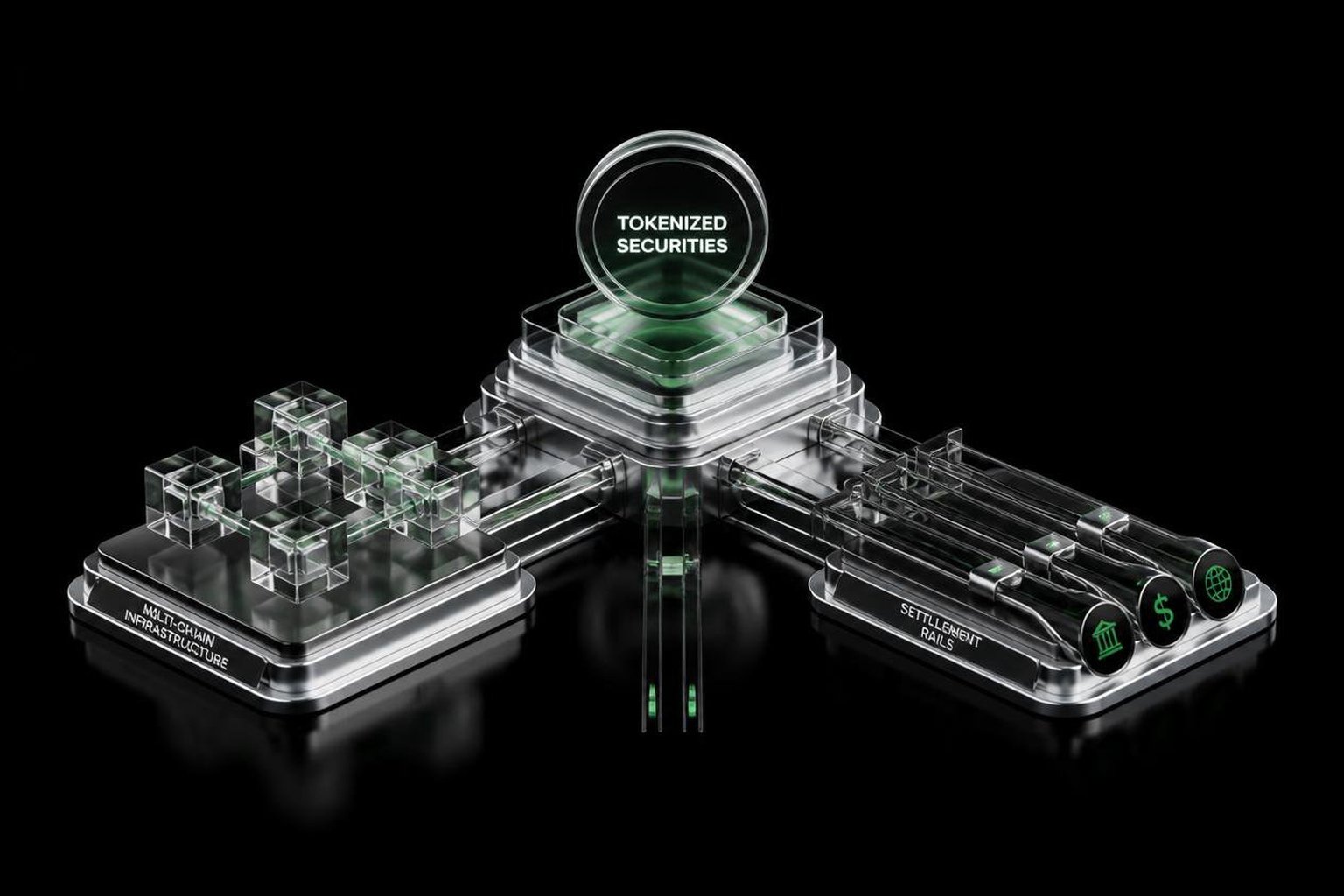
The Tokenized Securities Infrastructure Race: Who Builds the Rails
From Hanwha’s multi-chain platform in South Korea and Broadridge’s DLX in the US to Liqi’s $2 billion credit pipeline in Brazil, the competition in tokenized securities is shifting from “is it legal” to “who builds the rails.” For practitioners, this week marks the end of the speculation phase and the start of the infrastructure-building phase.
Article Analysis
Around September 9, the “market plumbing” for tokenized securities entered a period of concentrated deployment: Hanwha built a multi-chain platform on Avalanche ahead of South Korea’s February 4, 2027 legal recognition; Broadridge launched its “always-on” DLX infrastructure in the US; Brazil’s Liqi raised its issuance target with XDC from $500 million to $2 billion; and the European Central Bank’s Pontes settlement bridge goes live on September 21. Legal frameworks (Korea, SEC, MiCA, Taiwan) and institutional infrastructure (DTCC, Canton, Hanwha, tZERO) converged this week, signaling that tokenized securities are moving from “pilot narrative” to “who can build usable rails.”
Hanwha Bets on Multi-Chain: A Korean Broker Builds a Trading Platform Before the Law Lands
On September 9, Seoul Economic Daily reported that South Korea’s Hanwha Investment & Securities, together with blockchain firm FairSquare Lab, had built a tokenized securities platform supporting Avalanche. The significance lies not simply in “using blockchain” but in the fact that the system is designed as a multi-chain architecture, running simultaneously on Avalanche and enterprise chains such as Hyperledger Besu.
The timing is highly signal-laden. South Korea passed the tokenized securities law amendments in January 2026, allowing distributed ledgers to serve as legally recognized securities registers; those amendments take effect on February 4, 2027. The amendments do not create a separate category of securities. Instead, they permit conventional securities to use blockchain as the official record of ownership and issuance. In other words, Hanwha wants to have a workable platform running before the legal recognition goes live.
The Korea Securities Depository (KSD) is also preparing infrastructure capable of connecting to multiple distributed-ledger systems, with a planned architecture spanning Avalanche, Hyperledger Besu and Hyperledger Fabric. This is not a closed single-consortium-chain game; it is an open route where regulators explicitly support “multi-chain in parallel, unified registration.”
— Catenaa / Seoul Economic Daily, September 9, 2026
Hanwha Group’s tokenization footprint runs deep: group affiliates hold roughly a 9.6% stake in tokenization firm Securitize, making it the largest shareholder; in July, Hanwha Investment & Securities also invested 30 billion won (about $22.3 million) in Digital Asset, which operates Canton Network, an institutional blockchain for tokenized assets and regulated financial infrastructure.
Connect the dots: Hanwha is a Securitize shareholder, an investor in Canton operator Digital Asset, and simultaneously built its own Avalanche/Besu multi-chain platform. It is not betting on any single chain; it is laying out interoperable infrastructure across the board. This precisely captures the theme of this phase: the chain itself no longer matters as much as the “rails” that can plug into official registration and settlement.
Broadridge Launches DLX: Making “Always-On” the Operating System of Tokenized Securities
On the same day, US-based Broadridge (NYSE: BR) launched DLX, an “always-on” infrastructure platform covering the full lifecycle of tokenized assets. Positioned as “the operating system for tokenized finance,” DLX combines multi-chain enablement, a programmable smart-contract composer, 24/7 transaction capability, and institutional-grade workflow orchestration across traditional and on-chain markets.
DLX does not start from scratch. It builds on Broadridge’s Distributed Ledger Repo (DLR) capability, which processes more than $350 billion in daily collateral mobility and securities-financing activity. DLX extends this production-verified foundation across bonds, equities, funds, private markets and money-market instruments, covering issuance, trading, settlement, servicing, custody, governance and distribution.
DLX launches with the ability to connect to the DTCC Tokenization Service (via Canton and other networks). The deep logic here is that tokenized securities must connect with the existing custody and clearing system to enter the mainstream, and DTCC happens to be the hub of global securities clearing. Broadridge Global Head of Digital Innovation Horacio Barakat is direct about the positioning: DLX gives market participants an accelerated pathway to operating on-chain without sacrificing the controls, connectivity and operating models they rely on today.
— Horacio Barakat, Global Head of Digital Innovation, Broadridge, September 9, 2026
Also on September 9, Eddid Securities USA, the US subsidiary of Hong Kong’s Eddid Financial, announced a partnership with tZERO to provide trading, clearing and custody for digital asset securities through a correspondent clearing arrangement under FINRA Rule 4311, with access to the tZERO Securities ATS. Though smaller in scale, this news completes the same picture as Hanwha and Broadridge: regulated broker-dealers are packaging digital asset securities into existing brokerage experiences “as a service” rather than building their own full technology stacks.
Brazil’s Credit-Side Breakout: Liqi Puts $2 Billion of Structured Credit On-Chain
While Korea and the US build “trading and settlement rails,” Brazil is opening another path through structured credit. On September 9, Brazilian tokenization platform Liqi Digital Assets renewed its partnership with XDC Network for two more years, raising the targeted issuance from $500 million to $2 billion (through 2028).
The increase rests on faster-than-expected execution. Liqi and XDC originally signed in April 2025, targeting up to $500 million of real-world assets over 24 months; it was reached in about 15 months, nine months ahead of schedule. Liqi has become the largest issuer of yield-bearing assets on XDC, having deployed roughly $835 million of tokenized assets on XDC mainnet across 386 series, 60 asset pools and 378 smart contracts.
— Daniel Coquieri, CEO & co-founder, Liqi Digital Assets, September 9, 2026
Assets Liqi has issued on XDC include trade receivables, payroll-deductible loans, debentures, corporate credit and Brazilian receivables certificates, involving institutions including Itaú BBA, Banco BV, Banco ABC Brasil and Creditas. XDC Head of LATAM Diego Consimo stresses that these are “structured credit operations, originated within the regulated financial market, that now use blockchain as an effective part of their infrastructure.”
Regulation is tracking in parallel. In July, Brazil’s securities regulator CVM created a dedicated Tokenization Working Group to study DLT-based registration, custody, trading and settlement of securities, and to propose an experimental regulatory regime for tokenized securities. The group spans 14 internal areas and has begun discussions with ANBIMA, ABCripto, ABToken and other market participants. Brazil’s central bank is separately exploring tokenized finance through Drex, a DLT environment for regulated financial intermediaries.
On the data side, tokenization is moving beyond a single US-Treasury narrative toward a broader credit picture. RWA.xyz data as of September 9 shows roughly $7.82 billion of distributed tokenized credit and another $37.73 billion of represented credit assets across more than 2,500 assets, spanning corporate credit, structured credit, specialty finance and other non-sovereign debt. By blockchain, Ethereum leads distributed RWA value at about $17.6 billion, followed by BNB Chain, Solana and Stellar.
Why This Week Matters: Legal Recognition and Infrastructure Land at the Same Time
Placing the events around September 9 on a timeline reveals a clear structural inflection. Fitch Ratings captured it in its September 9 commentary: as regulatory rules in major financial markets become clearer, securities firms’ opportunities to expand digital-asset business are increasing, with legal and operational uncertainty around digital-asset custody, tokenized product issuance and distribution, and stablecoin payment and settlement all declining.
What this timeline reveals is a deep shift: the debate over tokenized securities has moved from “whether regulation allows it” (legal recognition) to “who provides the usable issuance, custody, trading and settlement rails” (infrastructure). Legal recognition answers “can it be done”; infrastructure answers “who builds it, how it runs, and how it connects to existing systems.” Fitch also notes that multiple jurisdictions’ legal recognition of blockchain-based ownership is boosting securities firms’ ability to issue and distribute tokenized securities and funds through existing brokerage and wealth-management platforms, directly echoing Hanwha, Broadridge and tZERO’s moves this week.
Implications for Practitioners
Sources
- 1. Hanwha Builds Avalanche Token Securities Platform — Catenaa, September 9, 2026
- 2. Broadridge Launches DLX, an Always-On Digital Asset Infrastructure Platform for Tokenized Markets — Broadridge PR, September 9, 2026
- 3. Eddid Securities USA Partners with tZERO for Digital Asset Securities Trading and Custody — PR Newswire, September 9, 2026
- 4. Brazil’s Tokenization Push Accelerates With $2 Billion Credit Plan — BeInCrypto, September 9, 2026
- 5. Fitch Ratings: Clearer Regulatory Frameworks Broaden Securities Firms’ Digital Asset Scope — Fitch Ratings, September 9, 2026
- 6. Countdown to Pontes: Europe’s Market Plumbing Enters Its Tokenised Test Phase — FinanceX Magazine, September 2026
发表回复