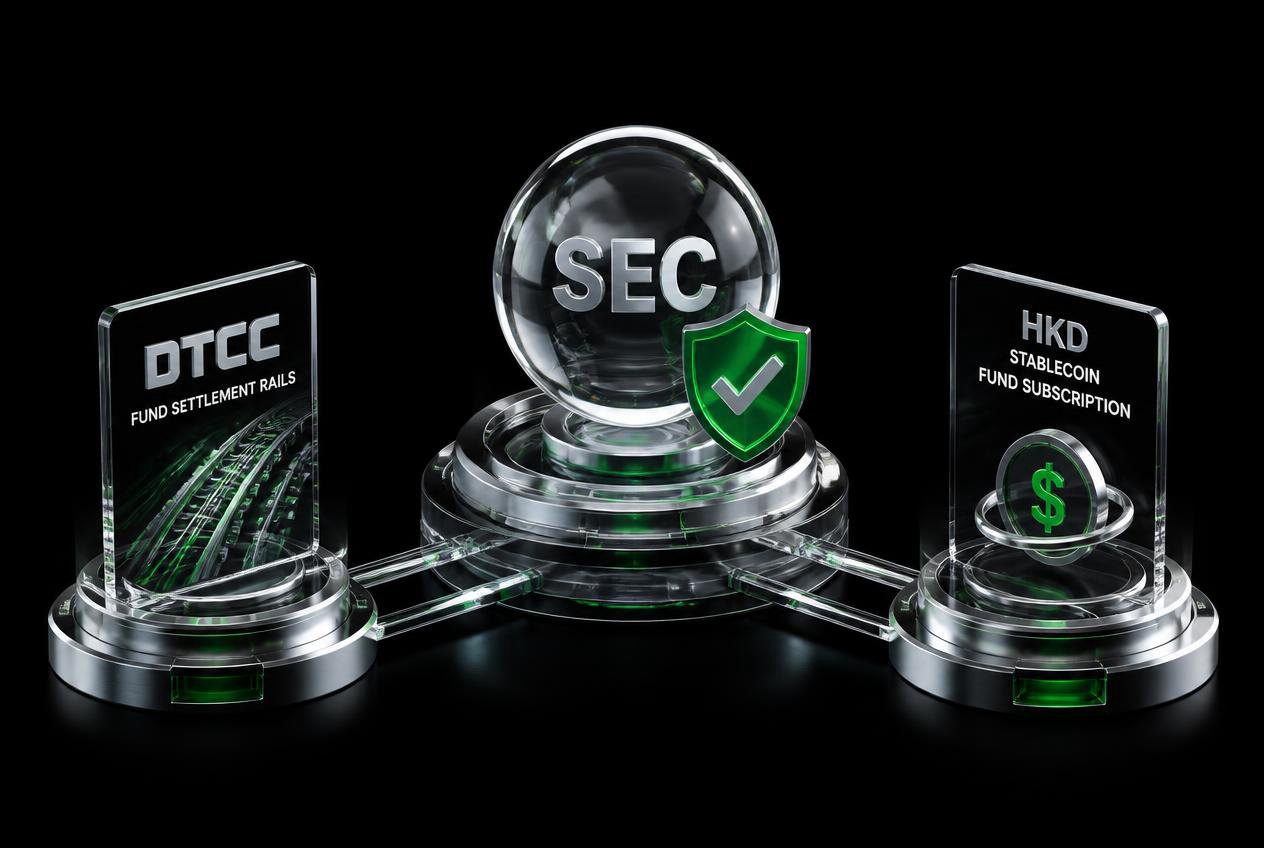
SEC Exemption Lifts On-Chain Assets; DTCC Opens Fund Rails to Tokenization
Bitcoin intraday high
$84,932
▲ 5.3% · 8-month high
Binance RWA platform
$753.6M
▲ 29.7% (30 days)
DTCC Fund/SERV share
85%+
of US mutual fund processing
Tokenized equities
€1.9B
6.3x in 18 months
SEC Exemption Reprices On-Chain Assets as Bitcoin Returns to an Eight-Month High
Markets have begun pricing in the SEC’s new five-year temporary exemption. The framework allows qualifying tokenized-securities venues to match buyers and sellers of tokenized US National Market System (NMS) equities through permissioned automated market makers (AMMs) and liquidity pools, provided the tokens carry the same rights as conventional shares, including dividends and voting. The news lifted the sector broadly: Bitcoin traded as high as $84,932, an eight-month high and a 5.3% daily gain, after briefly falling below $76,000 when the Fed raised rates by 25 basis points to a 3.75%-4% target range and a procedural vote on the CLARITY Act stalled.
- Hyperliquid’s HYPE token touched a record $96, pushing its market capitalization above $20 billion; over the past week UNI rose about 40%, AVAX about 47% and ENA about 50%, while RWA leader ONDO gained roughly 26%
- The “on-chain brokerage” narrative was repriced: after Backpack launched 24/7 US equity trading, its platform token jumped about 34% to an all-time high, as the market started treating licensed on-chain distribution as a standalone valuation factor
- Technical signals turned with it: Bitcoin posted its first weekly close above its 50-week moving average in 45 weeks, reinforcing the regulatory tailwind, though the $82,000 ceiling capped rallies in May and again in early September
Market pricing
Falling regulatory uncertainty is being discounted directly into infrastructure and distribution names, not just into narratives
Policy path
With legislation stalled, the SEC and CFTC are pushing tokenized securities forward using existing statutory authority
Risk note
Higher real rates after the hike will cap richly valued RWA tokens, favoring names with tangible settlement and issuance traction
Binance Adds 25 Stock Listings as Its On-Chain RWA Platform Nears $754 Million
On September 21, Binance listed 25 new equities on its traditional brokerage platform, Binance Stock Trading, spanning sectors from logistics to defense. Over the same period, tokenized assets on its blockchain-native RWA platform grew 29.7% in 30 days to $753.59 million. The exchange is running two product lines in parallel, conventional brokerage and native on-chain assets, feeding tokenized equities into the same existing user base.
- Tokenized equities allow fractional trading from $5 and 24/7 matching, and can be held in personal wallets, complementing rather than replacing the in-platform brokerage account
- The product line is extending into derivatives: Binance Futures rolled out 24/7 FX perpetual contracts, starting with USD/BRL at up to 100x leverage, carrying the “never closes” logic into currency trading
- Scale brings regulatory exposure: conventional securities and on-chain structures now run side by side on one platform, so custody, disclosure and accredited-investor definitions must hold under two rulebooks at once
Distribution
Existing brokerage users are funneled directly into tokenized assets at far lower acquisition cost than a standalone venue
Competition
Exchanges are competing for 24/7 trading mindshare with a stocks-plus-FX-plus-RWA bundle, shifting differentiation to asset breadth
Regulatory variable
Venue eligibility under the exemption, investor suitability and cross-border distribution determine whether the growth continues
Source: ChainResearch (citing U.Today) · September 21, 2026
DTCC’s Fund/SERV Admits Its First Tokenization Platform, Tapping Rails That Carry 85% of US Fund Trades
DTCC’s Fund/SERV platform admitted Oasis Pro Markets, a subsidiary of Ondo Finance, as a member on September 16. Oasis Pro Markets is a registered US broker-dealer and distributor of tokenized investment products, and the first tokenization platform to connect to Fund/SERV, which processes more than 85% of US mutual fund transaction activity. Members gain standardized access to fund companies, wealth platforms and service providers for transaction processing, reconciliation, distributions and reporting.
- The significance is standardization: tokenized distributors no longer need separate integrations with each fund company and can reuse the same infrastructure as traditional distributors, sharply cutting marginal integration cost
- Access is not the same as assets moving on-chain. Membership alone does not put Ondo funds or their underlying assets onto Fund/SERV, and realized volume depends on whether distributors actually route orders through the connection
- It extends DTCC’s existing trajectory: DTC previously received an SEC no-action letter to tokenize Russell 1000 equities, ETFs and US Treasuries in a controlled production environment, with rollout slated for the second half of 2026
Infrastructure
Tokenization shifts from building a parallel pipe to plugging into the existing one, lowering adoption friction
Institutional signal
A clearinghouse opening its membership to a tokenized distributor amounts to a legitimacy endorsement
To be proven
Value depends on distributors’ actual subscription and redemption flows, otherwise it stays “available” rather than “used”
Source: The Asian Banker · September 16, 2026
A Regulated Hong Kong Dollar Stablecoin Settles Fund Subscriptions for the First Time
China Asset Management (Hong Kong) said on September 18 that it completed an investment use case in which units of its digital money market fund were subscribed for and redeemed using HKDAP, a regulated Hong Kong dollar stablecoin issued by Anchorpoint Financial. Trades ran through accounts at OSL HK, a licensed digital asset exchange, while Standard Chartered acted as custodian for both the token and fund units as well as tokenization agent. The firm described it as one of the first cases in Hong Kong of a regulated HKD stablecoin settling digital fund subscriptions and redemptions.
- ChinaAMC (HK)’s digital money market fund series, launched in 2025, covers HKD, USD and RMB, with combined assets above HK$5.8 billion (about $745 million) as of June 16, 2026, and will progressively move toward continuous trading outside banking hours
- Anchorpoint received a stablecoin issuer licence from the Hong Kong Monetary Authority in April 2026 under the Stablecoins Ordinance and is a joint venture between Standard Chartered Bank (Hong Kong), HKT and Animoca Brands, concentrating issuance, custody and tokenization inside one regulated banking group
- Asset management capacity is expanding in parallel: the Hong Kong SFC authorized the BlackRock HKD Digital Liquidity Fund on September 10, the firm’s first tokenized fund in Asia-Pacific, also with Standard Chartered as custodian and tokenization partner and HKDAP among the digital cash routes
Why it matters
Stablecoins move from payments into fund settlement, closing the loop between on-chain cash and fund units
Structure
A regulated stablecoin plus a licensed exchange plus bank custody is replicable but sets a high bar
To be proven
No transaction size or fees were disclosed, and adoption depends on distributors’ use of the digital channel
Source: ChinaAMC (HK) release via Hubbis · The Asian Banker · September 18, 2026
Eurosystem Builds the Settlement Layer as the UK Puts Collateral Mobility at the Centre
The European Central Bank’s Pontes project is planned as an operational service in the third quarter of 2026 to connect market-based distributed-ledger-technology (DLT) platforms with TARGET settlement infrastructure. Its accompanying Appia contact group has drawn 61 financial-market and public-sector participants to help design a more unified European market for tokenized assets. In the same window, the Bank of England and the UK’s Financial Conduct Authority published feedback to their wholesale-tokenization call for input, drawing 123 responses, with most respondents naming post-trade processes, and collateral movement between counterparties in particular, as the main opportunity.
- The focus is shifting from how assets are tokenized to how tokenized instruments settle: issuance technology can replicate an asset’s representation, but only a settlement link to central-bank money addresses institutional finality concerns
- The UK has not changed existing collateral-eligibility rules, but has placed collateral mobility at the centre of its next phase of wholesale tokenization, with a joint roadmap due later in 2026 and a separate FCA consultation on tokenized gold
- A risk flag appeared alongside: ESMA’s half-year report noted many tokenized equities are issued as debt claims backed by underlying shares, with legal ownership staying off-chain, and that outstanding value rose from roughly EUR 300 million to almost EUR 1.9 billion in 18 months while remaining negligible against global equity markets
Settlement layer
Central-bank money connecting to DLT platforms is a prerequisite for institutional scale, not an optional accelerator
Regulatory pace
Europe is leading with infrastructure and standards while rules follow gradually, with milestones anchored inside 2026
Structural risk
A tokenized security and a tokenized debt claim on a security differ on rights and settlement, which will shape regulatory treatment and disclosure
Source: Fundshing (citing Cinco Días) · The Asian Banker · September 14-21, 2026
发表回复