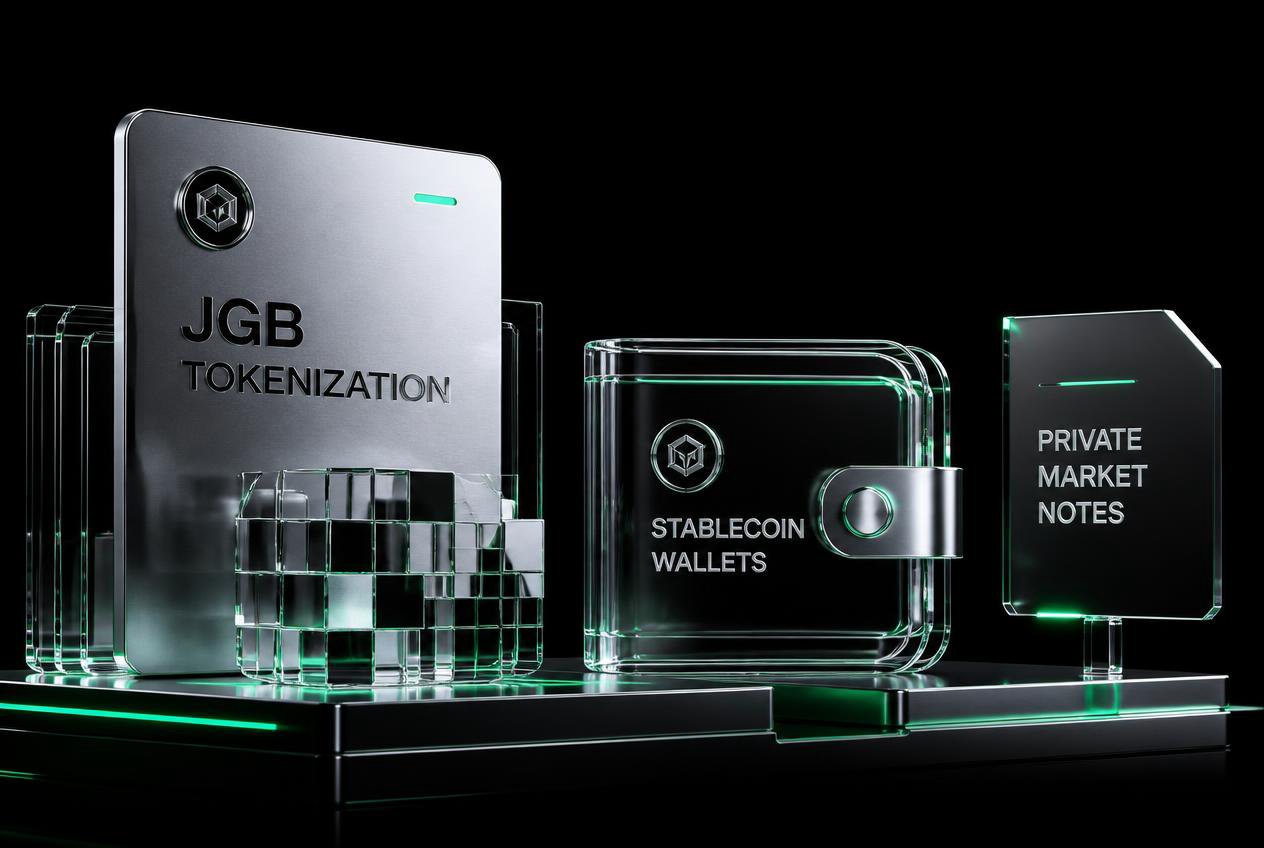
Sovereign Bonds Go Onchain: Japan JGB Study as Stablecoins Hit 82M Phones
Tokenized Treasuries Market
$15.1B
BUIDL retakes lead at $2.8B
Japan FY2027 Bond Issuance Request
¥143T
$918B · 4th straight record
Japan 10Y JGB Yield
2.95%
Highest since Sep 1996
Samsung Galaxy Devices
82M
Native USDC cross-border
Japan’s Finance Ministry Opens JGB Tokenization Study With Three Onchain Models
Japan’s Ministry of Finance held the inaugural meeting of its Study Group on On-Chain Government Bonds on October 8, putting JGB tokenization on the formal agenda. An official paper outlined three models: tokenizing the beneficiary rights of money market funds that invest in JGBs; making the book-entry transfer ledger blockchain-compatible, including extending to the Bank of Japan’s own ledger; and issuing a new form of government bond directly on a blockchain outside the existing settlement system. The BoJ and the FSA attended as observers, with a report targeted for January 2027.
- Driven by record debt pressure: the FY2027 bond issuance request reached ¥143 trillion ($918B), a fourth straight record; debt-servicing costs are set to hit ¥36.64 trillion ($234B)
- The 10-year JGB yield hit 2.95% in August, the highest since September 1996; the last two 10-year auctions drew weak bids, leaving demand in need of new buyers
- Overseas onchain investors are cited as the biggest beneficiaries — those already holding onchain assets could find a yield-bearing parking spot for idle cash
- A homegrown precedent exists: JPYC, the first yen-pegged stablecoin, is backed by domestic savings and JGBs; the more it issues, the more JGBs it buys
Policy Signal
The world’s third-largest bond market is now formally evaluating onchain issuance at central-bank level, moving the sovereign debt narrative from pilots to institutional study
Model Design
Three tiers run from shallow to deep — MMF beneficiary rights, central-bank ledgers, then native issuance — balancing incremental and radical approaches
Acknowledged Risks
Officials flag market fragmentation, 24/7 trading amplifying price swings, and system adaptation costs as open questions
Sources: TradingKey/Cryptopolitan · BigGo Finance · October 8, 2026
BlackRock’s BUIDL Retakes the Tokenized Treasury Crown at $2.8B, Overtaking Circle’s USYC
BlackRock’s USD Institutional Digital Liquidity Fund (BUIDL) has climbed back to roughly $2.8 billion in assets, reclaiming the top spot among tokenized US Treasury products after Circle’s USYC briefly overtook it in March 2026. BUIDL now holds about 18.5% of the $15.1 billion tokenized Treasury market, with the rest split between USYC and a fragmented roster of competitors; the broader market approaches $16 billion when including competing products.
- USYC uses an accumulating yield structure (NAV around $1.11); BUIDL is a traditional fund structure ($1.00 anchor, daily accrual, monthly payout) — each with trade-offs in collateral use cases
- Securitize runs BUIDL across eight blockchains; asset-servicing fees drove record Q1 2026 revenue and its NYSE listing
- Infrastructure is accelerating in parallel: DTCC plans a commercial launch of DTC tokenization in October; tZERO and ICE signed an MOU in late August to build the NYSE-affiliated digital trading platform
Market Structure
A “two giants plus long tail” pattern is emerging, mirroring the early stablecoin era as institutional capital converges on a handful of trusted platforms
Competitive Logic
The leadership contest is really about yield mechanics, entry thresholds and collateral compatibility
Infrastructure
With DTCC and ICE both nearing launch, the $300 trillion of global high-quality liquid assets (only 10% currently used as collateral) is starting to be unlocked
Sources: CoinTurk · CryptoCoinShow · October 8, 2026
Samsung Wallet Natively Adds USDC: Cross-Border Stablecoin Transfers on 82 Million Galaxy Devices
The Solana Foundation announced that Samsung Wallet and Samsung Pay will natively support stablecoins on Solana, letting US users send cross-border remittances in USDC from within Samsung Wallet starting the last week of October, across 82 million Galaxy devices. The feature is built into the existing wallet rather than alongside it — users never touch seed phrases, DEXs or bridges, and integrated fiat on/off-ramps handle local-currency conversion automatically.
- Custody and compliance: Bastion serves as the licensed stablecoin custodian with Coinbase Prime Vault as sub-custodian; transfers require biometric authentication on registered devices
- Wallet-to-wallet transfers are fee-free; payouts to bank accounts in 60+ countries incur destination-based fees shown in-app with estimated delivery times
- Solana has processed more than $5.25 trillion in stablecoin volume in 2026, with supply up nearly 20% year over year; PayPal, Western Union and Visa already use the network
- Samsung launched a blockchain wallet in 2019 and brought Coinbase into Samsung Wallet for 75 million US users in October 2025
Distribution Shift
Stablecoins move from crypto tools to an everyday payment rail preinstalled on phones, breaking the distribution bottleneck with 82 million devices
Ecosystem Synergy
With Solana stablecoin supply and volume both rising, the Samsung case offers OEM-level validation that stablecoins are payment rails
Competitive Landscape
Hardware wallets, system wallets and exchange wallets now form three distribution layers, pushing the retail onramp down to scan-and-send simplicity
Sources: PR Newswire · BSCN · October 7, 2026
Ondo Lists an OpenAI Private-Market Note, Putting Pre-IPO Exposure Into 24/7 Onchain Trading
Ondo Private Markets listed its first private-market note — the OpenAI Private Markets Note (OPAIPon) — on the Ondo Perps spot order book on October 8, letting qualified investors buy and sell economic exposure to OpenAI around the clock before any IPO. The venue showed a price of $1,132 with a bid-ask spread of $5.60 (0.49%) on launch day. The note tracks the realized per-share value of the reference company’s common stock but explicitly confers no OpenAI shares or shareholder rights.
- The product is a fully funded spot asset with no leverage or funding payments; access is limited to qualified non-US investors, with US persons excluded
- Holders receive an unsecured debt obligation of PM Issuer Co (BVI), not equity; redemption depends on a qualifying liquidity event (pricing six months after an IPO, a majority acquisition, or the ten-year term expiring)
- Ondo’s tokenized-asset infrastructure holds about $3.9 billion in TVL with more than 1 million holders; initial focus is on AI and private companies in robotics, cybersecurity and biotech
- The note is not currently eligible as collateral for perpetual positions on Ondo Perps, and liquidity may be limited with orders filling only partially
Product Innovation
It turns private-equity exposure that could not be monetized before an IPO into a self-custodied, transferable, round-the-clock onchain note
Regulatory Boundary
The note structure sidesteps equity classification, but how regulators characterize tokenized private-market exposure remains a watch item
Track Expansion
After tokenized stocks and Treasuries, private markets become the third RWA growth curve, with top tech names as the natural first targets
Sources: The Defiant · KCEX · October 8, 2026
发表回复