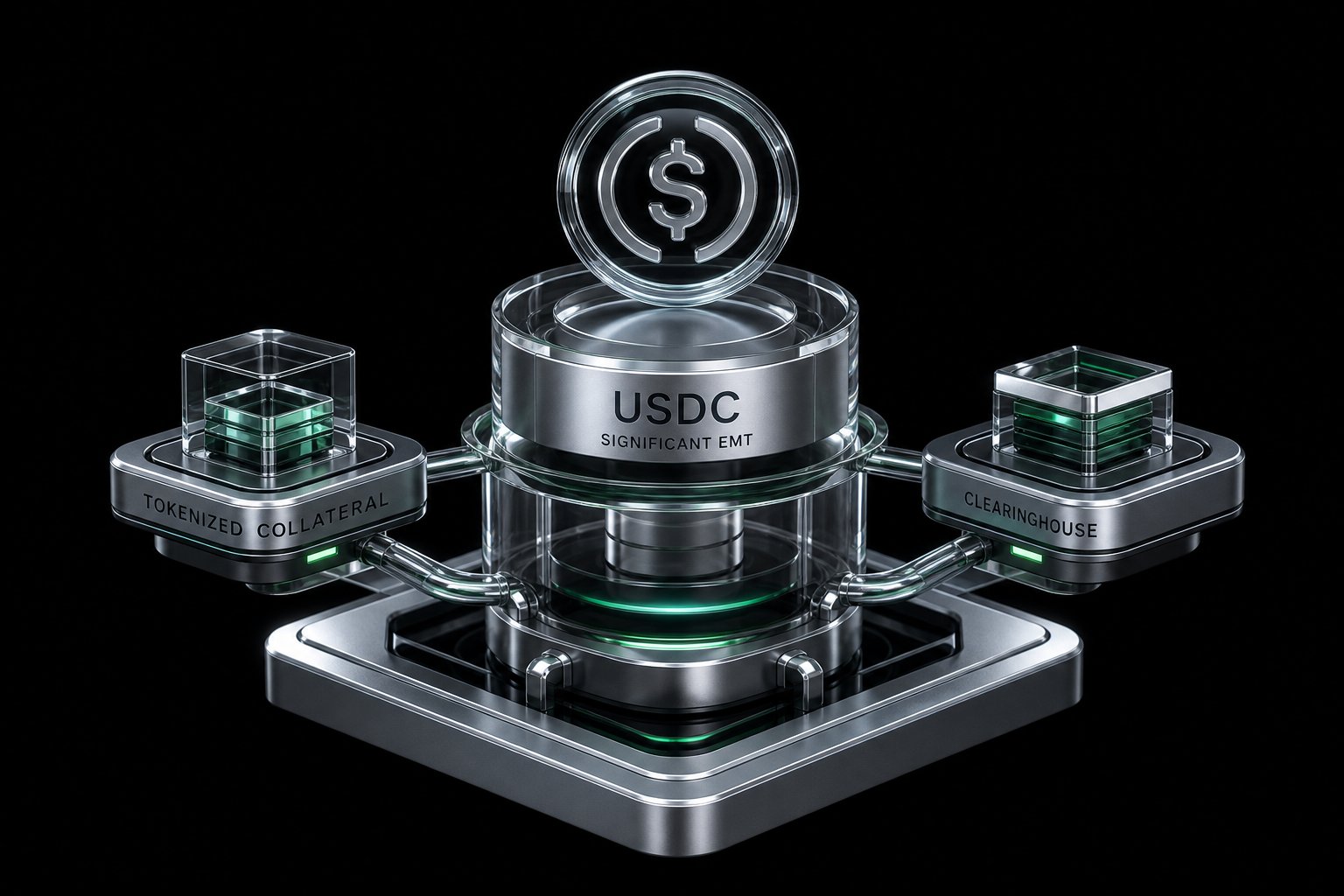
USDC Earns ‘Significant’ EU Status as Tokenized Collateral Hits Clearinghouses
Onchain RWA Market Cap
$39.18B
▲ 1.06% MoM
Asset Holders
5.26M
▲ 16.3% MoM
Stablecoin Market Cap
$292.4B
▲ 0.24% MoM
Stablecoin Monthly Volume
$6.44T
▼ 17.75% MoM
EBA Designates USDC as the EU’s First Significant E-Money Token, Shifting to Dual Supervision from November 12
The European Banking Authority (EBA) announced on October 14 that it has classified USDC, issued by Circle’s European entity, as a significant e-money token (EMT) under the Markets in Crypto-Assets Regulation (MiCA). The EU currently has 45 EMTs notified under MiCA, and USDC is the first to cross the “significance” threshold. From November 12, 2026, USDC will fall under the dual supervision MiCA provides for significant EMTs: direct supervisory duties for own funds, reserve assets, liquidity requirements and recovery and redemption plans will transfer from France’s Autorité de Contrôle Prudentiel et de Résolution (ACPR) to the EBA, while the ACPR continues to oversee governance, qualifying holdings, fit-and-proper assessment, outsourcing and conflicts of interest.
- Significant EMTs face tougher reserve requirements, including holding a higher share of reserves as bank deposits — a rule Circle publicly opposed in its response to the MiCA review
- The EBA has also signed a memorandum of understanding with the New York State Department of Financial Services (NYDFS), bringing Circle’s dual EU/US issuance structure into transatlantic supervisory information exchange
- Significance is reassessed annually under MiCA Articles 43/56 using indicators from Commission Delegated Regulation (EU) 2024/1506, so the status can change over time
Regulatory Impact
Stablecoin oversight moves from license-based access to tiered classification, putting leading issuers under heightened prudential constraints
Competition
Higher compliance bars push issuance toward top players, but the “significant” label does not automatically translate into market share
Cross-Border Ties
The EBA-NYDFS memorandum signals supervision shifting from single-jurisdiction licensing toward coordinated oversight of the same issuing group
Sources: EBA · BlockBeats · October 14, 2026
ESMA Consults on Tokenized Collateral for Central Clearing as Europe’s ~EUR510B Initial Margin Awaits Onchain Rails
The European Securities and Markets Authority (ESMA) has issued a call for evidence on whether and under what conditions EU central counterparties (CCPs) can safely and effectively use tokenized collateral, covering digital twins of traditional assets, natively issued onchain assets and hybrid models, with a focus on the liquidity of tokenized collateral in a clearing member default, client asset segregation and settlement finality. Responses are due by January 15, 2027, and ESMA will assess feedback in Q1 2027 before deciding next steps. At the end of June, Europe’s largest clearinghouses held around EUR510 billion in initial margin, roughly a third of it at EU-based CCPs.
- 30 questions center on four tests: the legal effect of transferring token ownership, record conflicts between digital twins and custodians, valuation haircuts for tokenized assets, and whether stablecoins qualify for the cash leg
- The only live European case is Eurex Clearing’s HQLAx ledger, where members can move collateral in minutes — though volumes are not disclosed
- The US moved earlier: the CFTC clarified in December 2025 that tokenized versions of eligible collateral can be accepted under existing rules, and J.P. Morgan met a CME margin call with tokenized securities in DTCC live trades in July
- The efficiency contrast: Citadel Securities settled a Treasury purchase on BNY’s private ledger in minutes and used it as overnight repo collateral, while G-SIBs post $74B of collateral a day across roughly 65 custody locations and front-load up to 63% of margin the night before a call
Market Impact
Clearinghouses are the core node for margin and collateral flows; opening tokenized collateral unlocks a deep institutional use case for onchain assets
Efficiency Gains
Institutions pre-post up to 63% of margin to avoid missing cut-offs; minute-level settlement can free large amounts of idle collateral
Prudential Boundary
The four tests — ownership, default handling, valuation and the cash leg — decide whether tokenized collateral offers the same certainty in a crisis
Sources: Blockstories Institutional · PANews · October 9, 2026
Ant Digital and HSBC Complete AI-Agent Micropayments on Tokenized Deposits, Settled in Real Time Under $2 per Payment
Ant Digital Technologies and HSBC announced the completion of a technical validation test for AI-agent micropayments: AI agents can discover and invoke digital services on behalf of users and complete payments in a single step, typically under $2 per transaction, with real-time settlement. In the test, HSBC’s Tokenized Deposit Service (TDS) provided settlement and real-time risk control via an MCP interface, Ant Digital’s Anvita Flow handled service invocation and micropayment settlement, and onchain transactions settled on the Jovay testnet, an Ethereum Layer 2. Both parties stressed the test was exploratory and not a commercial launch. Around the same time, Ant International completed its subscription to the Huaxia RMB Digital Currency Fund — digital RMB assets moved in real time from a China Construction Bank branch in Shanghai to Hong Kong and were used to subscribe in offshore RMB, closing the loop from cross-border digital RMB transfers to offshore RMB asset investment.
- This is the first bank-agent stack where discovery and payment live in one loop: Anvita Flow lets agents find and pay for services, while HSBC TDS handles settlement and real-time risk checks
- It extends a 2026 bank-led sequence: Santander x Mastercard Agent Pay (March), Sygnum mainnet per-transaction approvals (May), and CaixaBank x Visa Intelligent Commerce
- Agent payment volumes are surging and raising governance questions: one research firm observed roughly 1.28 million agent payments in a single day, from 145 addresses to 3 recipients, putting decision-authorization mechanisms in focus
Technical Validation
Tokenized deposits combined with AI agents give machine-initiated payments a bank-grade settlement and risk-control backbone
Cross-Border Link
Digital RMB cross-border transfer plus offshore investment now runs end-to-end, with the Huaxia fund added to Ant International’s treasury allocation
Risk Question
Risk checks judge whether a payment looks suspicious, not whether the agent’s choice was sound — authorization mechanisms have yet to be built
Sources: PANews · DEV Community · October 9, 2026
Robinhood Explores Stock Tokens Tied to Actively Managed ETFs as Bybit and Mantle Prepare 1:1-Backed mStocks
Robinhood Crypto posted that it is exploring, with T. Rowe Price Digital Assets — a global asset manager with $1.9 trillion under management — the launch of stock tokens linked to actively managed ETFs on Robinhood Chain, which would be the first such stock token if it succeeds. The collaboration is still exploratory: any launch requires completing legal due diligence, issuer board approval, final terms and regulatory approval in relevant jurisdictions. The same week, Bybit CEO Ben Zhou announced mStocks, a tokenized stock product built with Mantle: fully backed 1:1 by real assets, supporting 24/7 two-way redemption and connected to all AMM liquidity pools in the Mantle ecosystem for DEX trading.
- Robinhood Chain passed $1B in TVL about three months after launch, but daily transactions in early October were down 42% from mid-September as launch-period heat cooled
- Bybit also launched Bybit Direct Stock, letting users hold and trade real US stocks directly with access to over 1,000 trading pairs and actual ownership
- Tokenizing actively managed ETFs would put strategy portfolios rather than single stocks onchain, deepening the tokenized-stock asset pool
Product Form
From single index tokens to active-strategy tokens, the tokenized-stock pool keeps expanding
Competition
Robinhood, Bybit, Perpetuals.com and others are pushing tokenized stocks forward, intensifying platform competition
Compliance Boundary
Both products emphasize regulatory approval as a precondition, so launch timing remains uncertain
Sources: PANews · CryptoCompass · October 13, 2026
发表回复